
Introduction
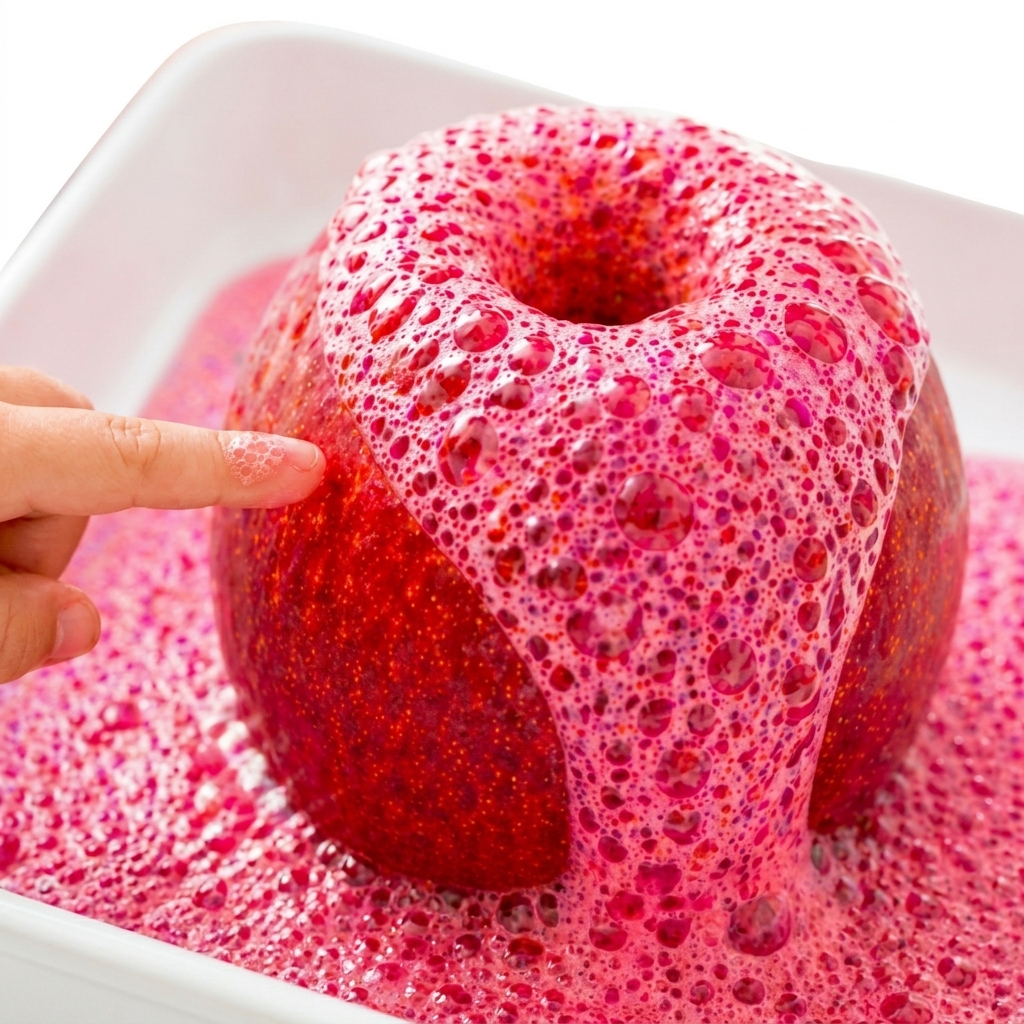
Science becomes much more exciting when children can see it, touch it, and experience it firsthand. That’s exactly why the Apple Volcano Experiment has become one of the most popular STEM activities for kids. This fun and colorful experiment transforms an ordinary apple into a miniature volcano, creating a fizzy eruption that captures children’s attention while teaching important scientific concepts.
Unlike complicated science projects that require expensive equipment, the Apple Volcano Experiment uses simple household ingredients that most families already have in their kitchens. The combination of baking soda and vinegar creates an exciting chemical reaction that looks like a real volcanic eruption, making learning both entertaining and memorable.
The best part is that this experiment can be expanded into several different science activities. Children can explore colors, chemical reactions, observation skills, prediction-making, and even basic scientific methods. Whether you’re a parent, teacher, homeschool educator, or camp counselor, these activities offer a wonderful way to introduce STEM concepts in a fun and approachable manner.
In this guide, you’ll learn how to perform the Apple Volcano Experiment and discover seven exciting science activities that build on the same concept. These projects encourage curiosity, creativity, and a love of learning while providing hours of educational entertainment.
Quick Overview Table
| Feature | Details |
| Activity Name | Apple Volcano Experiment |
| Category | STEM Science Activity |
| Age Group | 4–12 Years |
| Difficulty Level | Easy |
| Time Required | 15–45 Minutes |
| Cost | Budget-Friendly |
| Main Concepts | Chemical Reactions, Observation |
| Materials Needed | Apples, Baking Soda, Vinegar |
| Adult Supervision | Recommended |
| Educational Value | High |
What Is the Apple Volcano Experiment?
The Apple Volcano Experiment is a simple science activity that uses an apple as the volcano structure.
By combining baking soda and vinegar inside the apple, children can create a bubbling eruption that resembles a miniature volcano.
This experiment demonstrates:
- Chemical reactions
- Gas formation
- Observation skills
- Cause and effect
- Scientific inquiry
Because the materials are safe and inexpensive, it is an excellent choice for young scientists.
Why Kids Love the Apple Volcano Experiment
Children naturally enjoy activities that involve movement, surprises, and colorful reactions.
The Apple Volcano Experiment offers:
- Fizzy eruptions
- Hands-on participation
- Easy setup
- Fun observations
- Opportunities for creativity
It transforms science from a textbook subject into an exciting experience.
Materials You’ll Need
Gather the following supplies before starting.
Essential Materials
- 1 apple
- Baking soda
- Vinegar
- Spoon
- Small knife (adult use)
- Tray or plate
Optional Materials
- Food coloring
- Dish soap
- Measuring spoons
- Safety goggles
- Notebook for observations
These simple ingredients are enough to create a memorable science lesson.
How to Perform the Apple Volcano Experiment
Step 1: Prepare the Apple
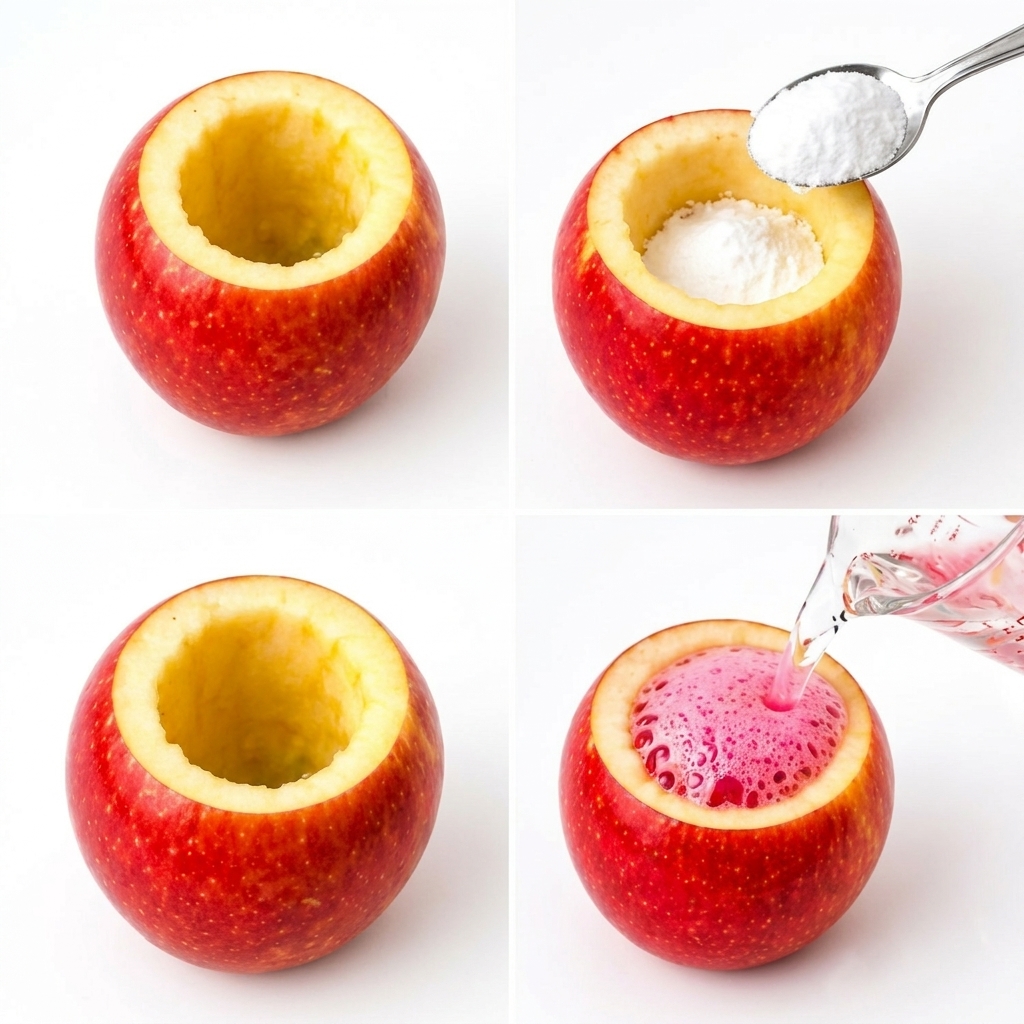
Using a small knife, carefully cut out the core section from the top of the apple.
Create a cavity large enough to hold baking soda.
Adult supervision is important during this step.
Step 2: Add Baking Soda
Place several teaspoons of baking soda into the cavity.
Fill it generously but avoid overpacking.
Step 3: Add Food Coloring
For a more dramatic eruption, add a few drops of food coloring.
Popular choices include:
- Red
- Orange
- Yellow
- Green
These colors make the eruption easier to see.
Step 4: Pour in Vinegar
Slowly pour vinegar into the apple.
Within seconds, bubbling foam will begin to rise.
Children will enjoy watching the “lava” flow from the apple volcano.
Step 5: Observe and Discuss
Encourage children to describe what they see.
Ask questions such as:
- What happened?
- Why did bubbles form?
- Which ingredient caused the reaction?
Observation is a key scientific skill.
The Science Behind the Apple Volcano Experiment
Understanding the science helps children connect fun activities to real learning.
Chemical Reaction
The eruption occurs because baking soda and vinegar react chemically.
Baking Soda
Baking soda is a base.
Vinegar
Vinegar is an acid.
When combined, they react to produce carbon dioxide gas.
Carbon Dioxide Formation
The reaction creates:
- Water
- Carbon dioxide gas
- Other byproducts
The gas forms bubbles that push the liquid upward.
This bubbling action creates the volcanic eruption effect.
Why the Apple Works
The apple acts as a natural container.
It holds the ingredients while adding a creative visual element.
Children often find the apple volcano more exciting than a regular cup experiment.
Activity 1: Rainbow Apple Volcano
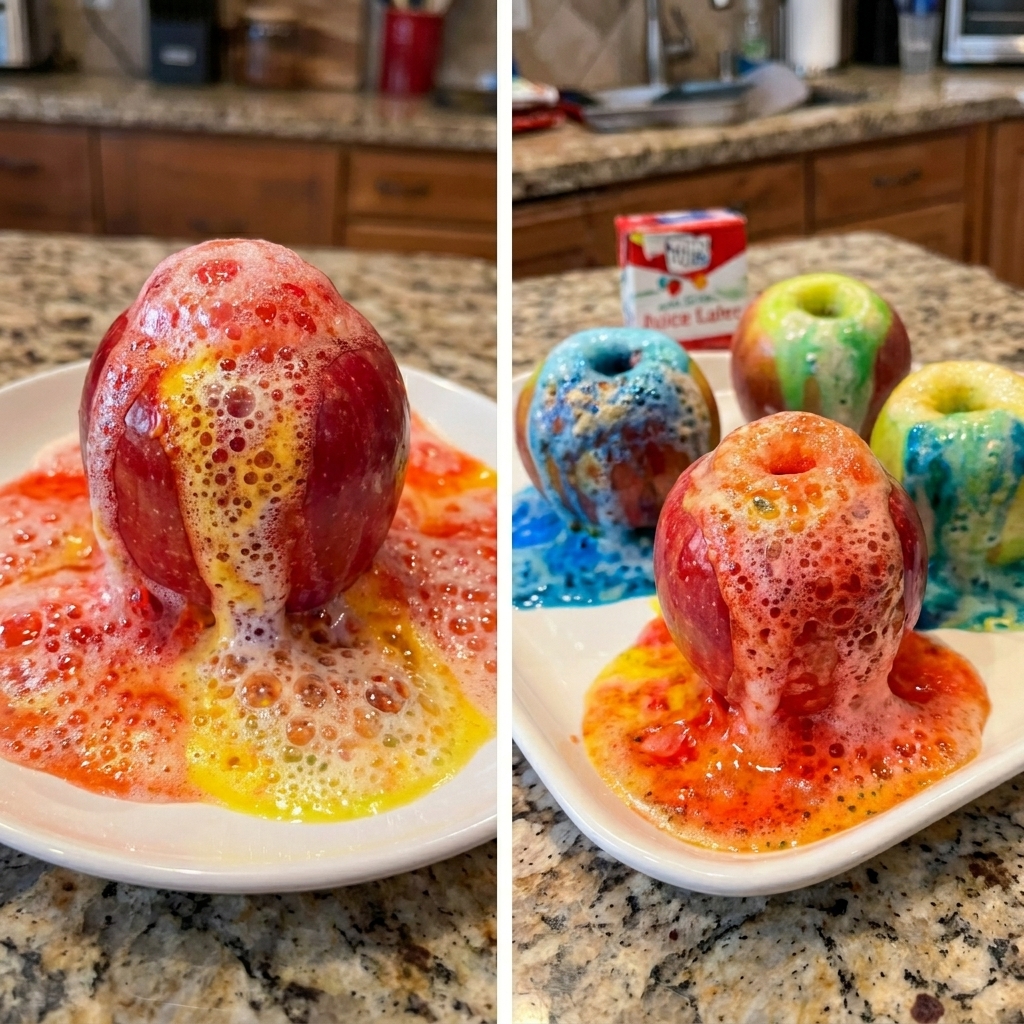
Add multiple food coloring colors to create a rainbow eruption.
Materials
- Apple
- Baking soda
- Vinegar
- Multiple food colorings
Learning Goals
- Color mixing
- Observation skills
- Creative experimentation
Children love watching colorful lava flow from the apple.
Activity 2: Giant Apple Volcano Challenge
Compare different apple sizes.
Instructions
Use:
- Small apple
- Medium apple
- Large apple
Measure eruption size and duration.
Learning Goals
- Measurement skills
- Prediction-making
- Data collection
Ask children which apple they think will create the largest eruption.
Activity 3: Apple Volcano With Dish Soap
Add dish soap to increase foam production.
Materials
- Apple volcano setup
- Small amount of dish soap
Results
The eruption becomes:
- Larger
- Foamier
- Longer-lasting
This variation is often a favorite among children.
Activity 4: Color Mixing Volcano
Use primary colors.
Examples
- Red + Yellow
- Blue + Yellow
- Red + Blue
Observe new color combinations during eruptions.
Learning Goals
- Color theory
- Scientific observation
Activity 5: Timed Volcano Experiment
Use a stopwatch.
Measure:
- Time until eruption begins
- Total eruption duration
- Foam height
Learning Goals
- Data recording
- Math integration
- Scientific method
This activity introduces basic experimental design.
Activity 6: Apple Volcano Prediction Chart
Before each eruption, ask children to make predictions.
Questions
- Which color will look best?
- Which apple will erupt most?
- What happens if more vinegar is added?
Record answers and compare with results.
Learning Goals
- Critical thinking
- Hypothesis development
Activity 7: Multi-Volcano Science Station
Create several apple volcanoes.
Use different variables:
- Different colors
- Different vinegar amounts
- Different baking soda quantities
Compare outcomes.
Learning Goals
- Experimental comparison
- Observation skills
- STEM exploration
Children enjoy seeing how small changes affect results.
Educational Benefits of the Apple Volcano Experiment
This simple activity supports many areas of learning.
Science Skills
Children learn about:
- Chemical reactions
- Gases
- Acids and bases
Critical Thinking
Kids ask questions and analyze results.
Observation Skills
They learn to notice details.
Problem-Solving
Experiments encourage creative thinking.
Confidence Building
Successful experiments increase self-esteem.
How Teachers Can Use This Activity
The Apple Volcano Experiment works wonderfully in classrooms.
Science Lessons
Introduce:
- Chemical reactions
- States of matter
- Scientific inquiry
Group Activities
Students can work in teams.
STEM Centers
Perfect for hands-on learning stations.
Science Fairs
Creates an engaging demonstration project.
Making the Experiment More Educational
Extend learning by asking questions.
Before
- What do you think will happen?
During
- What do you observe?
After
- Why did it happen?
This structure encourages scientific thinking.
Common Mistakes and Solutions
Too Little Baking Soda
Problem:
Weak eruption.
Solution:
Add more baking soda.
Too Much Vinegar at Once
Problem:
Reaction ends quickly.
Solution:
Pour slowly.
Small Apple Opening
Problem:
Foam cannot escape properly.
Solution:
Widen the cavity slightly.
Missing Tray
Problem:
Messy cleanup.
Solution:
Always place the apple on a tray.
Safety Tips
Although the experiment uses common ingredients, safety remains important.
Adult Supervision
Required when using knives.
Protect Surfaces
Use trays or newspapers.
Avoid Eye Contact
Keep vinegar away from eyes.
Wash Hands
Clean up after the experiment.
Turning the Activity Into a Science Lesson
The Apple Volcano Experiment can become a complete STEM lesson.
Observation Journals
Record:
- Predictions
- Observations
- Results
Data Charts
Track eruption sizes.
Scientific Vocabulary
Teach terms such as:
- Reaction
- Gas
- Experiment
- Observation
This reinforces educational concepts.
Frequently Asked Questions
What age is best for this experiment?
Children aged 4–12 enjoy this activity, with adult assistance for younger kids.
Can other fruits be used?
Yes. Oranges, lemons, and pumpkins can work as containers.
Is food coloring required?
No, but it enhances the visual effect.
How many times can one apple be used?
Several eruptions can often be performed before the apple becomes too soft.
Is this suitable for classrooms?
Absolutely. It is inexpensive, safe, and highly engaging.
Conclusion
The Apple Volcano Experiment is one of the most exciting and accessible science activities for children. Using simple household ingredients, kids can create bubbling eruptions while learning about chemical reactions, gases, observation, and scientific inquiry.
By expanding the experiment into multiple activities—such as rainbow eruptions, prediction charts, timed tests, and multi-volcano comparisons—children gain valuable STEM skills while having fun. The combination of hands-on learning and dramatic visual effects makes this experiment memorable and educational.
Whether you’re teaching in a classroom, planning a homeschool lesson, organizing a science camp, or simply looking for a rainy-day activity, the Apple Volcano Experiment offers the perfect balance of fun and learning. Gather your supplies, prepare your apple volcano, and let the scientific adventures begin!
