Rainbows have fascinated children and adults for centuries. Their bright bands of color inspire curiosity and wonder, making them the perfect subject for a fun science activity. One of the easiest ways to explore the science of light is by creating a rainbow inside a glass of water. This simple experiment uses everyday household materials to demonstrate how light bends and separates into different colors, helping children understand one of nature’s most beautiful phenomena.
Whether you’re a parent looking for an educational activity, a teacher planning a classroom experiment, or a homeschool educator searching for engaging STEM projects, this colorful experiment is an excellent choice. It combines science, creativity, and hands-on learning while encouraging children to ask questions, make observations, and think like young scientists.
Quick Overview Table
| Feature | Details |
| Experiment | Create a Rainbow Inside a Glass of Water |
| Activity Type | Science Experiment |
| Age Group | 5–12 years |
| Difficulty | Easy |
| Time Required | 15–20 minutes |
| Main Materials | Glass of water, white paper, sunlight or flashlight |
| Science Topic | Light Refraction and Color Spectrum |
| Indoor/Outdoor | Both |
| Adult Supervision | Recommended |
| Learning Skills | Observation, Scientific Thinking, STEM |
What Does It Mean to Create a Rainbow Inside a Glass of Water?
Creating a rainbow inside a glass of water is a simple science experiment that shows how white light can separate into the colors of the rainbow. When sunlight or a bright flashlight shines through water at the right angle, the water bends the light. This bending, called refraction, causes the light to spread into different colors.
The rainbow you see is similar to the one that appears in the sky after rain. Tiny water droplets in the atmosphere act like countless little prisms, splitting sunlight into the familiar colors: red, orange, yellow, green, blue, indigo, and violet.
This experiment allows children to recreate this natural process using just a few household items.
Why Children Love This Experiment
Children are naturally fascinated by colorful effects and surprising discoveries. Watching a rainbow appear inside a glass of water feels almost magical, even though it is based on scientific principles.
This activity captures children’s attention because it:
- Produces beautiful, colorful results.
- Requires only simple materials.
- Feels like performing a magic trick.
- Encourages exploration and experimentation.
- Helps children understand how rainbows form in nature.
Unlike many science experiments that involve mixing ingredients, this activity focuses on the fascinating behavior of light.
Materials You’ll Need
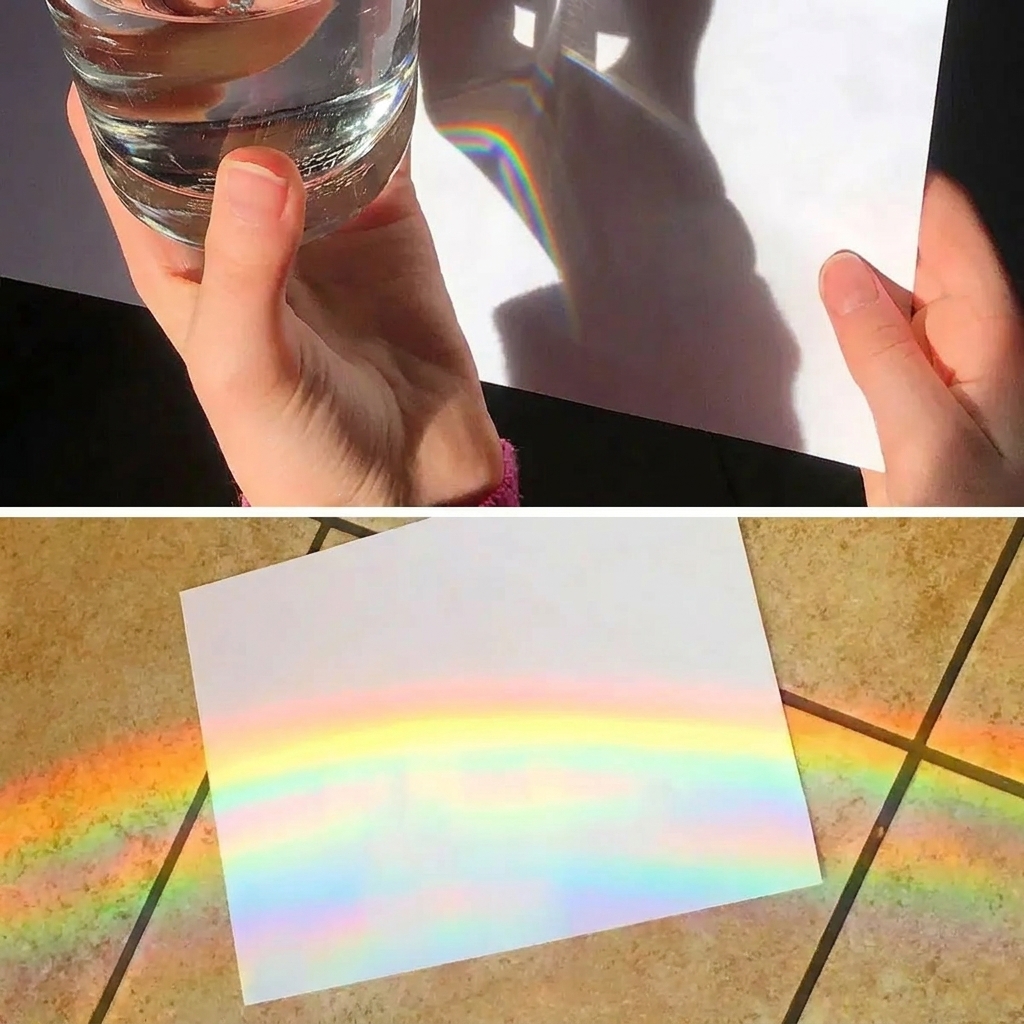
The supplies are easy to find in most homes.
Essential Materials
- A clear glass
- Clean water
- White sheet of paper
- Bright sunlight or a strong flashlight
- A table or flat surface
Optional Materials
- Colored paper
- Small mirror
- Prism
- Magnifying glass
- Notebook for observations
- Colored pencils
Step-by-Step Instructions
Step 1: Fill the Glass
Fill a clear glass about three-quarters full with clean water.
The water should be as clear as possible to allow light to pass through easily.
Step 2: Place the White Paper
Lay a sheet of white paper on a table or floor where sunlight reaches it.
If you are indoors without direct sunlight, you can use a bright flashlight.
Step 3: Position the Glass
Place the glass of water directly on or just above the paper.
Adjust its position until sunlight shines through the glass.
Step 4: Find the Right Angle
Slowly move the glass or change the angle of the light.
After a few adjustments, colorful bands of light should appear on the paper.
This is your rainbow.
Step 5: Observe Carefully
Encourage children to notice:
- Which colors appear first.
- Which colors are brightest.
- How the rainbow changes when the glass moves.
- How the rainbow changes when the light source changes.
Careful observation is an important part of scientific investigation.
The Science Behind the Rainbow
Although the experiment looks magical, it is based on the science of light.
White light from the Sun is actually made up of many colors combined together.
When light passes from air into water, it slows down and bends. This bending is called refraction.
Each color bends by a slightly different amount because each color has a different wavelength.
As a result, the colors spread apart, creating the visible rainbow.
This process is known as dispersion.
Understanding Refraction
Refraction happens whenever light moves between materials with different densities.
Examples include:
- Air to water
- Air to glass
- Water to glass
Because light travels at different speeds in different materials, it changes direction slightly.
Children can easily see this effect by placing a pencil in a glass of water. The pencil appears bent, even though it remains straight.
The Colors of the Rainbow
Children can learn the order of rainbow colors through this experiment.
The seven traditional colors are:
- Red
- Orange
- Yellow
- Green
- Blue
- Indigo
- Violet
A simple memory aid is the name ROYGBIV, using the first letter of each color.
While some rainbows make the colors appear more distinctly than others, all visible rainbows result from the same basic process of light splitting into its component colors.
Why White Paper Works Best
White paper reflects all colors equally.
This makes the rainbow bright and easy to see.
Dark paper absorbs much of the light, making the rainbow difficult to observe.
Children can compare different paper colors to see how the results change.
Learning Opportunities
This activity teaches much more than just how rainbows form.
Children also develop:
Observation Skills
They learn to notice small differences in light, color, and position.
Problem-Solving Skills
Finding the correct angle requires patience and experimentation.
Children learn that scientific discoveries often require trial and error.
Critical Thinking
Ask questions like:
- Why does moving the glass change the rainbow?
- Why doesn’t the rainbow appear immediately?
- Why are the colors always in the same order?
These questions encourage deeper thinking.
Scientific Vocabulary
Children become familiar with important science words such as:
- Refraction
- Reflection
- Dispersion
- Spectrum
- Light
- Wavelength
- Transparent
Learning new vocabulary helps build confidence in science.
Fun Variations to Try
Once children create one rainbow, they can explore many exciting variations.
Double Glass Experiment
Place two glasses of water side by side.
Compare how each rainbow appears.
Colored Water
Add food coloring to the water.
Observe whether the rainbow changes.
Children often discover that clear water produces the best results.
Mirror in Water
Place a small mirror partly underwater inside a bowl.
Shine sunlight or a flashlight onto the mirror.
A larger rainbow often appears on nearby walls or paper.
Outdoor Rainbow Hunt
After learning how rainbows form, children can search for natural rainbows after rain or near sprinklers and fountains.
This connects classroom science to the real world.
Questions to Ask During the Experiment
Encourage children to think like scientists by asking:
- Which angle creates the brightest rainbow?
- Does morning sunlight work better than afternoon sunlight?
- What happens if the water level changes?
- Does a larger glass make a bigger rainbow?
- Can two rainbows appear at once?
- What happens when the flashlight moves farther away?
Recording predictions and observations turns the activity into a true scientific investigation.
Real-Life Examples of Refraction
Children encounter refraction every day without realizing it.
Examples include:
- Rainbows after storms.
- Fish appearing closer than they really are.
- Swimming pools looking shallower than they are.
- Eyeglasses helping people see clearly.
- Camera lenses focusing images.
- Magnifying glasses enlarging objects.
Understanding refraction helps explain many everyday experiences.
Safety Tips
This experiment is very safe, but a few precautions should be followed.
Always:
- Avoid looking directly at the Sun.
- Use adult supervision with flashlights.
- Place the glass on a stable surface.
- Clean up spilled water immediately.
- Handle glass carefully to avoid breakage.
Using plastic cups can be a safer option for younger children.
Connecting Science with Art
After completing the experiment, children can express what they learned creatively.
Ideas include:
- Drawing their rainbow.
- Painting a colorful sky.
- Making rainbow crafts from paper.
- Creating a science journal.
- Writing a story about chasing a rainbow.
- Labeling the colors in order.
Combining science and art makes learning more memorable.
Common Mistakes and How to Fix Them
Sometimes the rainbow doesn’t appear right away.
Here are a few common problems and solutions.
No Rainbow Appears
Possible causes:
- The light is not bright enough.
- The angle is incorrect.
- The room is too bright.
- The paper is not white.
Try adjusting the position of the glass or moving to an area with stronger sunlight.
The Rainbow Looks Faint
A stronger light source often solves this problem.
Clear, clean water also improves visibility.
Colors Are Hard to See
Move the paper closer to the glass.
Small adjustments often make a big difference.
Extending the Learning
Children who enjoy this experiment may also like exploring other light-related activities.
Ideas include:
- Building a homemade kaleidoscope.
- Exploring shadows at different times of day.
- Making a simple periscope.
- Using a prism to split light.
- Creating colorful light patterns with CDs.
- Investigating mirrors and reflections.
These activities help reinforce the concepts of light and optics.
Why This Experiment Is Great for Classrooms
Teachers appreciate this activity because it is:
- Affordable.
- Easy to prepare.
- Safe.
- Visually engaging.
- Suitable for group work.
- Compatible with STEM lessons.
Students can work in small groups, compare results, and discuss why different setups produce different rainbows.
Frequently Asked Questions
Can I use a plastic cup instead of glass?
Yes. A clear plastic cup works well, especially for younger children.
Does it have to be sunny?
No. A bright flashlight can also work, although direct sunlight usually creates the brightest rainbow.
Why is white light made of many colors?
White light contains all the visible colors combined. Refraction separates these colors so we can see them individually.
Why can’t I see the rainbow immediately?
The angle of the light is very important. Small adjustments to the glass, paper, or light source often reveal the rainbow.
Can I repeat the experiment?
Absolutely. Try different times of day, different containers, or different light sources to compare the results.
Conclusion
Learning how to create a rainbow inside a glass of water is a simple yet fascinating way to introduce children to the science of light. With just a clear glass, water, white paper, and a source of bright light, young learners can witness how refraction and dispersion separate white light into the beautiful colors of the rainbow.
This hands-on experiment encourages curiosity, careful observation, and critical thinking while making science both accessible and enjoyable. It also provides opportunities to discuss weather, optics, and the natural world, helping children connect classroom concepts with everyday experiences.
Whether performed at home, in a classroom, or as part of a homeschool STEM lesson, this colorful activity inspires wonder and demonstrates that some of the most exciting scientific discoveries can begin with ordinary household materials. By exploring light through play, children develop a deeper appreciation for the beauty and science behind the rainbows they see in nature.
