
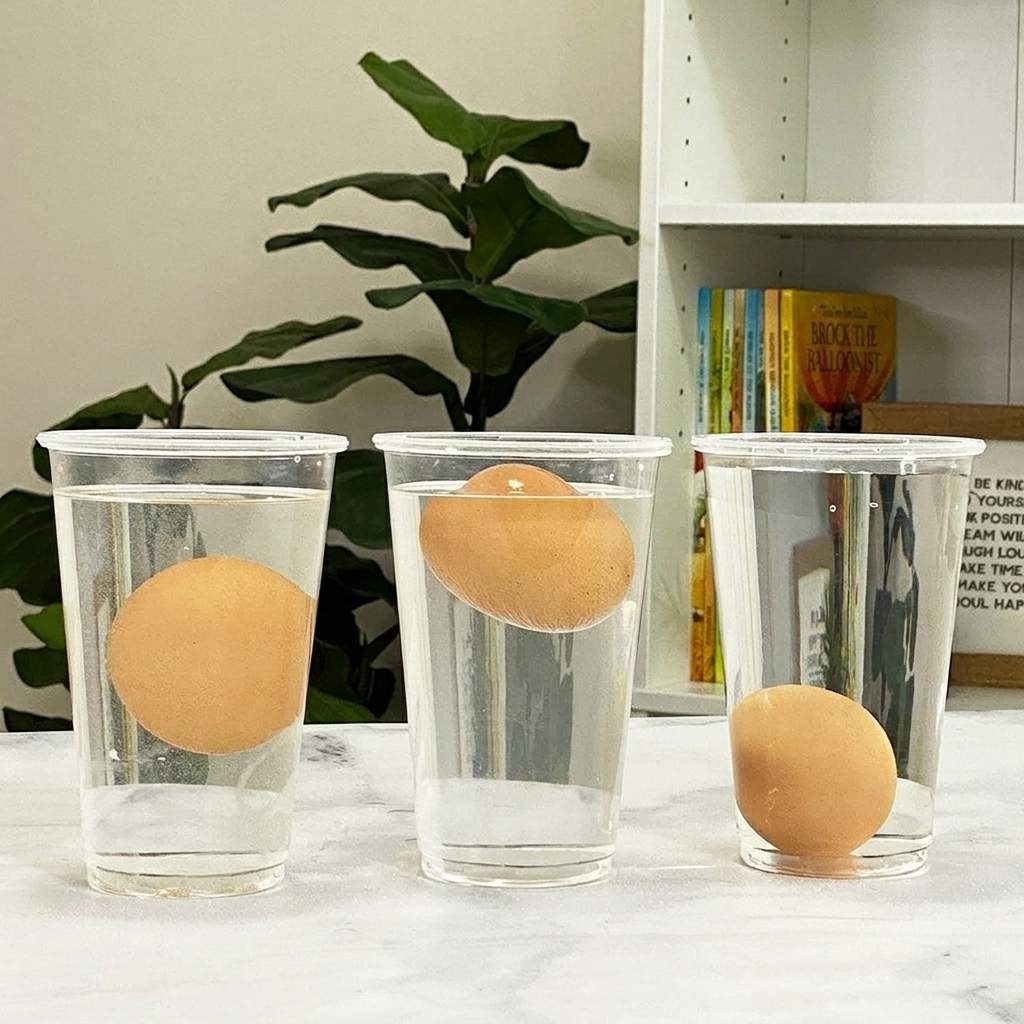
Science becomes much more exciting when children can see it in action. One of the easiest and most fascinating experiments to try at home or in the classroom is the egg floating in salt water experiment. Using only a few common household items, children can discover why some objects float while others sink, all while learning about the scientific concepts of density and buoyancy.
This simple STEM activity is ideal for parents, teachers, homeschool educators, and curious young learners. It requires very little preparation, is safe when supervised, and encourages children to observe, predict, and investigate the world around them. Best of all, the surprising moment when an egg rises to the surface of salty water captures children’s attention and sparks a desire to learn more about science.
Quick Overview Table
| Feature | Details |
| Experiment | Egg Floating in Salt Water |
| Activity Type | Science Experiment |
| Age Group | 5–12 years |
| Difficulty | Easy |
| Time Required | 15–20 minutes |
| Main Materials | Egg, water, salt, glass |
| Science Topic | Density and Buoyancy |
| Indoor/Outdoor | Indoor |
| Adult Supervision | Recommended |
| STEM Skills | Observation, Prediction, Critical Thinking |
What Is the Egg Floating in Salt Water Experiment?
The egg floating in salt water experiment is a classic science activity that demonstrates how the density of a liquid affects whether an object floats or sinks.
When a fresh egg is placed in a glass of plain water, it usually sinks to the bottom because the egg is denser than the water. However, when enough salt is dissolved into the water, the water becomes denser than the egg. As a result, the egg begins to float.
Although the experiment is simple, it introduces children to important scientific concepts that explain why ships float, why people float more easily in the ocean than in a swimming pool, and why the Dead Sea allows people to float effortlessly.
Why Children Enjoy This Experiment
Children love experiments that produce surprising results.
Watching an egg magically rise from the bottom of a glass feels almost like a magic trick, even though it is based entirely on science.
This activity is popular because it:
- Uses everyday household materials.
- Produces visible results within minutes.
- Encourages children to make predictions.
- Introduces scientific vocabulary.
- Inspires curiosity and experimentation.
Since children can repeat the experiment with different amounts of salt, it also encourages exploration and problem-solving.
Materials You’ll Need
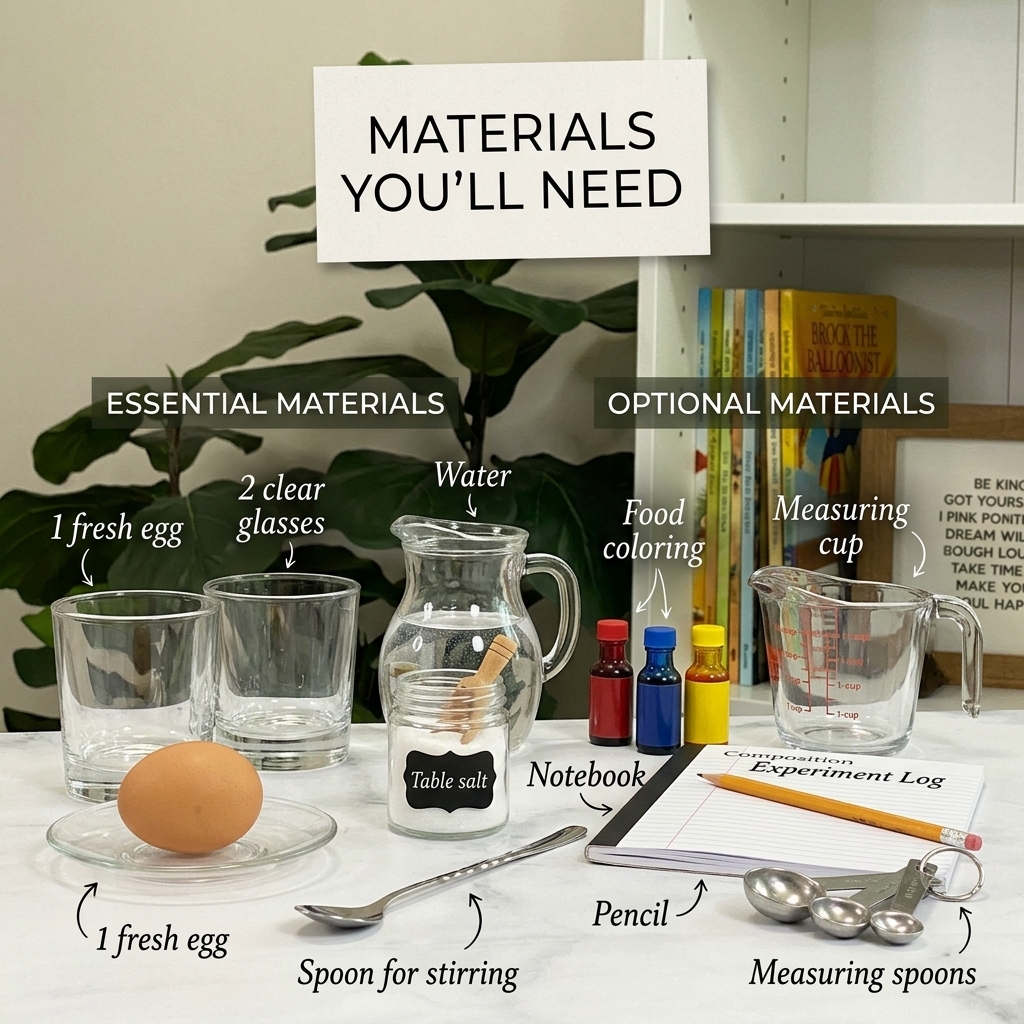
The supplies are simple and inexpensive.
Essential Materials
- 1 fresh egg
- 2 clear glasses
- Water
- Table salt
- Spoon for stirring
Optional Materials
- Measuring cup
- Food coloring
- Notebook
- Pencil
- Measuring spoons
Using clear glasses makes it easier for children to observe what happens to the egg.
Step-by-Step Instructions
Step 1: Fill the Glasses
Fill both glasses about three-quarters full with water.
One glass will remain plain water.
The second glass will become salt water.
Step 2: Test the Plain Water
Carefully place the egg into the first glass.
Observe what happens.
Most fresh eggs sink directly to the bottom.
Step 3: Prepare the Salt Water
Add several tablespoons of salt to the second glass.
Stir thoroughly until the salt dissolves completely.
The more salt that dissolves, the denser the water becomes.
Step 4: Place the Egg in the Salt Water
Carefully lower the egg into the second glass.
Watch closely.
The egg should begin floating near the top of the water.
Sometimes additional salt is needed if the egg still sinks.
Step 5: Compare the Results
Ask children to compare the two glasses.
Notice:
- The egg sinks in plain water.
- The egg floats in salt water.
- The egg may float halfway if the salt concentration is moderate.
These observations lead to discussions about density and buoyancy.
The Science Behind the Experiment
The key scientific concept in this activity is density.
Density describes how much matter is packed into a certain amount of space.
Objects with higher density are generally heavier for their size.
If an object is denser than the liquid around it, it sinks.
If the liquid is denser than the object, the object floats.
By adding salt to water, we increase the water’s density.
Eventually, the salt water becomes dense enough to support the egg.
Understanding Buoyancy
Another important concept is buoyancy.
Buoyancy is the upward force that a liquid exerts on an object.
When the buoyant force is greater than the object’s weight, the object floats.
When the object’s weight is greater than the buoyant force, it sinks.
Salt water provides a stronger buoyant force than fresh water because it is denser.
Why Salt Changes Everything
Salt dissolves into water and spreads evenly throughout the liquid.
The dissolved salt particles increase the total mass of the water without greatly increasing its volume.
As a result, the water becomes denser.
This change allows the egg to float.
Children often find it amazing that simply adding salt can completely change what happens to the egg.
Learning Opportunities
This experiment teaches many valuable science skills.
Observation Skills
Children carefully watch how the egg behaves in different liquids.
They learn to notice differences and record results.
Prediction Skills
Before adding the egg, ask:
- Will it float?
- Will it sink?
- What if we add more salt?
Making predictions helps children think scientifically.
Measuring Skills
Children practice measuring:
- Water
- Salt
- Time
- Spoonfuls
This reinforces both science and math skills.
Scientific Vocabulary
New words introduced include:
- Density
- Buoyancy
- Solution
- Dissolve
- Float
- Sink
- Matter
- Mass
- Volume
Learning these terms builds scientific confidence.
Real-Life Connections
The concepts demonstrated in this experiment appear in everyday life.
Examples include:
The Dead Sea
The Dead Sea contains extremely high levels of dissolved salt.
People float easily because the water is much denser than ordinary freshwater.
Ocean Swimming
Swimming in the ocean is often easier than swimming in a freshwater lake because seawater contains dissolved salt.
Ships
Large ships made of steel float because their overall density, including the air inside them, is less than the density of the water they displace.
Submarines
Submarines adjust their buoyancy by filling or emptying ballast tanks with water and air.
This allows them to sink, float, or remain at a chosen depth.
Fun Variations
Once children understand the basic experiment, they can try different versions.
Colored Salt Water
Add food coloring to the salt water.
This makes the experiment even more visually appealing.
Layered Water Experiment
Carefully pour salt water into a glass.
Then slowly add plain water on top.
Place the egg inside.
The egg may remain suspended between the layers because each layer has a different density.
Different Eggs
Compare:
- Fresh eggs
- Older eggs
- Small eggs
- Large eggs
Children can investigate whether all eggs behave the same way.
Salt Comparison
Try different amounts of salt.
Observe how much salt is needed before the egg begins floating.
Questions Children Can Investigate
Encourage scientific thinking by asking:
- How much salt is needed to float the egg?
- Does warm water dissolve salt faster?
- Does cold water work differently?
- Does the size of the glass matter?
- Can other liquids make the egg float?
- Does stirring speed affect the results?
Recording answers helps children practice the scientific method.
Safety Tips
This experiment is generally very safe.
However, remember to:
- Wash hands after handling raw eggs.
- Clean spills immediately.
- Handle glass containers carefully.
- Avoid tasting the salt water.
- Supervise younger children.
If an egg cracks during the experiment, dispose of it properly and clean the area thoroughly.
Common Mistakes
Sometimes the egg refuses to float.
Possible reasons include:
Not Enough Salt
Continue adding salt until the water becomes dense enough.
Salt Not Fully Dissolved
Stir thoroughly before adding the egg.
Undissolved salt at the bottom does not increase the density of the entire glass immediately.
Very Large Egg
Larger eggs may require slightly more salt.
Using Too Little Water
Ensure the egg has enough room to float freely.
Extending the Learning
This experiment can be combined with other STEM activities.
Children can:
- Measure the exact amount of salt required.
- Create graphs showing results.
- Compare fresh water with seawater.
- Research why oceans contain salt.
- Learn about famous salt lakes around the world.
- Write observations in a science journal.
These activities strengthen both scientific understanding and communication skills.
Why Teachers Love This Experiment
Teachers appreciate this activity because it is:
- Affordable.
- Easy to prepare.
- Highly visual.
- Safe for classrooms.
- Suitable for individual or group work.
- Connected to important science standards.
Students can compare results, discuss their observations, and explain why the egg behaves differently in each glass.
Frequently Asked Questions
Can I use any kind of salt?
Yes.
Table salt, sea salt, and kosher salt all work, although the amount needed may vary slightly because of differences in crystal size.
Does the water temperature matter?
Warm water usually dissolves salt more quickly, making preparation easier.
However, both warm and cold water can produce a floating egg if enough salt is dissolved.
Why does the egg float only halfway sometimes?
The water may not yet be dense enough for the egg to float completely.
Adding more dissolved salt often raises the egg higher.
Can this experiment be repeated?
Absolutely.
Simply prepare fresh salt water each time for the best results.
Why do old eggs sometimes float in plain water?
As eggs age, air enters through tiny pores in the shell, increasing the size of the internal air pocket. This makes older eggs less dense, which is why they may float even without added salt.
Conclusion
The egg floating in salt water experiment is a simple yet powerful way to introduce children to the scientific concepts of density and buoyancy. With only an egg, water, salt, and a glass, young learners can observe how changing the density of a liquid affects whether an object floats or sinks.
Beyond demonstrating an exciting scientific principle, this hands-on activity encourages curiosity, observation, prediction, and critical thinking. It also connects classroom learning to real-world examples, such as ocean swimming, ships, submarines, and the highly salty waters of the Dead Sea.
Whether used in a classroom, at home, or during a homeschool science lesson, this experiment provides an engaging STEM experience that children will remember. By exploring science through simple, everyday materials, they gain a deeper understanding of the world around them and discover that even ordinary objects can reveal extraordinary scientific ideas.
