

Making homemade playdough is one of the easiest and most rewarding activities families can enjoy together. With just a few simple kitchen ingredients, parents, teachers, and caregivers can create soft, colorful playdough that provides hours of imaginative fun while supporting children’s learning and development.
Unlike many store-bought modeling compounds, homemade playdough allows you to control the ingredients, customize the colors and scents, and make large batches at a low cost. Whether you’re planning a rainy-day activity, a preschool lesson, a homeschool project, or simply looking for a creative way to keep children entertained, homemade playdough is a fantastic choice.
This guide explains everything you need to know about making, using, and storing homemade playdough while exploring the many educational benefits it offers.
Quick Overview Table
| Feature | Details |
| Activity | Homemade Playdough |
| Activity Type | Sensory Play & Craft |
| Age Group | 2–10 years |
| Difficulty | Easy |
| Time Required | 20–30 minutes |
| Main Ingredients | Flour, salt, water, oil, cream of tartar |
| Skills Developed | Fine motor skills, creativity, sensory exploration |
| Indoor/Outdoor | Both |
| Adult Supervision | Recommended |
| Storage Time | 2–3 months in an airtight container |
What Is Homemade Playdough?
Homemade playdough is a soft, moldable dough made from common kitchen ingredients such as flour, salt, water, vegetable oil, and cream of tartar. It has a smooth texture that is easy for children to squeeze, roll, flatten, and shape into endless creations.
Playdough has been a favorite educational material for decades because it encourages open-ended play. There are no rules or right answers—children simply use their imagination to create anything they can think of.
Making playdough at home also turns the preparation itself into a learning activity, allowing children to measure ingredients, mix, observe changes, and practice following directions.
Why Homemade Playdough Is Better Than Store-Bought
While commercial playdough is convenient, homemade versions offer several advantages.
Some of the benefits include:
- Affordable ingredients
- Easy to make
- Customizable colors
- Adjustable textures
- Optional natural scents
- Larger batches for less money
- Fewer unnecessary additives
- Great family activity
Many families also enjoy knowing exactly what ingredients are used in the dough.
Ingredients You’ll Need
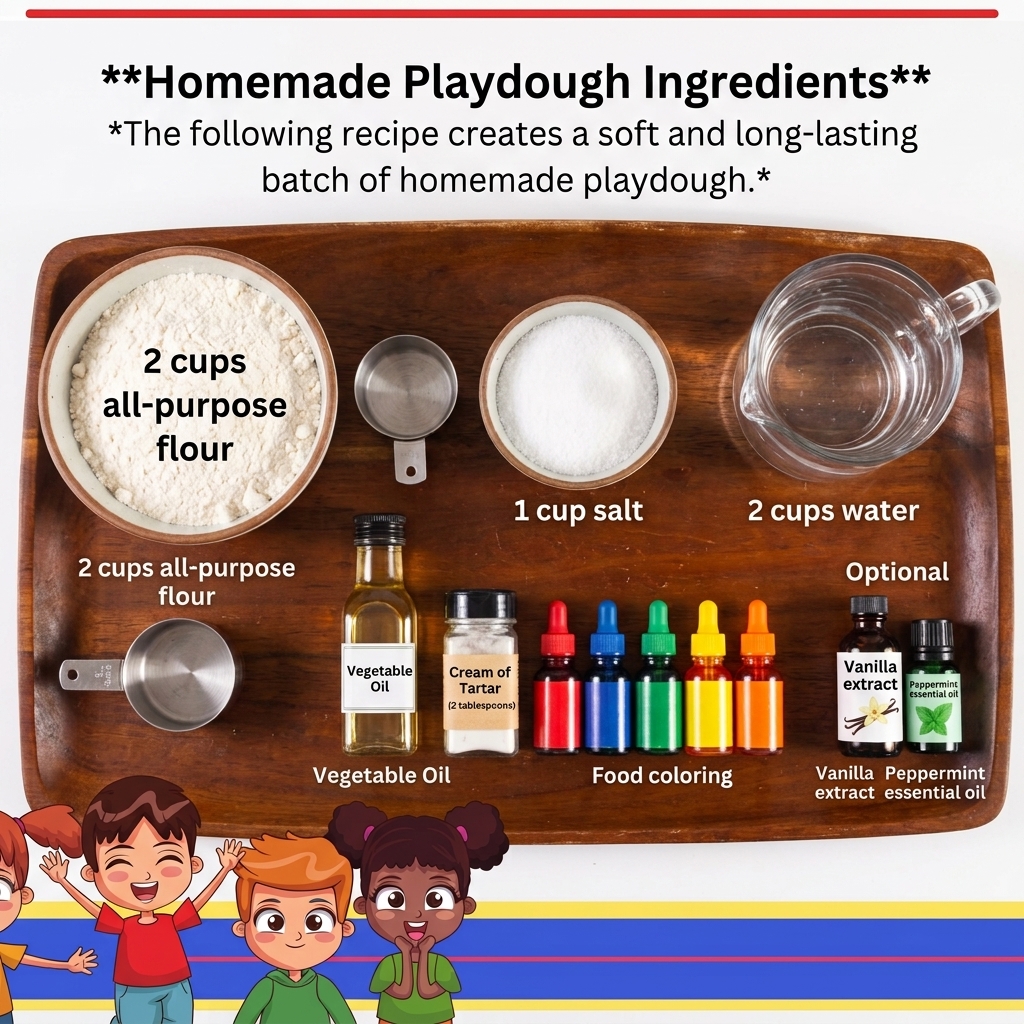
The following recipe creates a soft and long-lasting batch of homemade playdough.
Ingredients
- 2 cups all-purpose flour
- 1 cup salt
- 2 cups water
- 2 tablespoons vegetable oil
- 2 tablespoons cream of tartar
- Food coloring
- Optional essential oils or natural extracts (such as vanilla or peppermint)
These simple ingredients are available in most kitchens or grocery stores.
Step-by-Step Instructions
Step 1: Mix the Dry Ingredients
In a medium saucepan, combine:
- Flour
- Salt
- Cream of tartar
Mix thoroughly before adding liquids.
Step 2: Add the Wet Ingredients
Pour in:
- Water
- Vegetable oil
- Food coloring
Stir until everything is evenly combined.
Step 3: Cook the Mixture
Place the saucepan over medium heat.
Stir continuously.
After several minutes, the mixture begins thickening.
Eventually, it forms a soft ball of dough.
Step 4: Cool the Dough
Remove the dough from the heat.
Allow it to cool for several minutes before handling.
Warm dough is easier to knead but should not be too hot for children.
Step 5: Knead Until Smooth
Place the dough on a clean surface.
Knead it for several minutes until it becomes soft, smooth, and elastic.
If the dough feels sticky, sprinkle in a little extra flour.
If it feels dry, add a few drops of water.
The Science Behind Homemade Playdough
Making playdough introduces children to simple scientific concepts.
When the ingredients are heated together, the starch in the flour absorbs water and begins to swell. At the same time, the proteins in the flour help form a flexible structure that gives the dough its shape.
Salt acts as a preservative while also improving texture.
Vegetable oil makes the dough softer and smoother.
Cream of tartar increases elasticity and helps prevent the dough from becoming crumbly.
Although the process is not a chemical reaction like some science experiments, it demonstrates how combining ingredients and applying heat changes their properties.
Educational Benefits of Homemade Playdough
Playdough offers much more than entertainment.
1. Fine Motor Development
Rolling, pinching, squeezing, flattening, and cutting strengthen the small muscles in children’s hands.
These muscles are essential for:
- Writing
- Drawing
- Buttoning clothes
- Using scissors
- Holding pencils
2. Creativity and Imagination
Children can create:
- Animals
- Cars
- Flowers
- Food
- Buildings
- Letters
- Numbers
- People
Open-ended play encourages original thinking and storytelling.
3. Sensory Exploration
The soft texture provides valuable sensory experiences.
Children explore:
- Texture
- Temperature
- Shape
- Pressure
- Movement
Sensory play supports cognitive development while providing a calming activity.
4. Early Math Skills
Playdough naturally introduces math concepts.
Children can:
- Count balls of dough
- Compare sizes
- Measure lengths
- Create patterns
- Learn shapes
Learning occurs naturally through play.
5. Language Development
While playing, children describe:
- Colors
- Shapes
- Sizes
- Feelings
- Stories
Conversations during play expand vocabulary and communication skills.
Fun Color Ideas
Food coloring allows endless creativity.
Popular colors include:
- Red
- Blue
- Green
- Yellow
- Purple
- Orange
- Pink
Children also enjoy mixing colors to discover new shades.
For example:
- Blue + Yellow = Green
- Red + Blue = Purple
- Red + Yellow = Orange
Color mixing becomes another educational activity.
Natural Color Alternatives
Families who prefer natural ingredients can color playdough using:
- Beet powder (pink or red)
- Turmeric (yellow)
- Spinach powder (green)
- Cocoa powder (brown)
- Blue spirulina powder (blue)
- Activated charcoal (black)
These natural options create beautiful earth-toned playdough.
Adding Pleasant Scents
Homemade playdough can smell wonderful.
Consider adding a few drops of:
- Vanilla extract
- Lemon extract
- Almond extract
- Peppermint extract
- Cinnamon
- Pumpkin spice
If using essential oils, ensure they are appropriate for children and use only small amounts.
Creative Play Ideas
Once the playdough is ready, children can enjoy countless activities.
Build a Zoo
Create lions, elephants, giraffes, and monkeys.
Make a Bakery
Shape:
- Cookies
- Cakes
- Bread
- Donuts
- Pizza
Learn the Alphabet
Roll long “snakes” of dough to form letters.
Practice spelling simple words.
Create Numbers
Form numbers from 1 to 20.
Count matching objects.
Build a Garden
Make flowers, leaves, butterflies, and insects.
Discuss plants and nature.
Homemade Playdough Tools
You don’t need expensive toys.
Kitchen items work perfectly.
Examples include:
- Rolling pins
- Cookie cutters
- Plastic knives
- Bottle caps
- Forks
- Spoons
- Cups
- Straws
- Toothpicks (with supervision)
These tools encourage experimentation with textures and patterns.
Storage Tips
Proper storage keeps homemade playdough soft for weeks.
Store it:
- In airtight containers
- In resealable plastic bags
- Away from direct sunlight
- In a cool, dry place
If stored correctly, homemade playdough often lasts two to three months.
How to Refresh Dry Playdough
If the dough begins drying out:
- Add a few drops of water.
- Knead thoroughly.
- Add a tiny amount of vegetable oil if needed.
Avoid adding too much water at once.
Common Problems and Solutions
Dough Is Too Sticky
Add small amounts of flour until smooth.
Dough Is Too Dry
Add water one teaspoon at a time.
Dough Feels Grainy
Continue kneading until smooth.
Dough Cracks Easily
Mix in a little more oil.
Dough Smells Bad
Discard it and make a fresh batch.
Always check homemade playdough before giving it to children.
Safety Tips
Although homemade playdough uses food ingredients, it is not intended for eating.
Remember to:
- Supervise young children.
- Wash hands before and after play.
- Store the dough properly.
- Keep it away from pets.
- Discard moldy or spoiled dough.
Children with wheat allergies may need an alternative recipe made with gluten-free flour.
Extending the Learning
Playdough easily connects with many educational subjects.
Science
Build volcanoes, insects, planets, or life cycles.
Math
Count shapes and compare sizes.
Reading
Create letters and sight words.
Geography
Build mountains, rivers, and islands.
Art
Design sculptures and imaginative creations.
These activities make learning interactive and memorable.
Why Teachers Love Homemade Playdough
Educators often use homemade playdough because it is:
- Inexpensive
- Easy to prepare
- Long-lasting
- Reusable
- Suitable for many lessons
- Adaptable for different age groups
It supports both independent play and collaborative group activities.
Frequently Asked Questions
Is homemade playdough safe for toddlers?
Yes, with adult supervision. While it is made from food ingredients, its high salt content means it should not be eaten.
Can I make it without cream of tartar?
Yes. The dough will still work, but it may be slightly less smooth and not last as long.
Can I freeze homemade playdough?
Freezing is generally not recommended, as it can change the texture after thawing.
How long does homemade playdough last?
When stored in an airtight container, it usually stays soft for 2–3 months.
Can I make several colors at once?
Absolutely. Divide the dough into portions after cooking, then knead different food colorings into each piece.
Conclusion
Making homemade playdough is a simple, affordable, and enjoyable activity that combines creativity, sensory play, and early learning. With just a handful of common kitchen ingredients, families and educators can create a soft, colorful modeling dough that inspires children to explore, imagine, and build.
Beyond the fun of shaping animals, letters, or pretend food, playdough helps strengthen fine motor skills, supports language and math development, encourages problem-solving, and provides valuable sensory experiences. Because it can be customized with different colors, scents, and textures, every batch becomes a unique opportunity for creative expression.
Whether used during a rainy afternoon at home, in a preschool classroom, or as part of a homeschool curriculum, homemade playdough offers countless hours of meaningful, hands-on learning. It is a timeless activity that proves some of the best educational experiences come from the simplest materials.
