
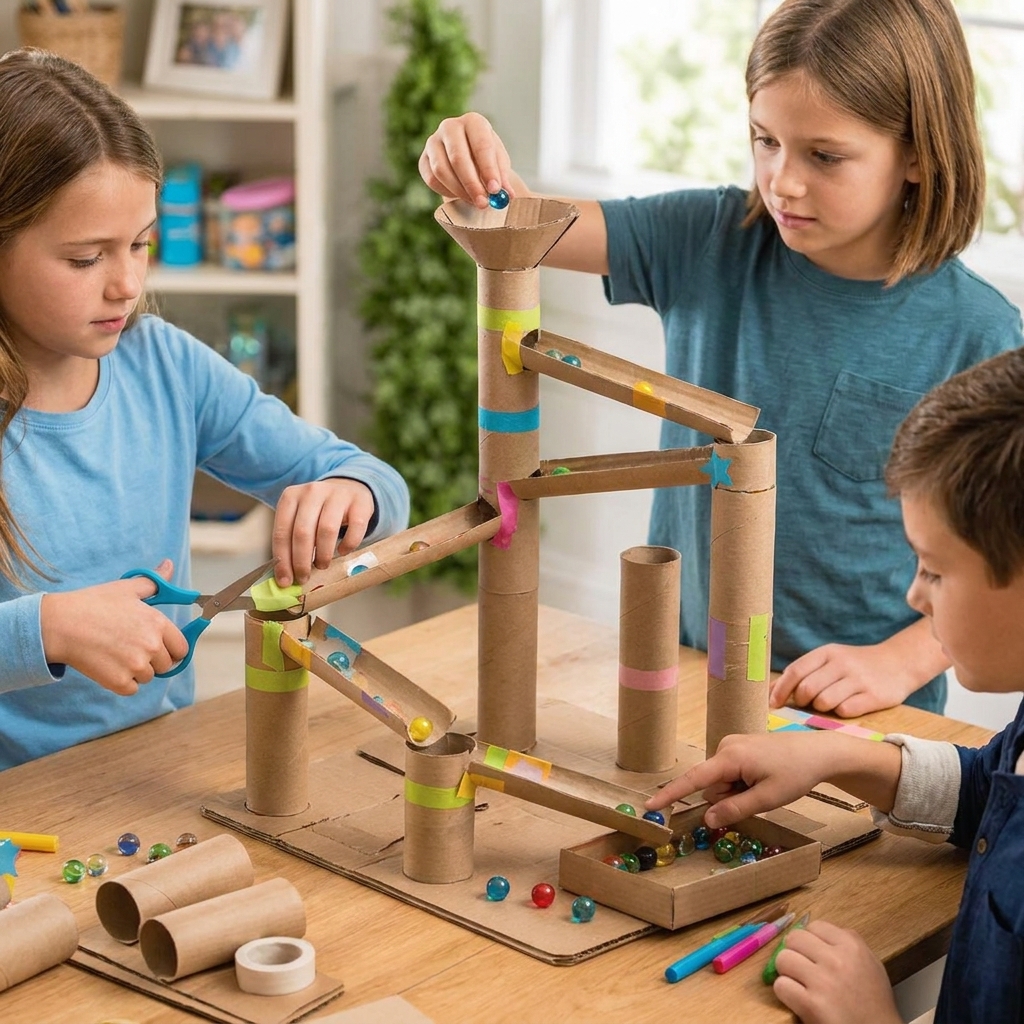
Hands-on school projects are some of the best ways for children to explore science, engineering, creativity, and teamwork. Instead of simply reading about how things work, students can build, test, and improve their own inventions. One exciting project that combines fun with learning is the Cardboard Ball Track Game. This activity challenges students to design and construct a winding track that guides a small ball from the starting point to the finish line using only gravity.
A cardboard ball track may look like a simple toy, but it introduces important concepts from STEM (Science, Technology, Engineering, and Mathematics). Students learn about gravity, slopes, friction, momentum, and problem-solving while creating a game that can be enjoyed repeatedly. The project encourages experimentation because every change in the track affects how the ball moves.
Using inexpensive or recycled materials makes this activity suitable for classrooms, science fairs, after-school clubs, and home learning. Cardboard boxes, paper tubes, tape, glue, craft sticks, and small balls are enough to build a fascinating course. Students can personalize their tracks with tunnels, bridges, loops, ramps, obstacles, and decorations.
The Cardboard Ball Track Game is not only educational but also entertaining. Friends and family can compete by timing how fast the ball reaches the end or by creating different challenge levels. This article explains how to design, build, test, and improve a cardboard ball track while exploring the scientific ideas behind its success.
Understanding the Project
The main goal of the project is to build a pathway that allows a small ball to travel smoothly from the highest point to the finish using gravity alone. The challenge is finding the perfect balance between speed, stability, and creativity.
Students quickly discover that every section of the track matters. A ramp that is too steep may cause the ball to fly off the track, while a section that is too flat may stop the ball completely. Careful planning helps ensure that the ball rolls continuously from start to finish.
This engineering challenge teaches that successful designs rarely happen on the first attempt. Testing and improving are essential parts of the process.
Choosing Materials
One of the greatest advantages of this project is that most materials can be found at home or recycled from packaging.
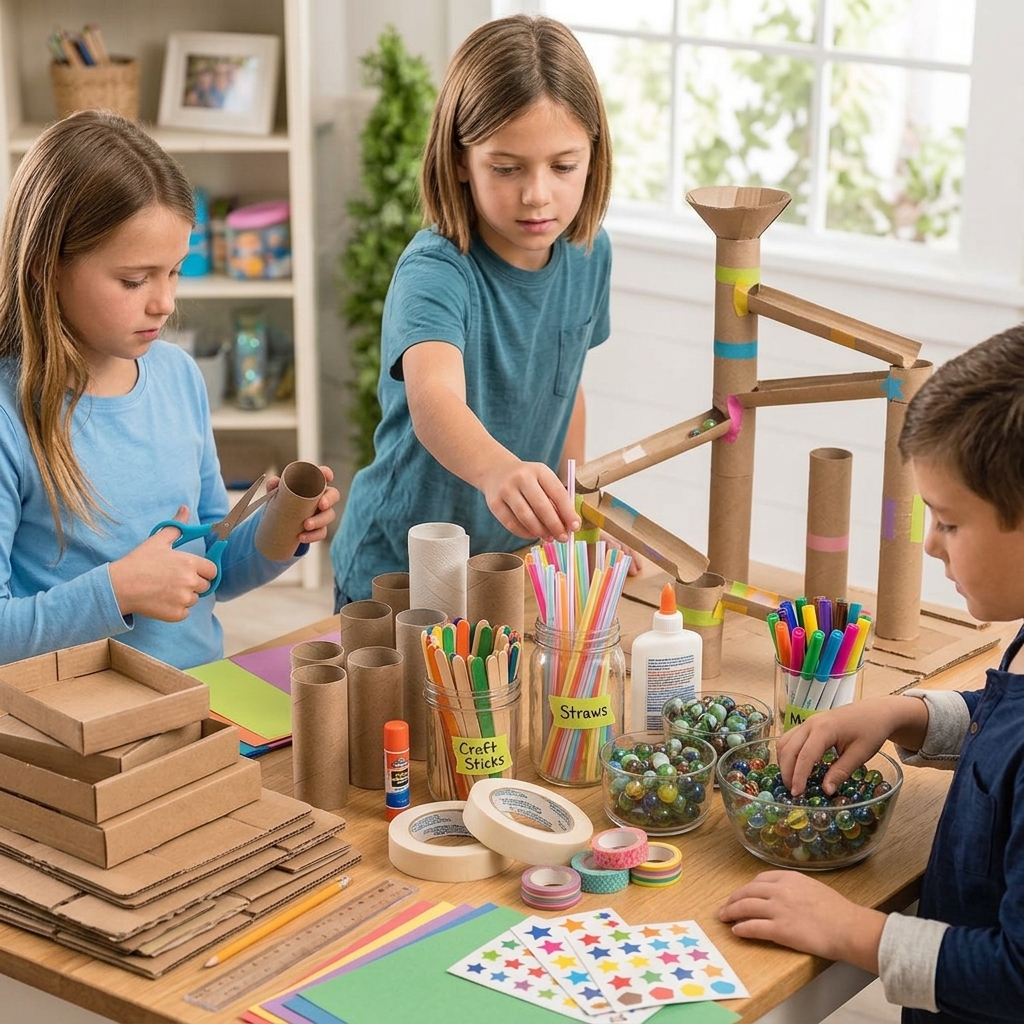
Useful materials include:
- Cardboard boxes
- Cardboard tubes
- Paper towel rolls
- Craft sticks
- Drinking straws
- Glue
- Masking tape
- Scissors
- Ruler
- Pencil
- Marbles or small balls
- Colored paper
- Markers and stickers for decoration
Choosing recycled materials helps protect the environment while reducing project costs.
Planning the Track
Before cutting any cardboard, students should draw a simple plan of the course. A sketch helps organize ideas and reduces mistakes during construction.
The design may include:
- Straight ramps
- Curved turns
- Spiral paths
- Bridges
- Tunnels
- Zigzag sections
- Small jumps
- Finish platform
The starting point should always be higher than the ending point so gravity can move the ball without assistance.
Students should also think about where supports will be placed to keep the track stable.
Building the Base
A strong base is essential because it supports the entire structure.
Large pieces of cardboard work well as the foundation. Vertical supports can be made from folded cardboard or empty paper tubes. These supports hold different track levels at various heights.
If the base is unstable, the ball track may shake or collapse during testing.
Taking time to strengthen the structure prevents many future problems.
Constructing the Ball Track
The track itself can be built using folded strips of cardboard.
Each strip should have small raised edges to prevent the ball from rolling off the sides. Gentle curves help guide the ball smoothly through corners.
Different sections should connect securely using glue or tape.
Students should avoid creating sharp corners because these often slow the ball or cause it to stop.
Smooth transitions between ramps produce the best results.
Testing the First Prototype
Once the basic track is complete, it is time for testing.
The ball is released from the starting point while students carefully observe its movement.
Important questions include:
- Does the ball reach the finish?
- Does it stop anywhere?
- Does it fall off the track?
- Does it move too quickly?
- Are the supports strong enough?
Every observation provides useful information for improving the design.
Mistakes are expected and should be viewed as learning opportunities.
Quick Overview Table
| Feature | Description |
| Project Name | Cardboard Ball Track Game |
| Project Type | STEM Engineering Activity |
| Difficulty | Easy to Intermediate |
| Recommended Age | 8 years and older |
| Main Materials | Cardboard, glue, tape, paper tubes, craft sticks |
| Science Concepts | Gravity, friction, momentum, slopes, energy |
| Estimated Build Time | 2–4 hours |
| Skills Learned | Creativity, engineering, teamwork, problem-solving |
| Cost | Low (mostly recycled materials) |
| Final Goal | Guide a ball smoothly from start to finish using gravity alone |
Improving the Design
Rarely does the first version of a ball track perform perfectly. After testing, students can identify weak points and make improvements. For example, if the ball rolls too quickly around a corner, the curve can be widened. If it stops on a flat section, the ramp angle can be increased slightly. Small changes often produce significant improvements in performance.
Adding supports beneath longer ramps also helps prevent bending, which can slow the ball. Students should continue testing after every modification until the track operates smoothly from beginning to end.
This process teaches an important lesson in engineering: successful designs are developed through repeated testing and refinement rather than perfection on the first attempt.
The Science Behind the Ball Track
Although the project appears simple, it demonstrates several important scientific principles.
Gravity is the main force that moves the ball. As the ball travels downhill, gravitational potential energy is converted into kinetic energy, causing the ball to speed up. Friction between the ball and the cardboard slows the motion, while momentum helps the ball continue moving through gentle curves and small obstacles.
The angle of each ramp is also important. Steeper ramps increase speed but can make the ball difficult to control. Shallower ramps provide better control but may not generate enough speed for the ball to complete the course.
By experimenting with these variables, students gain a practical understanding of physics that is much easier to remember than reading formulas alone.
Creative Ideas
Once the basic track is working, students can make the game even more exciting by adding creative features.
Ideas include:
- Moving bridges
- Rotating gates
- Spiral towers
- Jump ramps
- Bell or buzzer finish line
- Score zones
- Colorful decorations
- Numbered checkpoints
- Multiple paths with different difficulty levels
Students can even challenge classmates to build alternative routes and compare which design is faster or more reliable.
Educational Benefits
The Cardboard Ball Track Game develops many valuable skills beyond engineering.
Students improve their creativity by designing unique layouts. They strengthen mathematical thinking by measuring lengths, estimating slopes, and adjusting angles. They practice teamwork by sharing ideas and solving problems together.
Communication skills also improve as students explain their designs and discuss possible improvements.
Most importantly, the project builds confidence. Watching a ball successfully travel through a course they designed themselves gives students a strong sense of achievement and motivates them to continue exploring STEM subjects.
Safety Tips
Although this is a safe classroom project, basic safety rules should always be followed.
Scissors should be used carefully, and younger children should receive adult supervision when cutting cardboard. Hot glue guns should only be operated by adults or older students under close supervision.
The workspace should remain clean and organized to prevent accidents. Loose materials should be collected after the project is complete.
Following these simple precautions ensures that everyone enjoys the activity safely.
Conclusion
The Cardboard Ball Track Game is an engaging school project that combines creativity, engineering, and scientific discovery. Using inexpensive recycled materials, students can build an exciting marble run that demonstrates gravity, momentum, friction, and energy transfer in a practical and memorable way.
Throughout the project, students learn that planning, testing, observation, and continuous improvement are essential parts of engineering. Every adjustment helps them understand how small design changes influence performance. They also develop important life skills such as patience, teamwork, communication, and critical thinking.
Beyond the classroom, the concepts explored in this project relate to real-world engineering found in transportation systems, roller coasters, industrial conveyors, and automated manufacturing equipment. By creating their own cardboard ball track, students experience the excitement of solving problems through design and experimentation.
Whether used as a classroom activity, science fair exhibit, or family craft project, the Cardboard Ball Track Game provides hours of learning and entertainment. It proves that simple materials, combined with imagination and curiosity, can become powerful tools for education and innovation.
