
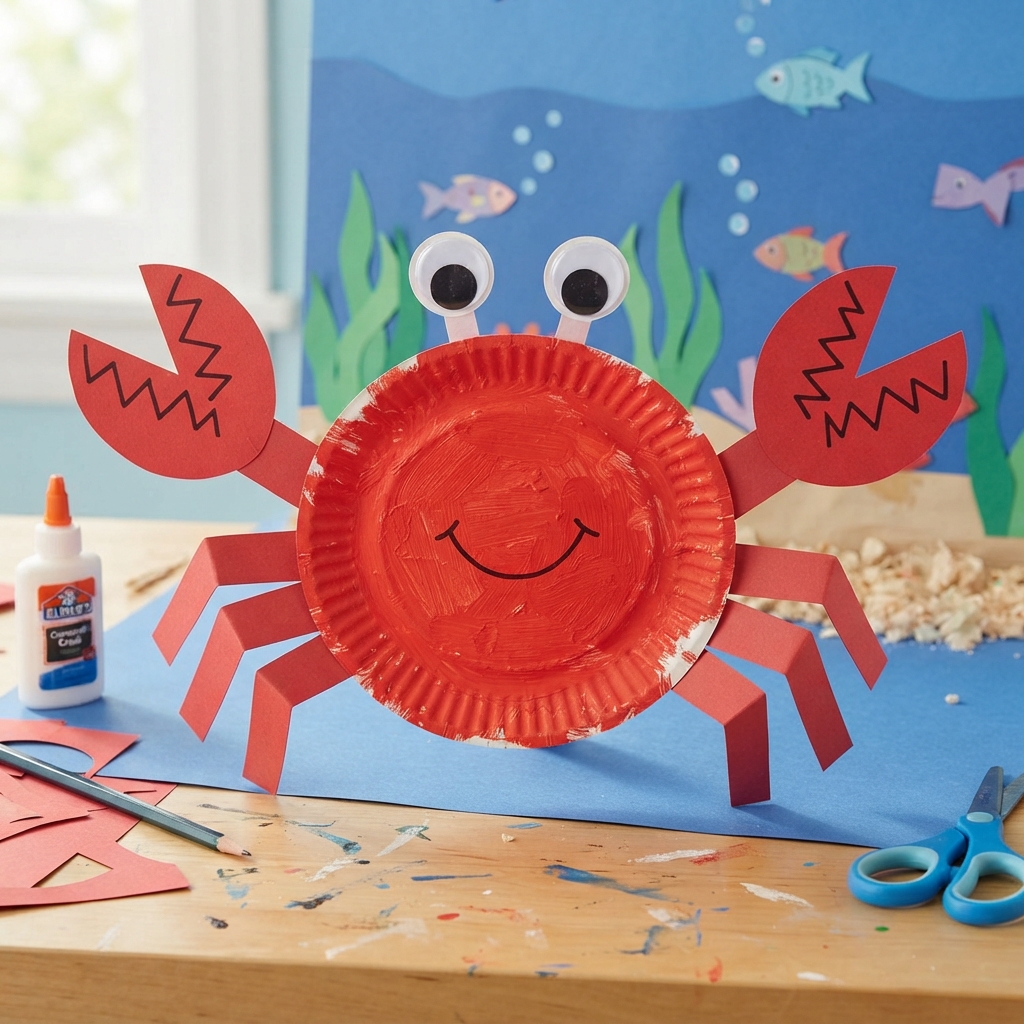
Making a crab from paper plates is a fun, simple, and creative craft project that children can enjoy at home, in school, or during a summer activity. With just a few basic materials, an ordinary paper plate can be transformed into a colorful crab with big eyes, claws, legs, and a cheerful personality. This project is especially enjoyable for children who love the ocean and marine animals.
Paper plate crafts are popular because they are inexpensive and easy to make. Most of the materials can be found around the house or in a classroom. Children can use paint, colored paper, glue, markers, and recycled cardboard to create their own unique crab. The activity also gives children an opportunity to practice cutting, drawing, painting, and assembling different pieces.
A paper plate crab can be more than just a fun decoration. It can also be part of an ocean-themed school project. While making the craft, children can learn interesting facts about crabs, their habitats, their body parts, and their role in marine ecosystems. This makes the activity a wonderful combination of art and science.
Why Make a Paper Plate Crab?
There are many reasons to choose a crab for a paper plate craft. Crabs have a simple but recognizable shape, making them easy for children to recreate. Their large claws, multiple legs, and funny eyes also provide plenty of opportunities for creative decoration.
The project encourages children to use their imagination. They can make a traditional red crab, a bright orange crab, or even an imaginary purple or blue crab. There is no single correct way to decorate the finished animal.
Paper plate crafts can also help develop fine motor skills. Cutting small shapes, holding a paintbrush, applying glue, and drawing details require children to use their hands carefully. These activities can strengthen hand-eye coordination and improve concentration.
Materials You Will Need
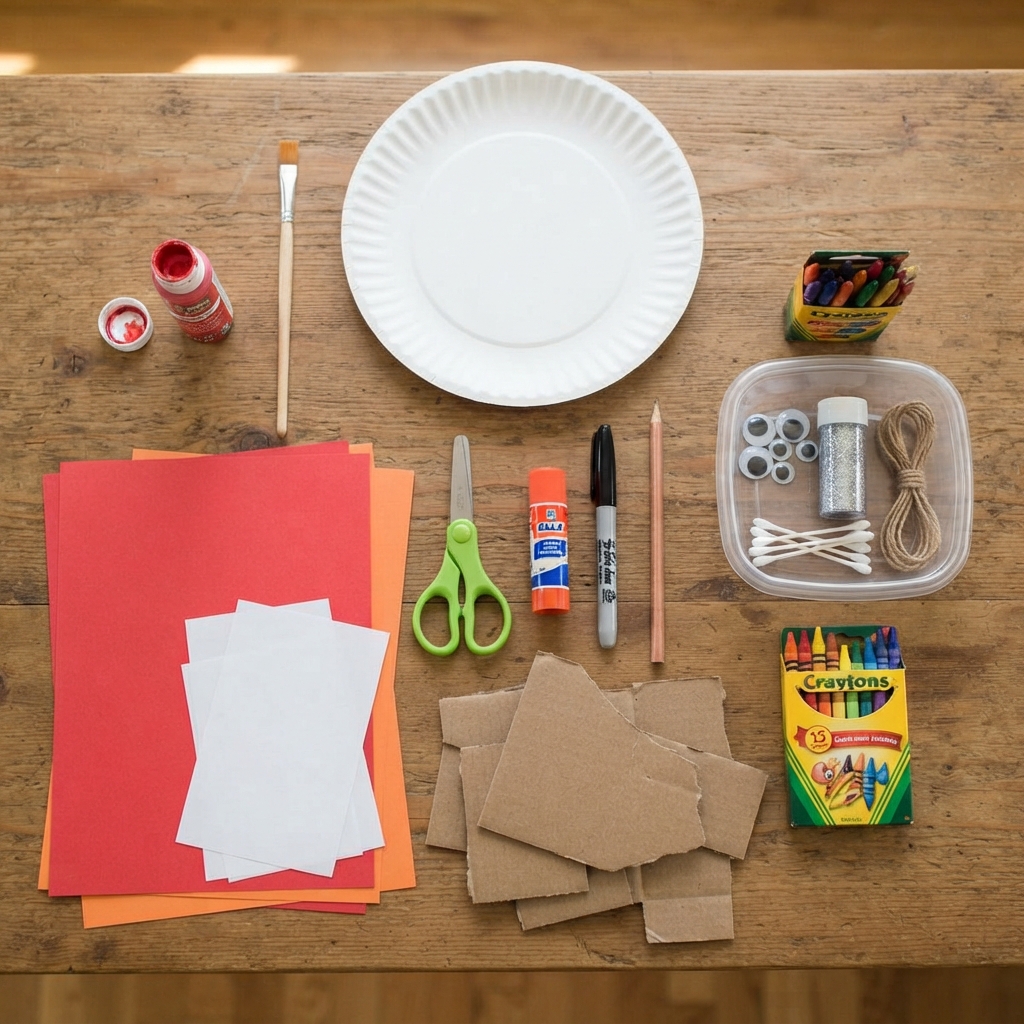
Before starting the project, gather all the necessary materials. You do not need expensive craft supplies. Many items can be found at home or purchased inexpensively.
You will need:
- One paper plate
- Red, orange, or brown paint
- Paintbrush
- Red or orange construction paper
- White paper
- Black marker
- Child-safe scissors
- Glue
- Pencil
- Cardboard scraps
- Optional googly eyes
- Optional crayons or colored pencils
- Optional glitter
- Optional cotton swabs
- Optional string
If you want to make the project more environmentally friendly, use recycled cardboard for the claws and legs. Old cereal boxes are especially useful because they are thin enough to cut but strong enough to hold their shape.
Preparing Your Workspace
Before beginning, prepare a clean workspace. Cover the table with newspaper, an old piece of paper, or a reusable craft mat. This will protect the surface from paint and glue.
Place all the materials within easy reach. If several children are working together, give each child their own paper plate and basic supplies.
It is also a good idea to wear an old shirt or apron when using paint. Allow enough space for the finished crafts to dry.
For young children, adults should supervise the use of scissors and glue. Child-safe scissors are recommended.
Step 1: Paint the Paper Plate
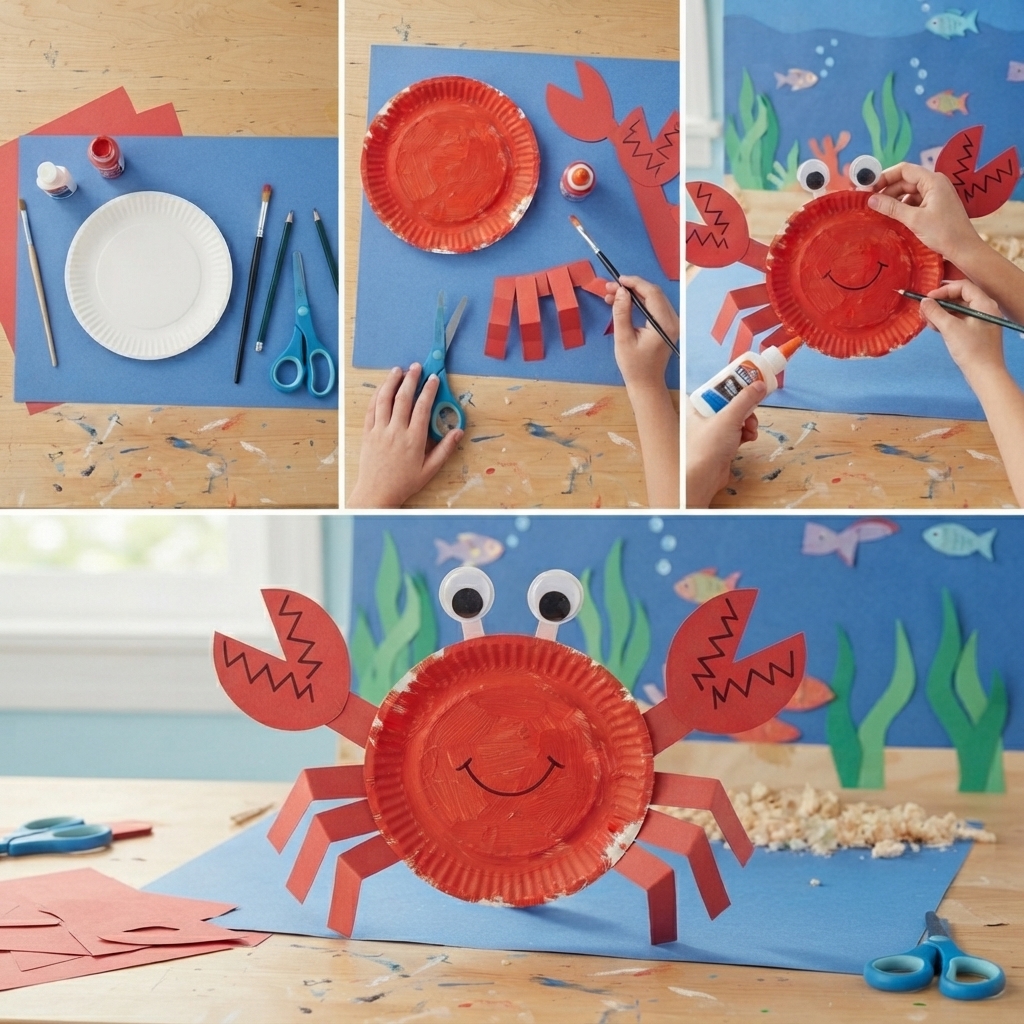
The first step is to turn the plain paper plate into the body of the crab.
Choose a color such as red, orange, or reddish-brown. Pour a small amount of paint onto a palette or disposable plate.
Using a paintbrush, cover the front of the paper plate with an even layer of paint. Try to reach the edges carefully.
Do not worry if the first layer looks slightly uneven. Paper plates can absorb paint quickly, so a second coat may be useful after the first coat dries.
Place the painted plate somewhere safe and allow it to dry completely.
If you do not want to use paint, you can cover the plate with red or orange construction paper. Another option is to color the plate with crayons or markers.
Step 2: Create the Crab’s Claws
The claws are one of the most recognizable features of a crab.
To make them, draw two large claw shapes on red or orange construction paper. You can also draw them on thin cardboard for extra strength.
The claws can be shaped like large pincers. Each claw should have two curved sections that meet near the end.
Carefully cut out both claws.
For younger children, an adult can draw the shapes first. Children can then cut them out with child-safe scissors.
Glue one claw to each side of the paper plate. You can position them slightly upward or outward to make the crab look lively.
For a three-dimensional effect, attach the claws with folded paper tabs instead of gluing them completely flat.
Step 3: Make the Crab’s Legs
Real crabs have ten legs, including their claws as specialized appendages, but you do not need to create all of them for a simple craft.
For a child-friendly paper plate crab, six or eight visible walking legs can create a recognizable appearance.
Cut several thin strips of red or orange paper. Bend each strip slightly to create a leg shape.
Glue the legs behind the paper plate so that they extend outward from both sides.
You can make the legs straight, curved, or slightly zigzagged. Using different shapes gives the crab a playful appearance.
If you want stronger legs, use cardboard instead of paper.
Step 4: Make the Eyes
The eyes are another fun part of the project.
Cut two small circles from white paper. Add black circles in the center to create pupils.
Alternatively, you can use googly eyes.
For a more realistic crab, make two small stalks from strips of paper and attach an eye to the top of each stalk.
Glue the eye stalks near the top of the paper plate.
You can make the eyes point in slightly different directions. This gives the crab a funny and friendly expression.
Step 5: Add a Face
Although crabs do not have human-style smiling faces, adding a simple mouth can make the craft more appealing to young children.
Use a black marker to draw a small curved smile below the eyes.
You can also draw tiny dots or short lines to represent other facial details.
If you want a cartoon-style crab, add eyebrows or small cheeks.
Encourage children to experiment with different expressions. One crab can look happy, another surprised, and another curious.
Step 6: Add Texture and Details
Once the basic crab is finished, it is time to add decorative details.
You can use a black or dark-red marker to draw curved lines across the claws. Add small dots to the body to create texture.
Another idea is to glue tiny pieces of paper onto the body to make a patterned shell.
Children can also add glitter, small stickers, or pieces of tissue paper.
However, decorations are optional. The simple painted crab can look wonderful on its own.
Step 7: Create a Paper Ocean
A paper plate crab becomes even more interesting when it is placed in an ocean-themed scene.
Use a large sheet of blue construction paper as the background.
Cut strips of green paper to create seaweed. Add small paper fish, shells, starfish, and bubbles.
Glue the crab onto the ocean background.
You can also add sand by using beige paper or drawing sand with crayons.
This creates a miniature underwater world that can be displayed on a classroom wall.
Making a Crab Family
Instead of making just one crab, children can create a whole family.
Use different paper plates and colors to make crabs of different sizes.
One crab can be large, another medium, and another small.
Give each crab a different facial expression. You could even give each one a name.
This is a fun group activity because every child can contribute a crab to the collection.
Teachers can place all the crabs together on a large ocean display.
Learning About Real Crabs
While making the craft, children can learn some interesting facts about real crabs.
Crabs are crustaceans, which means they have a hard outer covering called an exoskeleton. They live in many different environments, including oceans, beaches, rivers, and mangrove forests.
Many crabs walk sideways because of the way their legs and joints are arranged.
Crabs use their claws for different purposes. Depending on the species, claws may help them catch food, defend themselves, communicate, or move objects.
There are thousands of crab species around the world, and they come in many shapes, colors, and sizes.
This information can turn a simple art project into an educational experience.
Educational Benefits of the Craft
Making a paper plate crab supports several areas of childhood development.
First, it encourages creativity. Children decide which colors and decorations to use.
Second, the craft helps develop fine motor skills. Cutting paper, applying glue, painting, and drawing require controlled hand movements.
Third, following the steps teaches children about sequencing. They learn that certain tasks need to be completed before others.
The activity can also encourage language development. Children can talk about the crab’s body parts, habitat, food, and behavior.
For older children, the project can be combined with a short research assignment about marine life.
Recycling and Environmental Awareness
Using paper plates and recycled cardboard can introduce children to the idea of reusing materials.
Instead of throwing away cardboard packaging, children can turn it into craft supplies. This demonstrates that everyday objects can be used creatively.
You can also talk about keeping beaches and oceans clean.
Plastic waste and other pollution can harm marine animals. A craft project about crabs provides a natural opportunity to explain why people should avoid littering and protect marine habitats.
Children can create a small sign for their ocean display saying, “Keep Our Oceans Clean.”
Creative Variations
There are many ways to change the basic paper plate crab design.
For a realistic crab, use natural colors and add detailed patterns.
For a cartoon crab, use bright colors and oversized eyes.
For a fantasy crab, use purple, turquoise, pink, or rainbow colors.
You can also make a movable crab by attaching the claws and legs with paper fasteners. This allows some parts of the crab to move.
Another idea is to create a crab puppet. Attach the finished crab to a craft stick and use it for storytelling.
Children can invent a short story about their crab exploring the ocean.
Paper Plate Crab for a School Project
A paper plate crab can make an excellent school project because it is easy to complete and visually attractive.
Teachers can ask students to create different sea animals using paper plates. One student can make a crab, another can make a fish, another can make a jellyfish, and another can make a turtle.
All the animals can then be combined into one large ocean display.
Students can add labels describing each animal and its habitat.
This turns individual crafts into a collaborative classroom project.
Tips for a Successful Craft
Take your time when cutting the claws and legs. Small mistakes are not a problem, but careful cutting can make the final craft look cleaner.
Allow the paint to dry completely before adding paper decorations.
Use a small amount of glue. Too much glue can make paper wet and difficult to handle.
If the paper plate bends after painting, place it under a light book or flat object after it has dried completely.
Most importantly, encourage children to be creative. Their crabs do not need to look exactly like a sample.
Conclusion
Making a crab from a paper plate is a simple and enjoyable craft that brings creativity and marine-life learning together. With a paper plate, paint, construction paper, scissors, glue, and a few optional decorations, children can create a colorful crab with claws, legs, eyes, and a cheerful expression.
The project is easy enough for young children but can also be expanded into a more detailed activity for older students. By creating a paper ocean around the crab, children can build an entire marine habitat filled with fish, seaweed, shells, starfish, and other creatures.
Most importantly, this craft encourages children to learn through making. They practice fine motor skills, follow instructions, experiment with colors, and discover interesting facts about crabs and the ocean.
Whether it is made at home on a rainy afternoon, during a classroom lesson, or as part of a summer ocean-themed activity, a paper plate crab is a wonderful way to turn a simple everyday object into a fun work of art.
