
Quick Summary Table
| Feature | Details |
| Topic | A Scientific Experiment to Change the Color of Flowers |
| Keyword | A scientific experiment to change the color of flowers |
| Category | Plant Science / STEM Activities |
| Difficulty Level | Easy |
| Recommended Age | 6+ Years |
| Time Required | 1–5 Days (depending on activity) |
| Main Focus | Plant Biology, Capillary Action, Absorption |
| Materials Needed | White flowers, water, food coloring, household items |
| Learning Style | Hands-on STEM Experimentation |
| Number of Activities | 10 Fun Experiments |
Introduction
A scientific experiment to change the color of flowers is one of the most visually stunning and educational STEM activities for children and beginners. It transforms ordinary white flowers into vibrant, colorful creations using simple household materials. This experiment is not only beautiful to observe but also an excellent way to introduce important scientific concepts such as plant biology, capillary action, water transport, and absorption.
Children are naturally fascinated when they see flowers change color over time. What seems like magic is actually science happening inside the plant’s stem. As colored water moves upward through the stem, it carries pigment into the petals, gradually changing their appearance.
This hands-on experiment is perfect for classrooms, homeschooling, or family science activities. It requires minimal materials but delivers powerful learning outcomes. It also encourages patience, observation, and curiosity—key skills in STEM education.
In this guide, we will explore 10 fun and creative STEM activities based on flower color change experiments. Each activity is designed to be simple, engaging, and educational, helping children understand how plants absorb and transport water.
Why Flowers Change Color
Before exploring the activities, it is important to understand the science behind the process.
Flowers absorb water through their stems using a process called capillary action. Inside the stem are tiny tubes called xylem. These tubes transport water from the roots to the petals.
When colored water is used, the dye travels along the same path as the water. As it reaches the petals, it slowly changes their color.
Key scientific concepts include:
- Capillary action
- Water absorption
- Plant transport system
- Osmosis (in some variations)
- Pigment diffusion
This simple mechanism makes flowers an excellent natural tool for STEM learning.
Materials Commonly Used
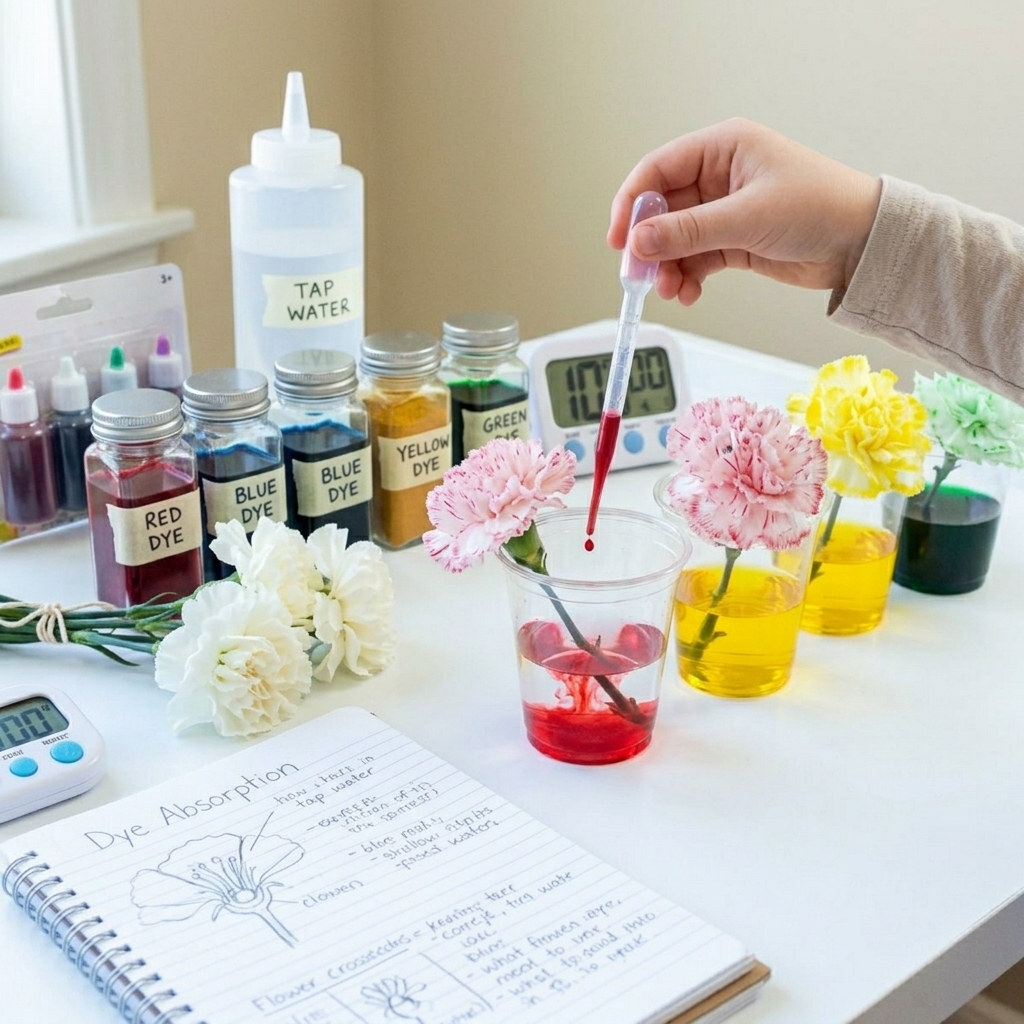
Most of the experiments require simple household or classroom items:
- White carnations or roses
- Clear cups or jars
- Water
- Food coloring
- Scissors
- Vegetable dyes (optional)
- Paper towels
- Split containers
These materials are safe, inexpensive, and easy to find.
1. Classic Flower Color Change Experiment
Materials
- White carnation
- Water
- Food coloring
- Glass
Instructions
- Fill a glass with water.
- Add several drops of food coloring.
- Place the flower stem in the water.
- Wait 24–72 hours.
Observation
The flower slowly changes color as it absorbs the dyed water.
Science Lesson
This demonstrates capillary action and water transport in plants.
2. Split Stem Color Experiment
Materials
- White flower
- Two cups
- Two food colors
Instructions
- Split the stem carefully in half.
- Place each half in different colored water.
- Observe color blending in petals.
Science Lesson
Different xylem channels transport different colored water.
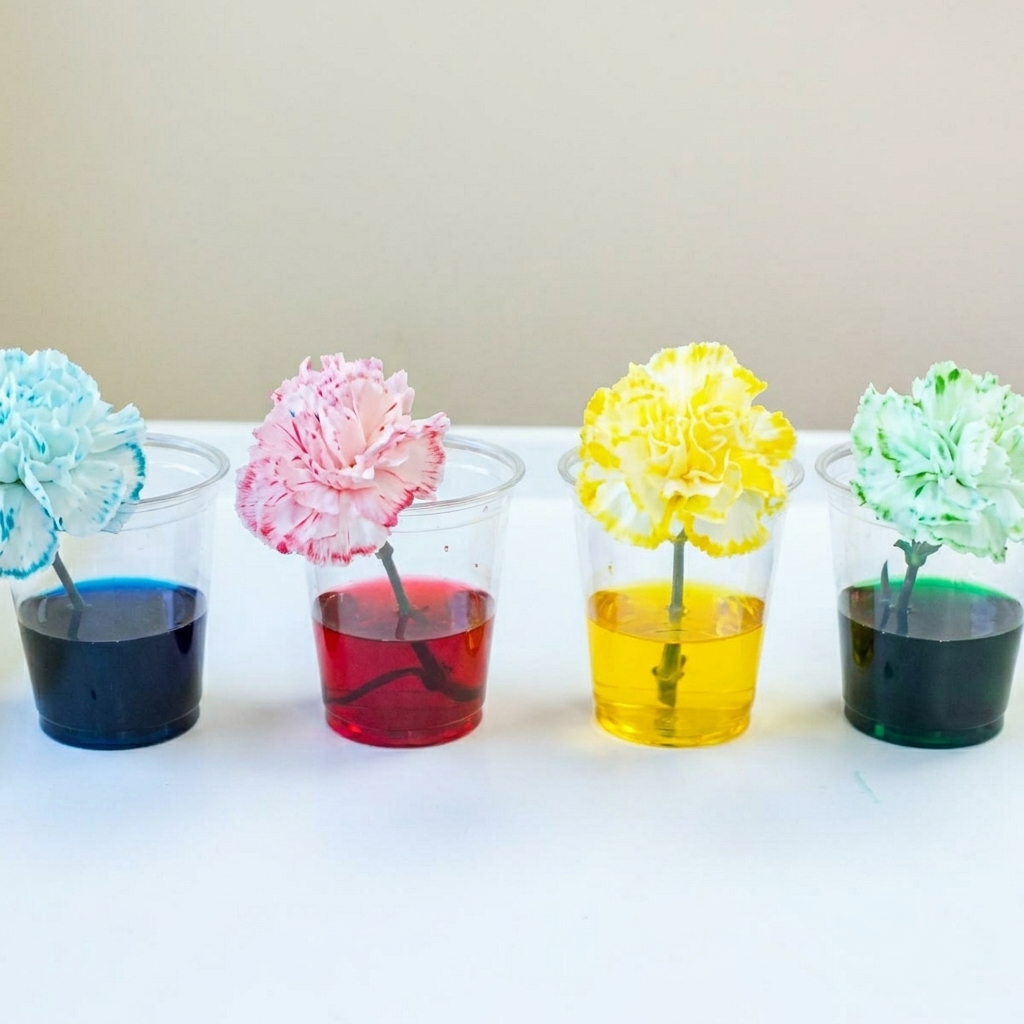
3. Rainbow Flower Experiment
Materials
- White carnation
- Multiple cups
- Different food colors
Instructions
- Place multiple flowers in different colored water.
- Observe different color transformations.
Science Lesson
Different pigments travel independently through stems.
4. Half-and-Half Flower Effect
Materials
- White flower
- Food coloring
- Tape
Instructions
- Cover half the stem.
- Place uncovered part in colored water.
- Observe partial color change.
Science Lesson
Only exposed xylem tubes absorb water.
5. Multi-Color Gradient Flower
Materials
- White flower
- Mixed color water
Instructions
- Gradually change water color over days.
- Observe gradual petal transformation.
Science Lesson
Color intensity depends on absorption rate.
6. Reverse Color Absorption Test
Materials
- Flower petals
- Colored water
Instructions
- Place petals in colored water.
- Observe reverse diffusion patterns.
Science Lesson
Osmosis affects water movement in plant tissues.
7. Split Cup Experiment
Materials
- Two-colored water container
- Flower
Instructions
- Divide cup into two colored sections.
- Place stem in center.
Science Lesson
Simultaneous absorption from multiple sources.
8. Ice Water vs Warm Water Test
Materials
- Two cups
- Different water temperatures
Instructions
- Place flowers in hot and cold dyed water.
- Compare speed of color change.
Science Lesson
Temperature affects absorption speed.
9. Natural Dye Experiment
Materials
- Beet juice
- Turmeric
- Spinach extract
Instructions
- Replace food coloring with natural dyes.
- Observe color differences.
Science Lesson
Natural pigments behave differently than synthetic ones.
10. Time-Lapse Flower Observation
Materials
- Flower
- Camera or notebook
Instructions
- Document flower every few hours.
- Record color changes.
Science Lesson
Scientific observation and data collection.
How Plants Transport Water
Plants use a system called xylem to transport water from roots to leaves and petals.
Water moves upward due to:
- Capillary action
- Transpiration pull
- Adhesion and cohesion of water molecules
This system ensures plants stay hydrated and healthy.
When dye is added, it follows the same pathway, making color changes visible.
Why This Experiment Is Important for Kids
A scientific experiment to change the color of flowers is valuable because it:
Encourages Curiosity
Children see real-life science in action.
Teaches Biology
Introduces plant structure and function.
Builds Observation Skills
Children track changes over time.
Develops Patience
Results take time to appear.
Promotes STEM Learning
Combines science, observation, and creativity.
Classroom and Home Applications
This experiment works well in:
- Science classrooms
- Homeschool lessons
- Nature clubs
- STEM workshops
Teachers can expand it into full lessons on plant biology.
Safety Tips
- Use safe, non-toxic dyes
- Handle scissors carefully
- Avoid ingesting materials
- Supervise young children
Common Mistakes
No Color Change
Possible reasons:
- Flower not fresh
- Weak dye solution
Slow Results
Temperature and flower type affect speed.
Uneven Coloring
Stem may not be fully submerged.
Conclusion
A scientific experiment to change the color of flowers is a simple yet powerful STEM activity that transforms ordinary white flowers into vibrant learning tools. Through 10 engaging experiments, children can explore how plants absorb water, how pigments travel through stems, and how environmental conditions affect biological processes.
This experiment combines beauty, curiosity, and science in a way that makes learning unforgettable. It encourages children to observe, question, and explore the natural world while developing essential STEM skills.
Whether used at home or in the classroom, this colorful science activity helps young learners see that science is not just something in textbooks—it is alive, beautiful, and all around them.
