
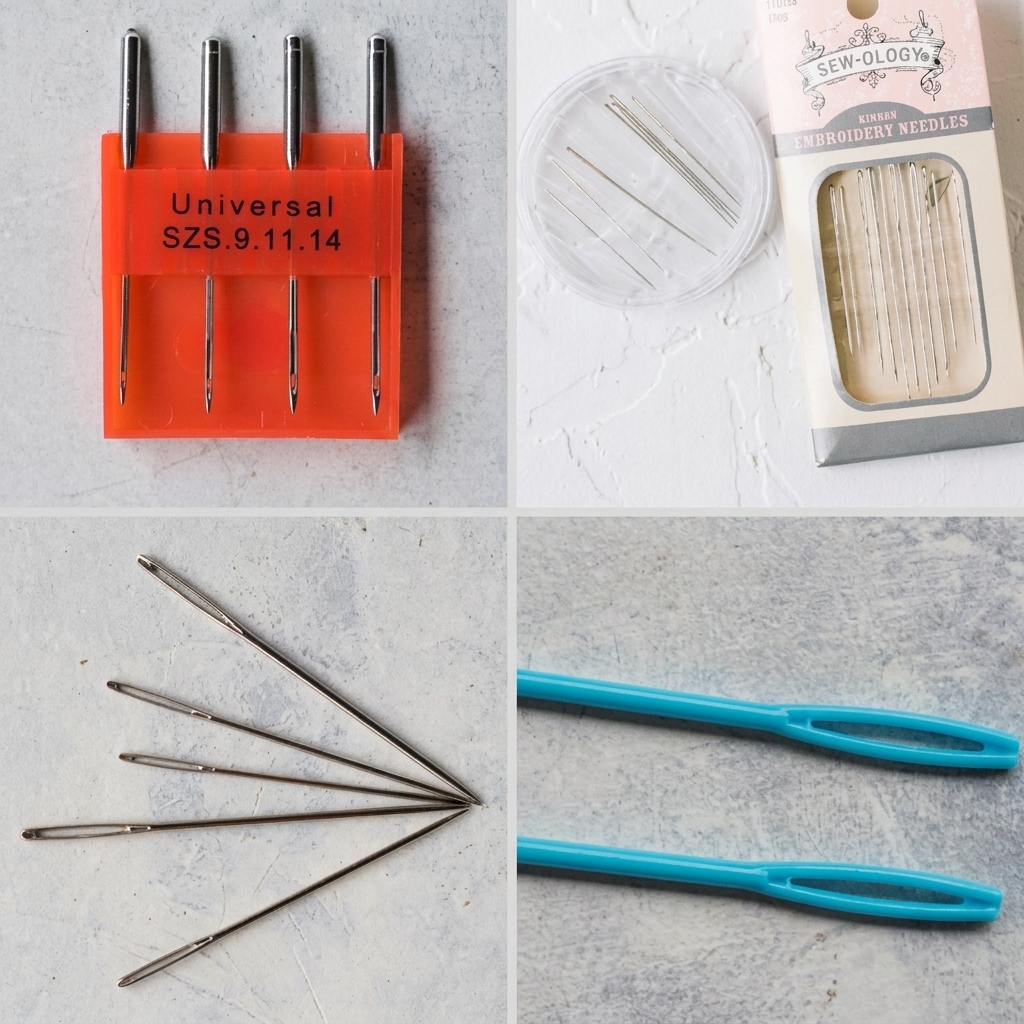
Choosing the right sewing needle can make a big difference in your sewing projects. Beginners often think that all needles are the same, but different needles are designed for different fabrics, threads, and sewing techniques.
Using the wrong needle can make sewing difficult, cause skipped stitches, damage the fabric, or even break the thread. Learning about the most common types of sewing needles will help you choose the right tool and make your projects easier.
This guide explains the main types of hand-sewing and machine needles, their uses, and how beginners can choose the right needle for different fabrics.
Why Choosing the Right Needle Matters
A sewing needle does more than simply pass thread through fabric. Its size, shape, point, and eye are designed for specific materials and techniques.
The right needle should:
- Pass smoothly through the fabric
- Work well with your thread
- Create clean stitches
- Avoid damaging the fabric
- Match the thickness of the material
For example, a sharp needle is useful for tightly woven cotton, while a ballpoint needle is better suited to stretchy knit fabric.
Understanding Sewing Needle Sizes
Needles come in different sizes. The exact numbering system can vary between needle types and manufacturers, but generally, a finer needle is used for lightweight fabric and a thicker needle is used for heavier material.
As a beginner, remember this simple rule:
Light fabric = smaller, finer needle.
Heavy fabric = larger, stronger needle.
Always consider both the fabric and the thread when choosing a needle.
Common Types of Hand-Sewing Needles
1. Sharps Needles
Sharps are general-purpose hand-sewing needles with a sharp point.
They are one of the best choices for beginners because they can be used for many everyday sewing tasks.
Best Uses
Sharps are suitable for:
- Cotton
- Linen
- Lightweight wool
- General repairs
- Basic sewing
- Small fabric projects
If you are building your first sewing kit, a small assortment of sharp needles is a good place to start.
2. Betweens Needles
Betweens are short, sturdy needles traditionally used for quilting.
Their shorter length allows quilters to make small, controlled stitches.
Best Uses
They are useful for:
- Hand quilting
- Detailed stitching
- Small, even stitches
- Working through multiple fabric layers
Beginners who want to try quilting may find betweens particularly useful.
3. Embroidery Needles
Embroidery needles usually have a longer and larger eye than standard sewing needles.
The larger eye makes it easier to thread embroidery floss, which can be thicker than regular sewing thread.
Best Uses
Use embroidery needles for:
- Hand embroidery
- Decorative stitching
- Cross-stitch
- Embroidery floss
- Surface embroidery
They work well for designs such as flowers, stars, butterflies, hearts, and other decorative patterns.
4. Ballpoint Needles
Ballpoint needles have a rounded tip instead of a sharp point.
The rounded tip moves between the fibers of knitted fabric instead of cutting through them.
Best Uses
Ballpoint needles are ideal for:
- Jersey
- Knits
- Stretch fabrics
- T-shirts
- Some athletic fabrics
If you are sewing stretchy fabric by hand, a ballpoint needle can help reduce the risk of snagging or damaging the material.
5. Chenille Needles
Chenille needles have a sharp point and a large eye.
They are often used with thicker threads and embroidery materials.
Best Uses
They work well for:
- Crewel embroidery
- Thick embroidery thread
- Ribbon embroidery
- Decorative stitching
The large eye makes them convenient when using thicker thread.
6. Tapestry Needles
Tapestry needles have a blunt, rounded point and a large eye.
Because the point is blunt, they are designed to pass through spaces between fabric threads rather than pierce them.
Best Uses
They are commonly used for:
- Cross-stitch
- Needlepoint
- Plastic canvas
- Counted embroidery
- Finishing yarn projects
Tapestry needles are especially useful when working on fabrics with clearly visible holes.
7. Crewel Needles
Crewel needles are similar to embroidery needles but are designed for crewelwork and thicker embroidery threads.
They have a sharp point and a longer eye.
Best Uses
Use crewel needles for:
- Crewel embroidery
- Wool embroidery
- Decorative surface stitching
- Medium-weight embroidery threads
They are a useful addition to an embroidery kit.
8. Milliner’s Needles
Milliner’s needles are long, thin needles with a sharp point.
They are traditionally associated with hat making but can also be used for certain decorative sewing techniques.
Best Uses
They can be useful for:
- Decorative embroidery
- Pleating
- Straw work
- Long, even stitches
- Certain specialty techniques
They are not usually essential for a beginner’s basic sewing kit.
9. Leather Needles
Leather needles are designed to pass through leather and other heavy materials.
They typically have a specially shaped point that helps penetrate tough material.
Best Uses
They can be used for:
- Leather
- Suede
- Vinyl
- Heavy synthetic materials
- Leather crafts
Leather can be difficult to sew by hand, so beginners should practice carefully and use appropriate protection.
10. Sailmaker’s Needles
Sailmaker’s needles are strong needles designed for heavy-duty materials.
They can be useful when working with thick canvas, heavy leather, and other demanding materials.
They are generally more specialized than the needles beginners need for everyday sewing.
11. Darning Needles
Darning needles are longer needles with relatively large eyes.
They are designed for repairing holes and reinforcing worn fabric.
Best Uses
Use them for:
- Sock repairs
- Sweater repairs
- Darning
- Woven repairs
- Working with thicker yarn
Their large eye makes it easier to use wool or heavier thread.
12. Bodkins
A bodkin is a blunt, wide needle-like tool used for threading elastic, ribbon, or cord through fabric channels.
It is not normally used for making regular stitches.
Best Uses
A bodkin can help with:
- Threading elastic
- Pulling ribbon through casings
- Inserting cords
- Moving drawstrings through fabric
It is a useful specialty tool for clothing and bag projects.
Choosing the Right Needle for Different Fabrics
One of the easiest ways to choose a needle is to consider the type and thickness of your fabric.
Lightweight Cotton
Use a fine sharp needle for lightweight cotton.
Medium-Weight Cotton
A general-purpose sharp needle works well for most medium-weight cotton projects.
Denim
Choose a strong, sturdy needle designed for heavy fabric. If sewing by machine, use a denim or jeans needle appropriate to the fabric weight.
Knitted Fabric
Use a ballpoint needle for many knit fabrics.
Wool
Choose a suitable sharp or embroidery-style needle depending on the thickness of the wool and the thread.
Leather
Use a leather needle designed specifically for leather or similar heavy materials.
Embroidery Fabric
Choose an embroidery or crewel needle according to the thickness of your embroidery thread.
How to Choose the Right Needle for Your Thread
The thread and needle should work together.
A very thick thread needs an eye large enough to accommodate it. A very fine thread usually works best with a smaller needle.
If the needle eye is too small, threading can become frustrating and the thread may fray.
If the needle is unnecessarily large, it may leave visible holes in delicate fabric.
Choose a combination that allows the thread to pass smoothly through the needle eye and fabric.
Hand-Sewing Needles vs. Sewing Machine Needles
Hand-sewing needles and sewing machine needles are not interchangeable.
Hand-sewing needles are designed to be held and pushed through the fabric manually.
Machine needles are designed to fit a particular sewing machine and move rapidly through the fabric.
Machine needles have a specific shank and construction that allows them to attach correctly to the machine.
If you are using a sewing machine, always check your machine’s instructions before selecting a needle.
How to Change a Sewing Needle
For hand sewing, changing needles is simple.
- Remove the old needle.
- Choose a needle appropriate for your fabric and thread.
- Thread the new needle.
- Check that the needle is clean and straight.
- Begin sewing carefully.
For a sewing machine, turn the machine off before changing the needle and follow the manufacturer’s instructions.
Signs That You Are Using the Wrong Needle
Your needle may not be suitable if you notice:
- The thread keeps breaking
- The fabric is being damaged
- Stitches look uneven
- The needle bends easily
- The needle is difficult to push through the fabric
- The thread repeatedly frays
- Machine stitches are skipped
If you notice these problems, try changing the needle size or type.
How to Store Sewing Needles Safely
Proper storage keeps your needles organized and reduces the risk of accidents.
You can store needles in:
- A pincushion
- A needle book
- A magnetic needle case
- A small sewing organizer
Never leave loose needles on your sewing table, chair, or floor.
Keep sewing supplies away from young children and pets.
A Beginner’s Needle Collection
You do not need every type of needle when you are starting.
A useful beginner collection could include:
- General-purpose sharp needles
- Embroidery needles
- Ballpoint needles
- Tapestry needles
- A few larger needles for thicker thread
Add specialty needles later as your sewing projects become more advanced.
Final Thoughts
Understanding the different types of sewing needles makes sewing much easier. The right needle can improve stitch quality, protect your fabric, and make your work more comfortable.
Start with a few general-purpose needles and learn how they work with different fabrics and threads. As you explore embroidery, quilting, repairs, or specialty fabrics, add the needle types designed for those techniques.
With the right needle in your hand, even a simple piece of fabric can become the beginning of a beautiful handmade project.
