
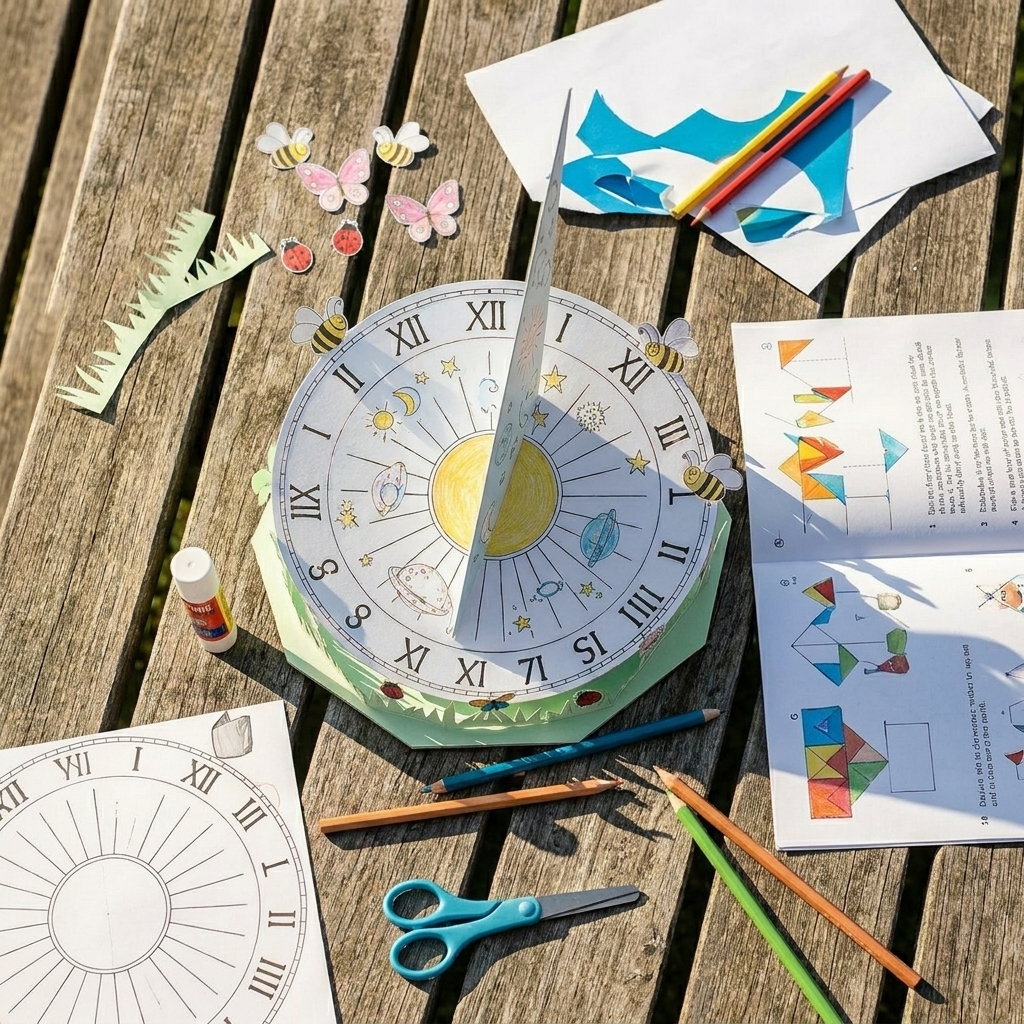
Making a simple sundial is one of the most exciting and educational activities children can try outdoors. In a world filled with digital clocks, smartphones, and smart devices, it can be surprising for kids to discover that people once used the Sun to tell time. This simple science project combines creativity, history, nature, and hands-on learning in a way that captures children’s curiosity.
A sundial is a device that uses the position of the Sun to indicate the time of day. By observing the shadow cast by a stick or pointer, children can understand how the movement of the Earth affects the Sun’s apparent motion across the sky. The best part is that making a simple sundial requires only a few inexpensive materials and can be completed in a short amount of time.
Many children enjoy projects that allow them to create something useful while learning new concepts. Making a simple sundial does exactly that. It transforms a basic outdoor activity into an engaging lesson about science, mathematics, geography, and history.
Quick Overview Table
| Feature | Details |
| Project Name | Making a Simple Sundial |
| Age Group | 5–12 Years |
| Difficulty Level | Easy |
| Time Required | 20–30 Minutes |
| Main Materials | Paper plate, stick, marker, ruler |
| Learning Topics | Science, Timekeeping, Earth Rotation |
| Indoor or Outdoor | Outdoor |
| Educational Value | High |
| Fun Factor | Excellent |
| Adult Assistance | Minimal |
What Is a Sundial?
A sundial is one of the oldest instruments used to measure time. Long before mechanical clocks were invented, people relied on the Sun’s position in the sky to organize their daily activities.
The basic principle is simple. A stick, known as a gnomon, casts a shadow onto a marked surface. As the Sun moves across the sky, the shadow shifts position. These changes can be used to estimate the time.
When children begin making a simple sundial, they are not just creating a craft. They are recreating a tool that has been used by civilizations for thousands of years.
Materials Needed
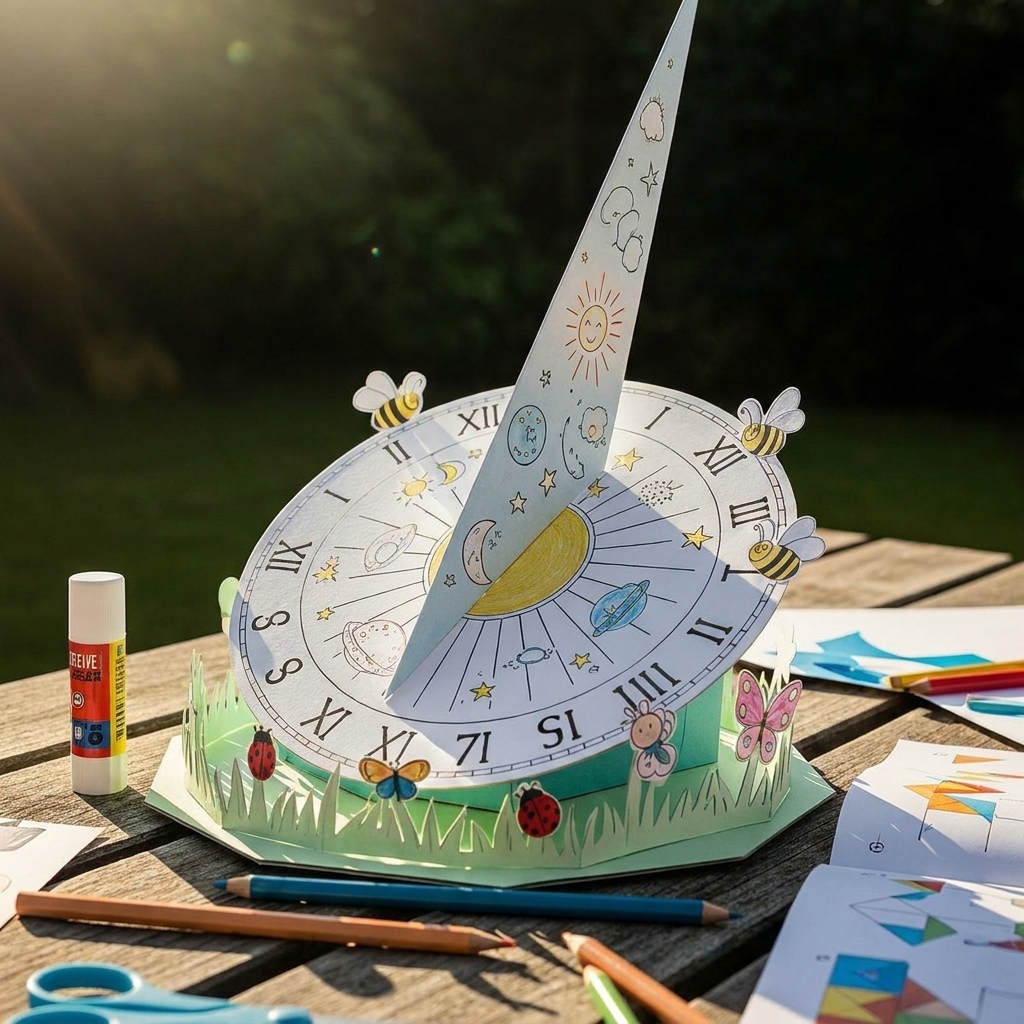
One reason kids enjoy making a simple sundial is that the materials are easy to find.
You will need:
- A paper plate
- A pencil or wooden stick
- Modeling clay
- Marker pens
- Ruler
- Sunny outdoor space
- Clock or watch for reference
Most families already have these items at home, making the project affordable and accessible.
Step-by-Step Instructions
Step 1: Prepare the Base
Take a paper plate and place it on a flat surface. This will serve as the dial of the sundial.
Step 2: Create the Gnomon
Insert a pencil or stick through the center of the plate. Use clay underneath to keep it standing upright.
Step 3: Position the Sundial
Place the sundial in a sunny location. Make sure it remains stationary throughout the day.
Step 4: Mark the Hours
At each hour, observe where the shadow falls and mark the location on the plate.
Step 5: Label the Time
Write the corresponding hour next to each mark.
Step 6: Observe and Learn
Continue observing throughout the day to create a complete time map.
This process helps children understand how shadows change over time.
Why Kids Love This Project
1. It Feels Like a Real Scientific Experiment
Children naturally enjoy discovering how things work. Making a simple sundial allows them to become scientists for a day.
Instead of reading about shadows in a textbook, they can watch changes happen in real time. This hands-on approach makes learning more memorable.
Kids often feel proud when they realize they can predict the movement of shadows and understand why those changes occur.
2. It Connects Them with Nature
Many modern activities take place indoors. A sundial encourages children to spend time outside.
Fresh air, sunshine, and observation become part of the learning experience.
Children begin noticing:
- The Sun’s position
- Cloud patterns
- Shadow lengths
- Changes during the day
These observations help build awareness of the natural world.
3. It Encourages Creativity
Making a simple sundial is not limited to science.
Kids can decorate their paper plates with:
- Bright colors
- Animal drawings
- Space themes
- Seasonal decorations
- Personal designs
Each sundial becomes unique.
This combination of art and science makes the project appealing to children with different interests.
4. It Teaches Time in a Fun Way
Learning to tell time can be challenging for young children.
A sundial offers a visual and interactive way to understand hours passing throughout the day.
Instead of seeing numbers move on a digital screen, children observe physical changes in shadows.
This makes the concept of time easier to grasp.
5. It Creates a Sense of Achievement
Few things are more satisfying for children than building something that works.
When kids complete their sundial and see it successfully track the Sun’s movement, they experience a sense of accomplishment.
This success boosts confidence and encourages further exploration of science and engineering activities.
Educational Benefits
Understanding Earth’s Rotation
One of the biggest lessons from making a simple sundial involves understanding Earth’s rotation.
Although it appears that the Sun moves across the sky, it is actually the Earth rotating on its axis.
The changing shadow provides a visible demonstration of this concept.
Learning About Shadows
Children discover that:
- Shadows change direction.
- Shadows change length.
- Shadows depend on the Sun’s position.
These observations introduce basic principles of light and geometry.
Developing Observation Skills
Scientific thinking begins with careful observation.
Kids learn to:
- Notice details
- Record information
- Compare results
- Draw conclusions
These skills support future learning across many subjects.
Building Patience
A sundial works gradually throughout the day.
Children must wait, observe, and record data over time.
This process teaches patience and persistence.
Historical Connections
Making a simple sundial also introduces children to history.
Ancient civilizations used sundials long before modern clocks existed.
The:
- Ancient Egyptians
- Ancient Greeks
- Ancient Romans
- Ancient Chinese
all developed methods for measuring time using sunlight.
Learning about these cultures helps children understand how human innovation evolved over centuries.
Ways to Extend the Project
Create a Permanent Garden Sundial
Families can build a larger version in the backyard using:
- Stones
- Wooden stakes
- Paint
- Decorative markers
This creates a lasting educational feature.
Compare Seasons
Children can observe how shadows differ during:
- Spring
- Summer
- Autumn
- Winter
This introduces seasonal science concepts.
Keep a Shadow Journal
Students can record:
- Shadow length
- Weather conditions
- Time of day
over several weeks.
This transforms the activity into a long-term investigation.
Combine with Weather Studies
Kids can compare sunny days with cloudy days.
They quickly learn why sunlight is essential for a sundial to function.
Common Challenges and Solutions
The Stick Falls Over
Solution:
Use more clay or a stronger support base.
The Shadow Is Difficult to See
Solution:
Move the sundial to a brighter location.
The Marks Do Not Match the Clock
Solution:
Ensure the sundial remains in the same position all day.
Clouds Block the Sun
Solution:
Wait for clearer weather conditions.
These simple fixes help children stay motivated.
Safety Tips
Although making a simple sundial is very safe, children should follow basic precautions:
- Wear sunscreen on sunny days.
- Stay hydrated.
- Avoid looking directly at the Sun.
- Work under adult supervision when needed.
These habits promote safe outdoor learning.
How Parents and Teachers Can Help
Adults can enhance the experience by asking questions such as:
- Why do you think the shadow moved?
- What happens at noon?
- Which shadow is the longest?
- Why does the shadow change direction?
These discussions encourage critical thinking and deeper understanding.
Teachers can also connect the project to lessons about:
- Astronomy
- Geography
- Mathematics
- History
- Environmental science
This makes the activity suitable for both home and classroom learning.
Conclusion
Making a simple sundial is much more than a craft project. It is an exciting journey into science, history, and nature. Children love the activity because it is hands-on, creative, educational, and rewarding. By watching shadows move across a homemade dial, they gain a better understanding of time, sunlight, and Earth’s rotation.
The project requires only a few materials, making it affordable and easy for families and teachers to organize. Most importantly, it encourages curiosity and exploration—two essential ingredients for lifelong learning.
Whether used in a classroom, backyard, or community event, making a simple sundial remains a timeless activity that inspires young minds. It is easy to see why so many children enjoy creating one and why this simple project continues to teach valuable lessons generation after generation.
