
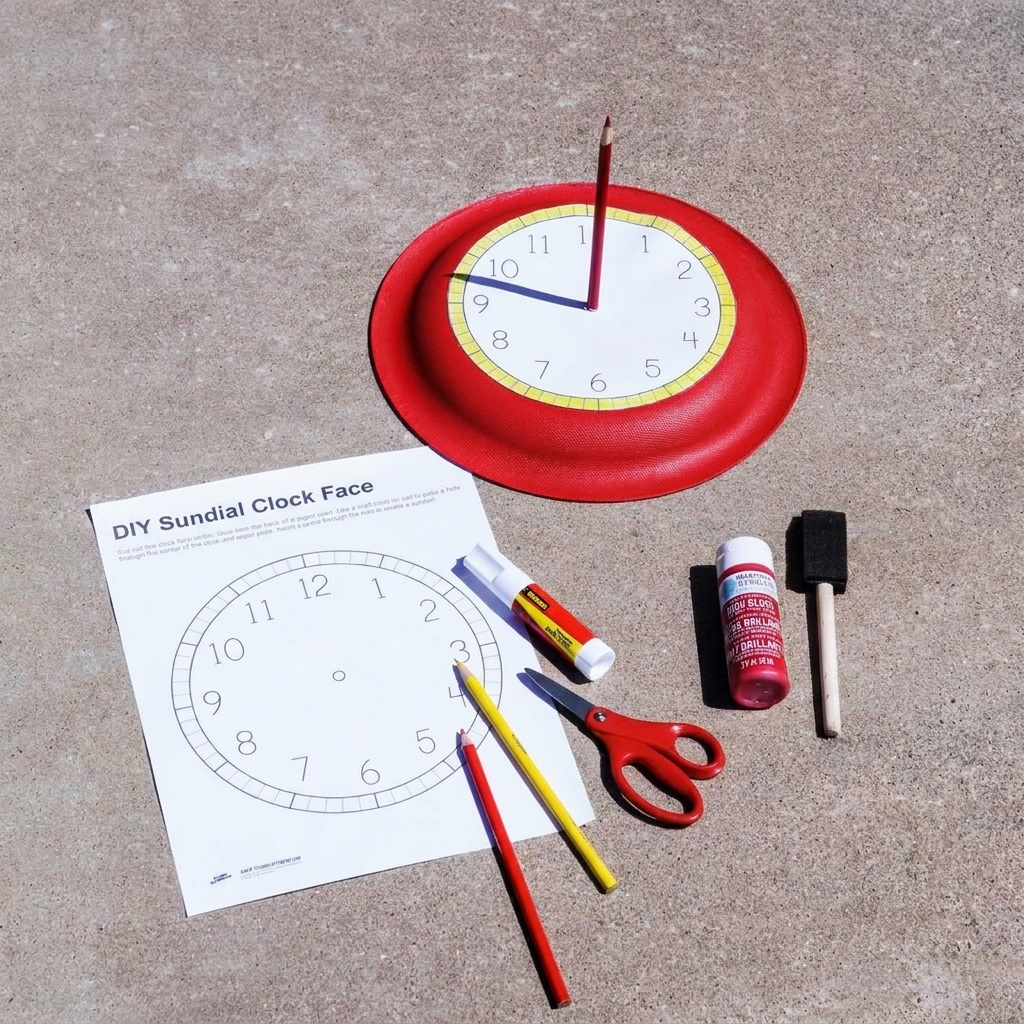
Long before clocks, watches, and smartphones existed, people relied on the Sun to measure the passing of time. One of the oldest and most fascinating ways to do this was by using a simple sundial. Making a homemade sundial is an engaging science and history project that helps children understand how the Earth’s rotation affects shadows and how ancient civilizations tracked time using only sunlight.
This easy STEM activity combines astronomy, geography, mathematics, and observation. It encourages children to explore the outdoors, develop scientific thinking, and appreciate one of humanity’s earliest inventions. Whether you’re a parent, teacher, or homeschool educator, learning how to make a simple sundial is a rewarding project that blends education with hands-on creativity.
Quick Overview Table
| Feature | Details |
| Activity | Make a Simple Sundial |
| Activity Type | Outdoor Science & STEM Project |
| Age Group | 6–14 years |
| Difficulty | Easy |
| Time Required | 30–60 minutes (plus observation time) |
| Main Materials | Paper plate, pencil, ruler, marker, compass |
| Science Topic | Earth’s Rotation, Shadows, Sunlight |
| Indoor/Outdoor | Outdoor |
| Adult Supervision | Recommended |
| Skills Developed | Observation, Timekeeping, Critical Thinking |
What Is a Sundial?
A sundial is one of the earliest devices invented to tell time. It works by using the position of the Sun to cast a shadow from a pointer, called the gnomon, onto a marked surface. As the Sun appears to move across the sky during the day, the shadow changes position, indicating different hours.
Although modern clocks are far more accurate, sundials remain valuable educational tools because they demonstrate how the movement of the Earth creates the changing position of the Sun and its shadows.
Building a simple sundial allows children to experience this ancient method of timekeeping firsthand.
The History of Sundials
Sundials have been used for thousands of years by civilizations around the world.
Ancient Egyptians used simple shadow clocks as early as 1500 BCE. Later, the Greeks and Romans improved sundial designs, making them more accurate and portable. Similar devices were also developed in China, India, and the Middle East.
Before mechanical clocks became common, sundials were one of the most reliable ways to estimate the time during daylight hours.
Today, many parks, gardens, museums, and schools still display decorative sundials as reminders of this remarkable invention.
Why Make a Homemade Sundial?
Creating a homemade sundial offers many educational benefits.
Children learn:
- How shadows change throughout the day.
- Why the Sun appears to move across the sky.
- The relationship between Earth’s rotation and time.
- Basic astronomy concepts.
- Observation and recording skills.
- Patience through long-term investigation.
Unlike many science activities that last only a few minutes, a sundial encourages children to return throughout the day to observe changing shadows.
Materials You’ll Need
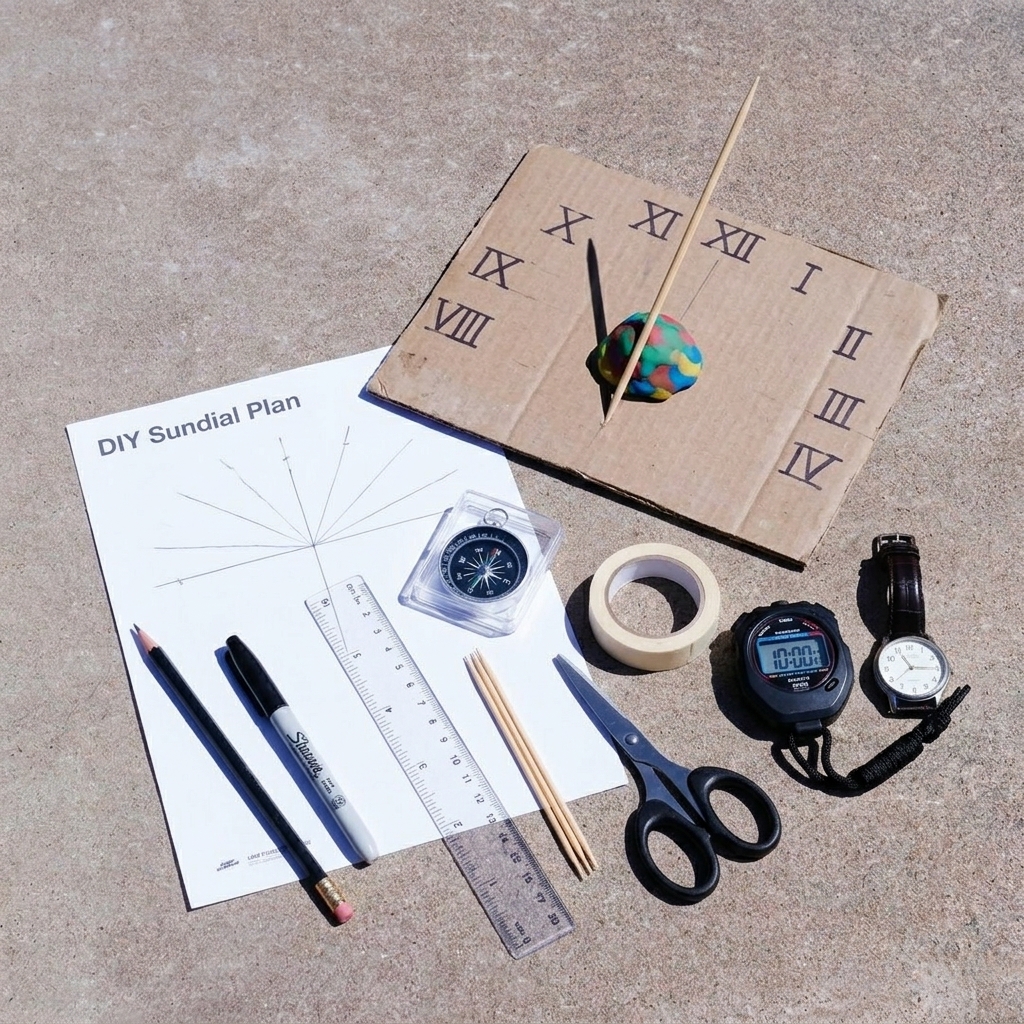
Most supplies are inexpensive and easy to find.
Basic Materials
- Paper plate or sturdy cardboard
- Pencil
- Marker
- Ruler
- Compass (for finding north)
- Small stick or wooden skewer
- Modeling clay or tape
- Stopwatch or clock (for marking the hours)
Optional Materials
- Colored pencils
- Stickers
- Paint
- Laminating sheet
- Notebook
- Camera
Decorating the sundial makes the activity even more enjoyable.
Step-by-Step Instructions
Step 1: Prepare the Base
Use a paper plate or cut a large circle from cardboard.
Write the number 12 near the top edge.
Leave plenty of space for the remaining hour numbers.
Step 2: Create the Gnomon
The gnomon is the part that casts the shadow.
Push a pencil, wooden skewer, or stick through the center of the plate.
Secure it with clay or tape so it stands upright.
Step 3: Find True North
Place the sundial outside in a sunny location.
Use a compass to align the sundial toward true north (or true south if you live in the Southern Hemisphere).
Proper alignment improves accuracy.
Step 4: Mark the Hours
Beginning at noon, observe where the shadow falls.
Mark the shadow’s position and write the current hour.
Return every hour to repeat the process.
By the end of the day, your sundial will have its own hour markings.
Step 5: Test Your Sundial
On another sunny day, place the sundial in the same location and orientation.
Observe whether the shadow points close to the correct hour.
Small differences are normal because homemade sundials are approximate rather than perfectly precise.
The Science Behind a Sundial
A sundial works because the Earth rotates once every 24 hours.
As Earth spins, the Sun appears to move across the sky from east to west.
The changing position of the Sun causes shadows to move throughout the day.
The gnomon blocks sunlight, creating a shadow.
As the Sun’s apparent position changes, the shadow points to different hour markings.
This simple principle has been used for thousands of years to estimate time.
Understanding Earth’s Rotation
Many children believe the Sun moves around Earth.
In reality, Earth rotates on its axis.
One complete rotation takes about 24 hours.
This rotation creates:
- Day and night
- Sunrise
- Sunset
- Moving shadows
A sundial provides a visual demonstration of Earth’s continuous rotation.
Why Shadows Change Length
Children often notice that shadows are not only moving—they also change size.
This happens because the Sun’s angle changes throughout the day.
Morning
The Sun is low.
Shadows are long.
Midday
The Sun is highest.
Shadows become shortest.
Evening
The Sun lowers again.
Shadows become long once more.
Observing these changes teaches children how the angle of sunlight affects shadow length.
Educational Benefits
Making a sundial supports learning in many subjects.
Science
Children learn about:
- Astronomy
- Sunlight
- Shadows
- Earth’s rotation
- Observation
Mathematics
Students practice:
- Measuring
- Estimating
- Recording time
- Reading clocks
- Geometry
Geography
Children learn:
- Cardinal directions
- North and south
- Latitude
- Position of the Sun
History
Students discover how ancient civilizations measured time before modern technology.
Critical Thinking
Children ask questions such as:
- Why did the shadow move?
- Why isn’t it exactly like my watch?
- Why are shadows different in winter?
These questions promote scientific curiosity.
Fun Ways to Decorate Your Sundial
Children enjoy personalizing their projects.
Ideas include:
- Rainbow colors
- Planet drawings
- Animal decorations
- Space themes
- Flower patterns
- Ancient Egyptian symbols
Creative decoration encourages artistic expression while maintaining scientific value.
Experiments to Try
After building the sundial, children can perform additional investigations.
Compare Morning and Afternoon Shadows
Measure the shadow every hour.
Graph the results.
Seasonal Changes
Use the sundial during different seasons.
Compare how the shadow changes.
Different Locations
Place the sundial in different areas of the yard.
Observe whether nearby buildings or trees affect accuracy.
Shadow Length Investigation
Measure the shadow using a ruler throughout the day.
Record each measurement.
Questions Children Can Explore
Encourage inquiry with questions like:
- Why does the shadow move?
- When is the shadow shortest?
- Why can’t a sundial work at night?
- What happens on cloudy days?
- Why are shadows different during winter and summer?
- Can two sundials show different times?
Recording answers strengthens scientific reasoning.
Real-Life Uses of Sundials
Although modern clocks have replaced sundials for daily timekeeping, they are still found in many places.
Examples include:
- Botanical gardens
- Museums
- Historic buildings
- Public parks
- University campuses
- Science centers
Many decorative sundials are also installed in private gardens.
Common Mistakes
Sometimes homemade sundials do not work as expected.
Here are common problems.
Incorrect Direction
If the sundial is not aligned correctly, the shadow will point to the wrong hour.
Crooked Gnomon
The stick should remain straight and secure.
Too Much Shade
Trees or buildings can block sunlight.
Choose an open area.
Moving the Sundial
The sundial should remain in the same location after the hour markings are created.
Safety Tips
Since this is an outdoor activity, remember to:
- Wear sunscreen.
- Drink water.
- Avoid looking directly at the Sun.
- Use scissors carefully.
- Supervise younger children.
- Stay in a safe outdoor area.
Sun safety is an important part of any outdoor science activity.
Extending the Learning
A sundial can inspire many related projects.
Children can:
- Build a larger garden sundial.
- Research ancient civilizations.
- Learn about time zones.
- Study seasons.
- Observe sunrise and sunset.
- Create a weather journal.
These projects help connect science with history and geography.
Why Teachers Love Sundial Activities
Teachers appreciate homemade sundials because they are:
- Affordable.
- Easy to build.
- Highly visual.
- Connected to multiple subjects.
- Suitable for STEM education.
- Excellent for outdoor learning.
Students enjoy returning throughout the day to observe the changing shadow.
Frequently Asked Questions
Can a sundial work indoors?
Not usually. It requires direct sunlight to cast a clear shadow.
Why doesn’t my sundial match my clock exactly?
Modern clocks use standardized time zones, while a sundial follows the Sun’s apparent position. Factors such as your location within a time zone, daylight saving time (where applicable), and the seasonal variation known as the “equation of time” can cause differences.
Can a sundial work on cloudy days?
Heavy cloud cover blocks the Sun, making the shadow dfficult or impossible to see.
Why is the shadow shortest at noon?
Around solar noon, the Sun reaches its highest point in the sky, so the light shines more directly downward, creating the shortest shadow of the day.
Can children build a permanent sundial?
Yes. Using wood, stone, or weather-resistant materials, families can create a durable garden sundial for long-term observation.
Conclusion
Learning how to make a simple sundial is a wonderful way to introduce children to the science of sunlight, shadows, and Earth’s rotation. Using everyday materials such as a paper plate, a pencil, and a compass, young learners can recreate one of humanity’s oldest methods of telling time while exploring important concepts in astronomy, geography, mathematics, and history.
Beyond teaching scientific principles, a homemade sundial encourages patience, careful observation, and curiosity. As children watch the shadow move throughout the day, they gain a deeper understanding of how our planet rotates and why the Sun appears to travel across the sky.
Whether used at home, in a classroom, or as part of a homeschool STEM curriculum, this hands-on project transforms an ancient invention into an engaging educational experience. It reminds us that sometimes the simplest tools can teach the biggest lessons about the natural world.
