
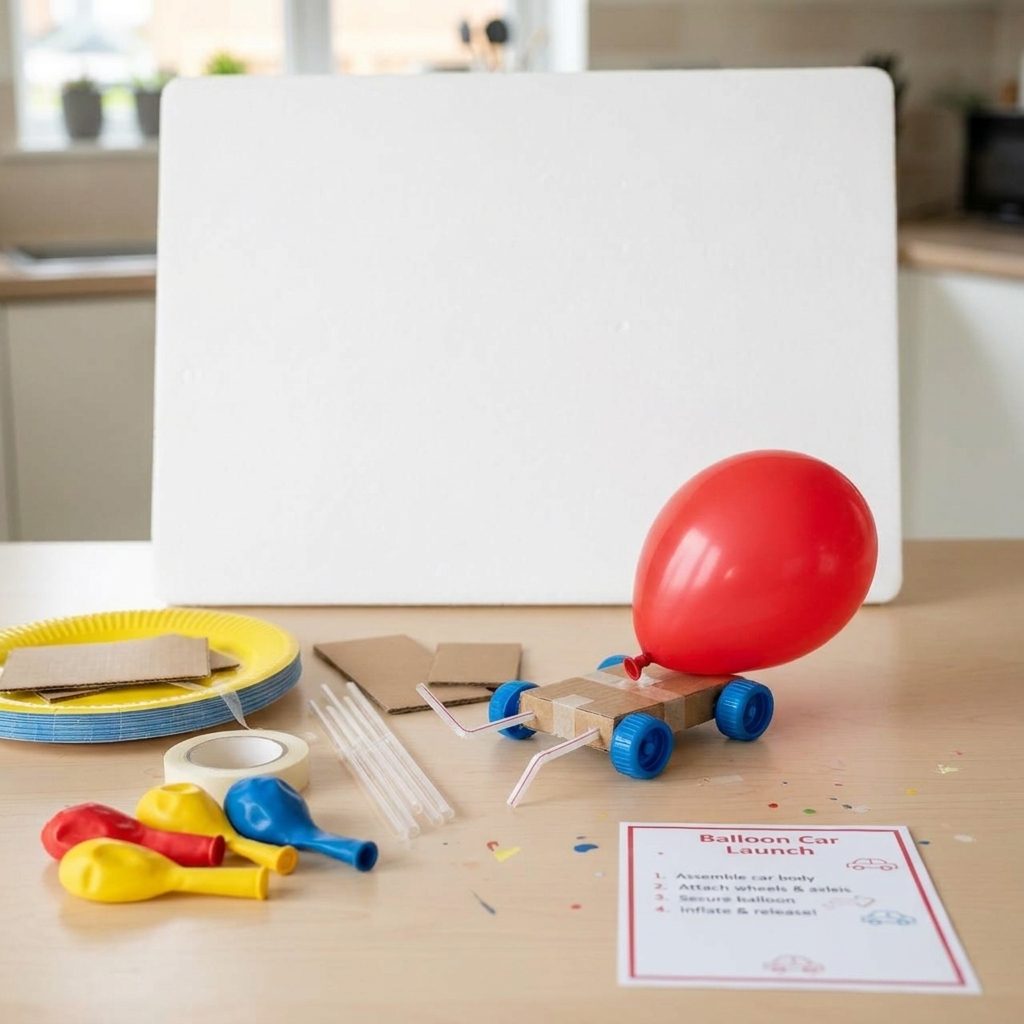
Making a car powered by balloons is one of the most exciting and simple STEM activities for kids, students, and curious minds of all ages. With just a few recycled materials, a balloon, and a little creativity, you can build a moving vehicle that races across the floor powered only by air. Watching a homemade car zoom forward creates instant excitement while secretly teaching important science and engineering concepts.
This fun experiment combines education and entertainment perfectly. Whether you are planning a science fair project, a classroom activity, or a weekend DIY challenge at home, a DIY balloon car delivers hands-on learning in a memorable way. It encourages creativity, problem-solving, and critical thinking while keeping kids away from screens for a while.
So, what exactly is a balloon-powered car? A balloon-powered car is a small vehicle that moves when air escapes from an inflated balloon. The escaping air creates thrust that pushes the car forward, demonstrating Newton’s Third Law of Motion: for every action, there is an equal and opposite reaction.
From simple cardboard models to advanced aerodynamic racers, making a car powered by balloons can become an endless adventure in science and design.
The Science of Zoom: How Balloon Cars Work
Understanding the science behind making a car powered by balloons makes the project even more exciting. This activity introduces several physics concepts in a simple and visual way.
Newton’s Third Law of Motion
The main scientific principle behind a DIY balloon car is Newton’s Third Law of Motion.
F=maF=maF=ma
When air rushes backward out of the balloon, the car moves forward. The backward-moving air is the action, while the forward motion of the car is the reaction.
Imagine a rocket launching into space. A balloon car works in a similar way, only on a much smaller scale.
Energy Conversion
When you inflate the balloon, you store potential energy inside the stretched rubber and compressed air. Once released, that energy transforms into kinetic energy, which makes the car move.
The more air stored inside the balloon, the greater the energy available for movement.
Important Physics Concepts
Thrust
Thrust is the pushing force created by the escaping air. Stronger thrust usually means faster movement.
Friction
Friction occurs when the wheels rub against the surface or axle. Too much friction slows the car down.
Aerodynamics
A smooth, lightweight shape reduces air resistance and helps the car travel farther.
Mass
Heavier cars require more force to move. Lightweight designs often perform better.
Momentum
Once moving, the car gains momentum, helping it continue rolling even as the balloon loses air pressure.
The Weight Factor
Newton’s Second Law explains why lighter cars accelerate faster.
F=maF=maF=ma
If you add extra weight such as coins or heavy decorations, the same amount of force must move more mass, reducing acceleration.
Tools of the Trade: Gathering Your Materials
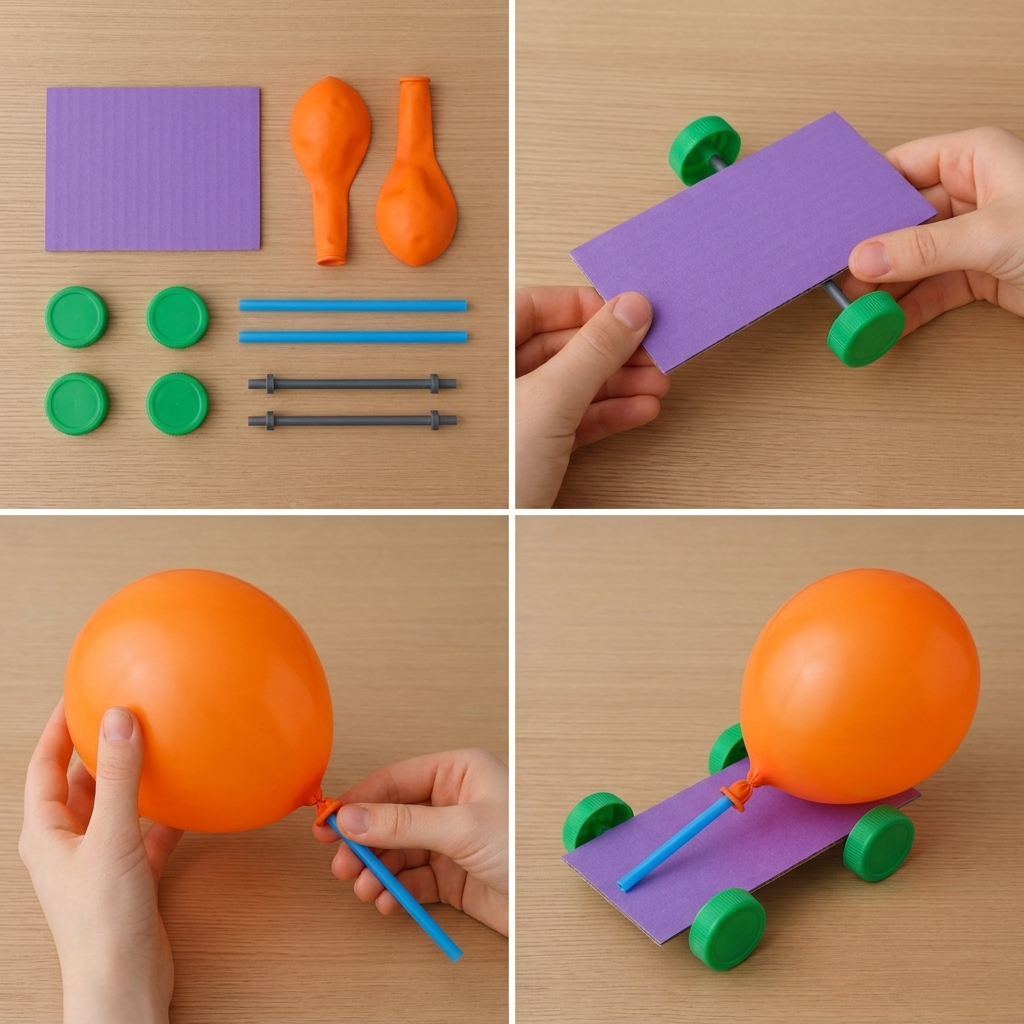
One of the best things about making a car powered by balloons is that you can use inexpensive or recycled materials.
The Chassis
The chassis is the body of your car. Common choices include:
- Plastic water bottles
- Juice boxes
- Corrugated cardboard
- Foam board
- Recycled containers
Plastic bottles are especially popular because they are lightweight and aerodynamic.
The Engine
Your engine consists of:
- Balloons
- Drinking straws
- Tape or rubber bands
Round balloons typically provide more consistent airflow than long skinny balloons.
Boba straws are also popular because their larger diameter allows more airflow for extra thrust.
The Axle System
The axle system allows the wheels to spin smoothly.
Good axle materials include:
- Wooden skewers
- BBQ sticks
- Pencils
Many builders slide the axles through drinking straws to reduce friction.
The Wheels
Wheel options include:
- Bottle caps
- Old CDs
- Cardboard circles
- Plastic lids
Lightweight wheels with balanced centers usually perform best.
Step-by-Step Construction: The Best Water Bottle Method
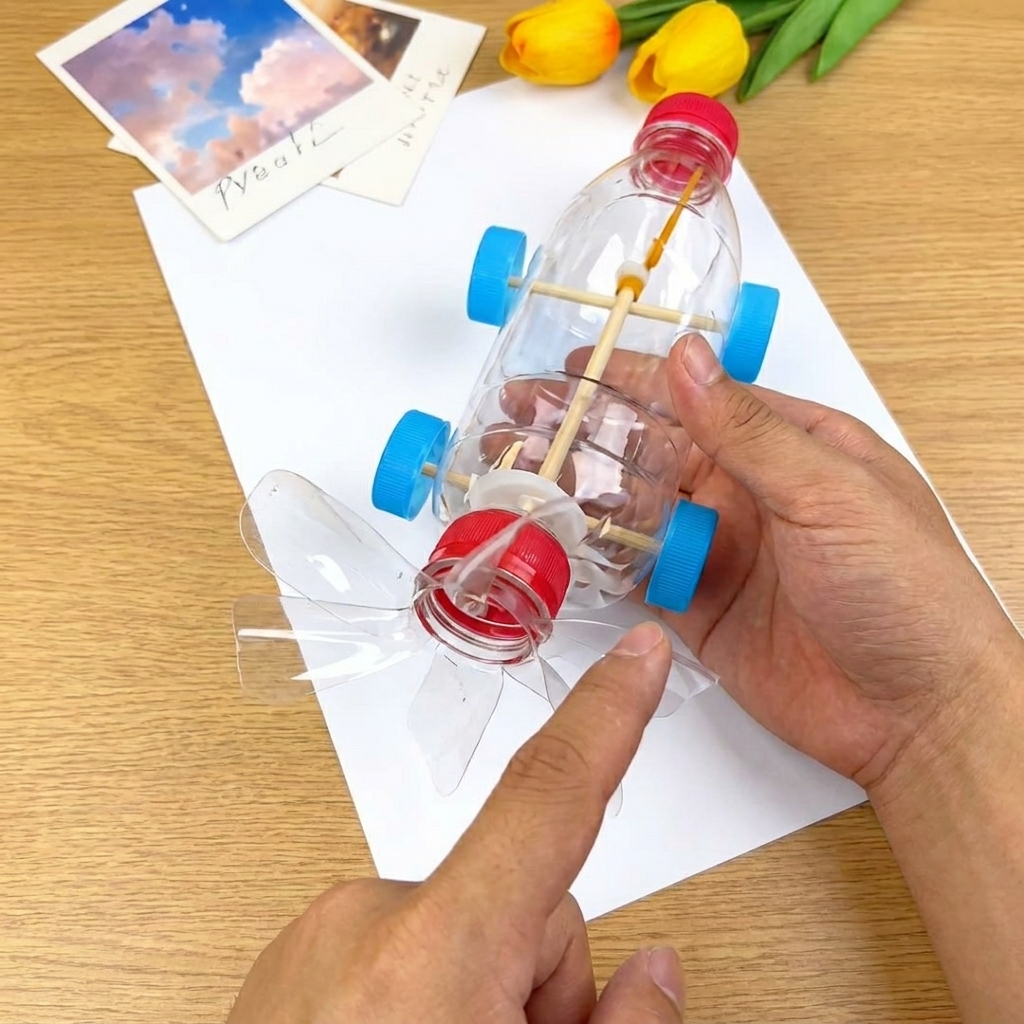
The water bottle design is often considered the best recycled balloon car project because it combines lightweight construction with excellent aerodynamics.
Step 1: Prepare the Body
Take an empty plastic bottle and remove the label. Clean and dry it thoroughly.
The bottle will serve as the main frame of your balloon-powered car.
Step 2: Create the Axle Mounts
Tape two straws underneath the bottle parallel to each other.
Make sure the straws are perfectly aligned. Crooked axle mounts will cause the car to veer sideways.
Insert wooden skewers through the straws.
Step 3: Attach the Wheels
Poke holes in four bottle caps.
Attach one cap to each end of the skewers.
Ensure the wheels spin freely without wobbling.
Leave a small gap between the wheel and the body to reduce friction.
Step 4: Build the Balloon Engine
Insert a straw into the balloon opening and secure it tightly using tape or rubber bands.
Make the connection airtight so air does not escape prematurely.
Tape the straw securely to the top of the bottle.
Inflate the balloon through the straw, hold the air inside, place the car on the floor, and release.
Watch your DIY balloon car race forward.
Troubleshooting: When the Wheels Don’t Turn
Even the best balloon cars sometimes face problems. Fortunately, most issues are easy to fix.
Problem: Air Leaks
If the balloon loses air before launch, check the balloon-to-straw connection.
Use extra tape or tighter rubber bands to seal leaks.
Problem: Too Much Friction
If the wheels struggle to spin:
- Check if the wheels rub against the body
- Ensure the axles spin smoothly
- Use straighter skewers
Reducing friction dramatically improves performance.
Problem: Car Veers Left or Right
Crooked axles are usually the cause.
Double-check that:
- Both axles are parallel
- Wheels are centered
- The chassis is balanced
Problem: Car Does Not Move
Possible causes include:
- Balloon under-inflated
- Car too heavy
- Wheels stuck
- Weak airflow
Try using a larger balloon or lighter materials.
Optimization: 50+ Ideas to Level Up Your Balloon Car
Once you master the basics of making a car powered by balloons, you can experiment with advanced upgrades.
Distance Hacks
Use Larger Straws
Wider straws allow faster airflow and can improve travel distance.
Reduce Weight
Use lightweight cardboard or thin plastic materials.
Improve Wheel Alignment
Straight wheels reduce wasted energy.
Speed Hacks
Create a Streamlined Shape
Aerodynamic designs cut through the air more efficiently.
Rocket-shaped designs are especially popular for speed competitions.
Use Smooth Wheels
Balanced wheels reduce vibration and rolling resistance.
Test Different Balloon Sizes
Large balloons often produce stronger thrust.
Creative Balloon Car Variations
Here are some exciting recycled balloon car project ideas:
Rocket Balloon Car
Shape the body like a rocket for a futuristic look.
Eco-Friendly Balloon Car
Use recycled CDs and bottle caps for sustainable building.
Double Balloon Power
Attach two balloons for extra thrust.
Monster Truck Balloon Car
Use oversized wheels for rough terrain.
Race Car Edition
Add spoilers, racing stripes, and aerodynamic curves.
All-Terrain Balloon Car
Experiment with rubber wheels for outdoor surfaces.
Mini Balloon Dragster
Build a long, narrow design optimized for speed.
These creative designs make STEM learning more engaging and encourage experimentation.
The Engineering Design Process (EDP)
Making a car powered by balloons is more than just a craft project. It teaches real engineering skills.
Ask
What kind of car do you want to build? Fastest? Longest distance? Most creative?
Imagine
Brainstorm ideas and sketch possible designs.
Plan
Choose materials and map out construction steps.
Create
Build your first prototype.
Test
Launch the car and observe what happens.
Improve
Make adjustments and test again.
This process mirrors how real engineers design vehicles, machines, and even spacecraft.
Most importantly, mistakes are valuable learning opportunities. Every failed attempt provides information that helps improve the next version.
Quick Overview Table
| Feature | Best Option |
| Chassis | Plastic water bottle |
| Wheels | Bottle caps |
| Axles | Wooden skewers |
| Engine | Round balloon |
| Best Goal | Lightweight design |
| Main Physics Concept | Newton’s Third Law |
| Common Problem | Friction |
| Best Improvement | Better wheel alignment |
Conclusion
Making a car powered by balloons is one of the best hands-on STEM projects for children, students, and families. It combines creativity, science, engineering, and fun into one exciting activity. With simple household materials, you can build a DIY balloon car that demonstrates real physics principles while encouraging problem-solving and innovation.
Whether you are creating a recycled balloon car project for a science fair or simply enjoying a weekend experiment at home, the possibilities are endless. Every design teaches valuable lessons about motion, thrust, aerodynamics, and engineering design.
The best part is that no two balloon cars are exactly alike. Each test run offers a new chance to improve speed, distance, and creativity.
So grab a balloon, gather some recycled materials, and start building your own balloon-powered racing machine today.
