
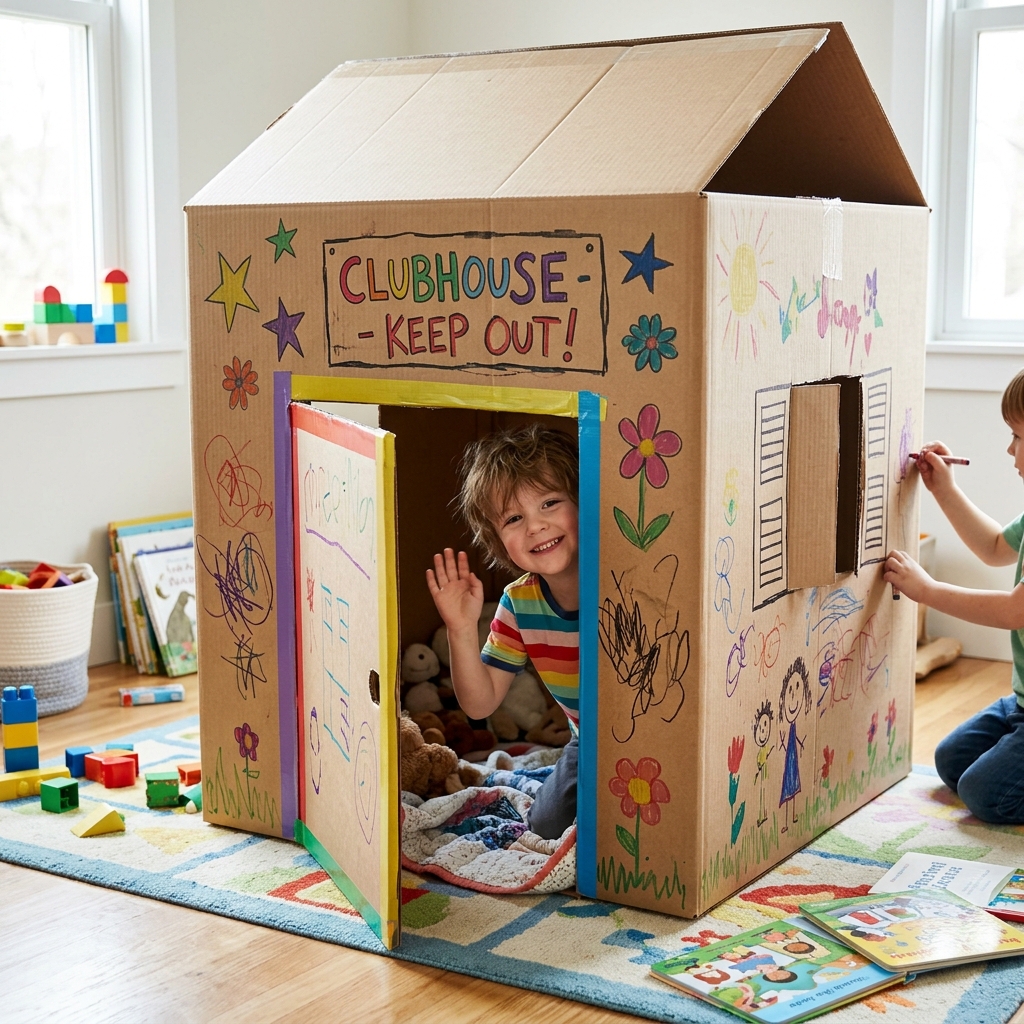
Children have an incredible ability to transform ordinary objects into magical worlds through the power of imagination. A large cardboard box that adults might consider packaging waste can become a castle, a spaceship, a bakery, a fire station, or a cozy little home in the eyes of a child. One of the most exciting and educational craft projects for children is building a cardboard playhouse from a single large box. This hands-on activity combines creativity, engineering, art, mathematics, storytelling, and environmental awareness in one unforgettable learning experience.
Unlike many toys that come ready to use, a cardboard playhouse allows children to become designers, architects, builders, decorators, and storytellers all at once. They plan the layout, cut windows and doors, decorate the walls, and furnish the interior according to their own ideas. Once construction is complete, the playhouse becomes an imaginative space where adventures begin and memories are created.
Teachers, parents, and caregivers appreciate this project because it encourages active learning while requiring only inexpensive or recycled materials. Children learn valuable academic and practical skills while having fun, and they also discover the importance of recycling by giving new life to something that would otherwise be thrown away.
Most importantly, every cardboard playhouse is unique. Some become colorful cottages, while others become pirate hideouts, fairy castles, jungle huts, space stations, or tiny neighborhood shops. Every finished project reflects the creativity and personality of its young builder.
Why Children Love This Project
Children naturally enjoy building spaces they can call their own. A cardboard playhouse gives them the opportunity to create a private world where imagination has no limits.
They especially enjoy:
- Designing their own house
- Decorating every part of the structure
- Crawling inside after it is finished
- Playing pretend games
- Inviting friends to join
- Creating endless stories
Unlike many crafts that are displayed and forgotten, a cardboard playhouse continues to provide entertainment for weeks or even months.
Educational Goals
This simple project supports learning across many different subjects.
Children develop:
- Creativity
- Fine motor skills
- Gross motor skills
- Spatial awareness
- Problem-solving
- Planning skills
- Communication
- Teamwork
- Artistic expression
- Mathematical thinking
- Engineering awareness
- Environmental responsibility
Learning becomes meaningful because children immediately see the results of their work.
Materials Needed
Most materials are inexpensive and easy to find.
Basic materials include:
- One large cardboard box
- Additional cardboard scraps
- Child-safe scissors
- Craft knife (adult use only)
- Glue
- Masking tape
- Ruler
- Pencil
- Markers
- Paint
- Paintbrushes
- Colored paper
- Construction paper
Optional decorations include:
- Fabric scraps
- Stickers
- Ribbon
- Washi tape
- Yarn
- Foam sheets
- Artificial flowers
- Cotton balls
- Buttons
- Paper shapes
Using recycled materials helps children understand sustainable living.
Planning the Playhous
Every successful project begins with a plan.
Children first decide:
- What kind of house they want
- Where doors should be
- How many windows they need
- Whether they want a chimney
- What decorations they will include
Drawing a simple sketch teaches planning and organization.
Preparing the Box
The large cardboard box becomes the main structure.
Adults carefully cut the major openings while children help measure and mark the locations.
The box should be clean, dry, and sturdy.
Children quickly discover that careful preparation makes construction much easier.
Cutting Doors and Windows
Adding doors and windows immediately transforms the box into a real house.
Children help design:
- Front doors
- Side windows
- Roof windows
- Flower boxes
- Mail slots
- Decorative shutters
Opening doors and windows makes the playhouse interactive.
Building the Roof
Different roof styles create different types of houses.
Popular designs include:
- Gable roof
- Flat roof
- Cottage roof
- Castle towers
- Curved roof
Children learn simple engineering ideas while experimenting with stability and balance.
Decorating the Exterior
Painting and decorating is often the favorite part.
Children create:
- Brick houses
- Wooden cabins
- Fairy cottages
- Beach houses
- Treehouses
- Fire stations
- Castles
- Space stations
Bright colors encourage artistic expression.
Decorating the Interior
The inside becomes just as exciting as the outside.
Children add:
- Curtains
- Rugs
- Pictures
- Shelves
- Paper furniture
- Windowsills
- Clocks
- Plants
Every decoration makes the playhouse feel more realistic.
Creating Cardboard Furniture
Small furniture pieces make pretend play even more enjoyable.
Children build:
- Tables
- Chairs
- Beds
- Sofas
- Bookshelves
- Kitchens
- Desks
- Toy storage
Simple cardboard scraps become beautiful miniature furniture.
Mathematics in Construction
The project naturally introduces mathematics.
Children practice:
- Measuring lengths
- Comparing sizes
- Counting materials
- Identifying shapes
- Estimating distances
- Recognizing symmetry
These real-world applications make mathematics easier to understand.
Discovering Engineering
Building a playhouse teaches basic engineering concepts.
Children learn about:
- Strong structures
- Weight distribution
- Stable foundations
- Balanced construction
- Reinforcement
They quickly understand why some designs are stronger than others.
Improving Fine Motor Skills
Many construction activities strengthen hand coordination.
Children practice:
- Drawing
- Painting
- Cutting
- Folding
- Gluing
- Decorating
These skills support handwriting and everyday tasks.
Encouraging Imagination
Every child imagines something different.
One child creates a bakery.
Another designs a veterinarian’s clinic.
Someone builds a pirate ship.
Another creates a magical fairy house.
Creative freedom allows every child to express individuality.
Storytelling and Role Play
The completed playhouse becomes the setting for countless adventures.
Children pretend to be:
- Families
- Shopkeepers
- Doctors
- Firefighters
- Astronauts
- Explorers
- Teachers
- Bakers
Role-playing strengthens communication and social development.
Language Development
The playhouse supports literacy activities.
Children can:
- Write signs
- Create invitations
- Tell stories
- Read aloud
- Describe rooms
- Practice conversations
Language becomes meaningful through play.
Science Connections
Teachers can connect the project with science topics such as:
- Building materials
- Recycling
- Weather
- Homes around the world
- Animal shelters
- Energy conservation
Children discover that science exists in everyday life.
Environmental Awareness
One of the strongest lessons involves sustainability.
Children learn to:
- Reuse materials
- Reduce waste
- Recycle responsibly
- Protect natural resources
- Appreciate creative recycling
They begin viewing cardboard as a valuable resource rather than trash.
Working Together
Large projects encourage teamwork.
Children divide responsibilities.
Some measure.
Others paint.
Some decorate.
Others build furniture.
Cooperation teaches respect, responsibility, and leadership.
Seasonal Decorations
The playhouse can change throughout the year.
Spring:
- Flowers
- Butterflies
- Birds
Summer:
- Beach decorations
- Garden furniture
- Sunshine artwork
Autumn:
- Pumpkins
- Colorful leaves
- Harvest displays
Winter:
- Snowflakes
- Holiday lights
- Paper fireplaces
Seasonal decorations keep the project exciting.
Home Extension Activities
Families can continue expanding the project.
Ideas include:
- Adding a garden
- Building a mailbox
- Making cardboard pets
- Creating furniture
- Designing playground equipment
- Building sidewalks
The playhouse grows along with children’s imagination.
Safety Guidelines
Simple safety rules are important.
Children should:
- Use scissors carefully.
- Ask adults to use craft knives.
- Keep workspaces organized.
- Clean up materials after working.
- Wash hands after painting.
Safety creates a positive learning environment.
Learning from Challenges
Every construction project includes small obstacles.
Perhaps:
- A wall bends.
- The roof collapses.
- Glue dries slowly.
- Decorations fall off.
Instead of becoming discouraged, children learn persistence and creative problem-solving.
Every mistake becomes an opportunity to improve.
Presenting the Finished Playhouses
Children proudly introduce their completed houses.
They explain:
- The house design
- Favorite features
- Decoration ideas
- Construction challenges
- Creative solutions
Presentations strengthen confidence and speaking skills.
Skills Developed
By completing this project, children strengthen many lifelong abilities.
These include:
- Creativity
- Planning
- Communication
- Engineering awareness
- Artistic design
- Collaboration
- Environmental responsibility
- Patience
- Self-confidence
- Critical thinking
These skills benefit future learning in every subject.
Tips for Teachers
Teachers can help children succeed by:
- Preparing materials ahead of time.
- Demonstrating each step clearly.
- Encouraging original ideas.
- Allowing enough decorating time.
- Celebrating effort rather than perfection.
- Displaying completed playhouses.
- Organizing a classroom playhouse exhibition.
Positive encouragement helps every child enjoy success.
Long-Term Benefits
Unlike many temporary crafts, a cardboard playhouse remains useful long after construction.
Children continue using it for:
- Imaginative play
- Reading corners
- Storytelling
- Drama activities
- Quiet spaces
- Family games
The playhouse becomes a treasured part of everyday learning.
Conclusion
Building a cardboard playhouse from a single box is one of the most enjoyable and meaningful projects children can experience. It combines creativity, engineering, mathematics, language, science, environmental education, and artistic expression into a single hands-on activity that children genuinely love. By transforming one ordinary cardboard box into a wonderful place for play and imagination, children discover that creativity is far more valuable than expensive materials.
Throughout the project, they strengthen fine motor skills, improve problem-solving abilities, practice planning and measurement, and gain confidence by expressing their own ideas. They also learn valuable lessons about sustainability by giving discarded cardboard a completely new purpose.
Most importantly, the finished playhouse becomes much more than a craft. It becomes a magical world where children create stories, build friendships, solve imaginary problems, and explore endless adventures. Whether built in a classroom, at home, in a library, or during a community workshop, a cardboard playhouse inspires curiosity, cooperation, creativity, and joyful learning. With only one simple cardboard box, a few craft supplies, and an active imagination, children can build a place filled with unforgettable memories, meaningful learning, and countless hours of imaginative fun.
