
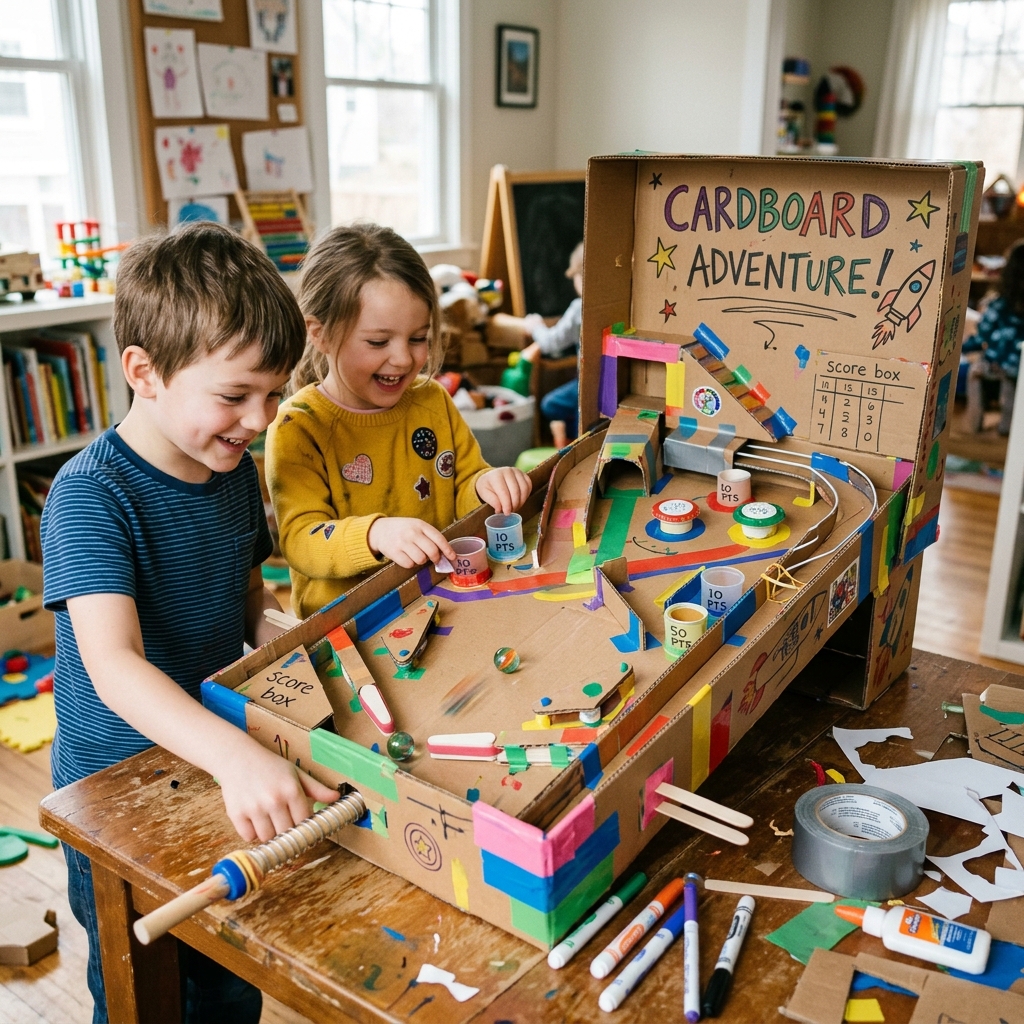
Children love games, especially when they have the opportunity to build the games themselves. One of the most exciting hands-on projects for children is creating a cardboard pinball machine using recycled materials. This engaging activity combines creativity, engineering, physics, mathematics, art, and problem-solving into a single project that is both educational and entertaining. Instead of simply playing a finished game, children become inventors, designers, and engineers as they create a fully functional pinball machine from ordinary cardboard.
A cardboard pinball machine introduces children to important scientific concepts in a playful and memorable way. As they design ramps, obstacles, bumpers, and launch mechanisms, they naturally explore gravity, force, motion, friction, and energy. They also develop valuable practical skills such as measuring, cutting, assembling, testing, and improving their designs.
Teachers, parents, and youth leaders appreciate this project because it encourages critical thinking, teamwork, and creativity while using inexpensive recycled materials. Children discover that exciting inventions do not require expensive equipment. With imagination, patience, and a few simple supplies, they can transform an ordinary cardboard box into a fascinating game that provides hours of enjoyment.
Even after the project is complete, the pinball machine continues to offer educational value. Children can improve their designs, create new game rules, organize friendly competitions, and continue experimenting with different layouts and obstacles. Every modification teaches something new and inspires further creativity.
Why Children Love This Project
Children enjoy projects that become playable games after construction.
A cardboard pinball machine offers the excitement of both building and playing.
Children especially enjoy:
- Designing their own game
- Creating original obstacles
- Decorating the playfield
- Testing different layouts
- Competing with friends
- Improving their machine
Every successful ball launch brings excitement and encourages children to continue experimenting.
Educational Goals
Although the activity feels like play, it develops many important skills.
Children improve:
- Creativity
- Problem-solving
- Engineering awareness
- Scientific thinking
- Fine motor skills
- Mathematical understanding
- Planning
- Teamwork
- Communication
- Patience
- Concentration
- Environmental responsibility
Project-based learning makes these skills meaningful through hands-on experience.
Materials Needed
Most materials are inexpensive or recycled.
Basic supplies include:
- Corrugated cardboard
- Large cardboard boxes
- Craft glue
- Masking tape
- Child-safe scissors
- Craft knife (adult use only)
- Wooden craft sticks
- Drinking straws
- Rubber bands
- Marbles
- Bottle caps
- Paper cups
- Ruler
- Pencil
- Markers
- Paint
Optional decorations include:
- Stickers
- Colored paper
- Foam sheets
- Washi tape
- Small bells
- Decorative gems
- Paper stars
- LED lights (optional)
Recycled materials help children understand sustainable creativity.
Understanding How Pinball Works
Before construction begins, children learn the basic idea behind a pinball machine.
A marble is launched onto a sloped playing surface.
As it rolls downward, it strikes bumpers, walls, tunnels, and targets.
The player scores points depending on which objects the marble touches.
Eventually, the marble returns to the bottom, ready for another turn.
This simple explanation introduces children to engineering and physics.
Planning the Game
Every successful project starts with a plan.
Children think about:
- Where the marble should begin
- Where obstacles should be placed
- How points will be scored
- Where the game should end
- Which paths the marble might follow
Sketching ideas on paper encourages organization and careful planning.
Building the Base
The playing surface begins with a strong piece of cardboard.
Cardboard strips underneath create a gentle slope.
Children quickly discover that the angle affects how the marble moves.
If the slope is too steep, the marble moves too quickly.
If it is too flat, the marble may stop rolling.
These observations introduce simple engineering principles.
Adding Side Walls
Cardboard walls prevent the marble from rolling off the board.
Children carefully measure and attach the borders.
They learn the importance of precision while building stable structures.
Creating the Launcher
The launcher is one of the most exciting parts of the machine.
Using cardboard, rubber bands, and craft sticks, children build a simple launching mechanism.
Pulling the launcher stores energy.
Releasing it sends the marble forward.
This demonstrates elastic potential energy in a fun and practical way.
Designing Obstacles
Obstacle design is where creativity truly shines.
Children create:
- Bumpers
- Tunnels
- Bridges
- Ramps
- Curved paths
- Bottle-cap targets
- Paper cup goals
- Moving gates
- Spiral tracks
- Mini mazes
Every obstacle changes the marble’s movement.
Children quickly begin experimenting with different arrangements.
Creating Scoring Areas
The game becomes more exciting with scoring zones.
Children design targets worth:
- 10 points
- 20 points
- 50 points
- 100 points
- Bonus points
They invent their own rules, making every machine unique.
Decorating the Playfield
Now the machine becomes a work of art.
Popular themes include:
- Space adventure
- Dinosaur world
- Pirate island
- Jungle expedition
- Ocean exploration
- Race track
- Medieval castle
- Superheroes
- Fantasy kingdom
- Carnival
Colorful designs make every game visually exciting.
Discovering Physics
The project naturally introduces important scientific concepts.
Children observe:
- Gravity
- Motion
- Speed
- Friction
- Collisions
- Direction changes
- Energy transfer
These ideas become easy to understand through experimentation.
Mathematics in Action
Mathematics appears throughout the project.
Children:
- Measure distances
- Compare angles
- Count points
- Add scores
- Record results
- Calculate averages
Mathematics becomes useful instead of abstract.
Engineering and Problem-Solving
Very few pinball machines work perfectly on the first attempt.
Perhaps:
- The marble gets stuck.
- A ramp is too steep.
- An obstacle blocks the path.
- The launcher lacks power.
Children solve these problems by testing and improving their designs.
Engineering becomes an exciting challenge.
Improving Fine Motor Skills
Construction strengthens hand coordination.
Children practice:
- Measuring
- Cutting
- Folding
- Painting
- Gluing
- Positioning small objects
These skills support many other classroom activities.
Encouraging Creativity
No two machines look alike.
Some children create colorful fantasy worlds.
Others design realistic sports arenas.
Some build underwater adventures.
Others invent futuristic cities.
Creative freedom encourages originality and confidence.
Working Together
Group projects strengthen teamwork.
Children divide responsibilities.
Some build the launcher.
Others create obstacles.
Some decorate.
Others test the game repeatedly.
Working together teaches communication, cooperation, and leadership.
Classroom Competitions
Completed machines can be used for exciting tournaments.
Awards may recognize:
- Highest score
- Most creative design
- Best engineering
- Most challenging layout
- Best teamwork
- Most colorful machine
Friendly competition motivates children while celebrating creativity.
Environmental Education
One of the strongest lessons involves recycling.
Children learn that cardboard boxes can become valuable learning materials.
Teachers discuss:
- Reducing waste
- Reusing materials
- Recycling responsibly
- Conserving natural resources
Children begin thinking differently about everyday packaging.
Expanding the Project
The machine can continue evolving.
Children may later add:
- New ramps
- Extra obstacles
- Multiple levels
- Sound effects
- Decorative lighting
- Magnetic challenges
- Additional scoring zones
Continuous improvement encourages lifelong learning.
Home Activities
Families can continue the project together.
Ideas include:
- Building new obstacle courses
- Organizing family tournaments
- Designing scorecards
- Inventing new game rules
- Decorating for holidays
These activities strengthen family bonds.
Safety Guidelines
Simple rules help ensure a safe project.
Children should:
- Use scissors carefully.
- Allow adults to use craft knives.
- Keep marbles away from very young children.
- Organize materials neatly.
- Clean workspaces after finishing.
Safety supports successful learning.
Learning from Mistakes
Challenges are part of every engineering project.
Sometimes:
- Glue comes loose.
- Obstacles collapse.
- The marble jumps out.
- Measurements are inaccurate.
Instead of becoming discouraged, children learn perseverance and resilience.
Every mistake becomes a valuable lesson.
Presenting the Finished Machines
Each child or team presents their completed machine.
They explain:
- The design theme
- How the launcher works
- Special obstacles
- Scoring rules
- Construction challenges
- Improvements made
Presentations strengthen confidence and communication skills.
Skills Developed
By completing this project, children strengthen many lifelong abilities.
These include:
- Creative thinking
- Scientific reasoning
- Engineering awareness
- Mathematical understanding
- Artistic expression
- Collaboration
- Communication
- Planning
- Patience
- Environmental responsibility
These skills benefit learning across every subject.
Tips for Teachers
Teachers can make the project even more successful by:
- Preparing clean recycled materials in advance.
- Demonstrating each construction step.
- Encouraging experimentation.
- Allowing enough testing time.
- Praising creative solutions.
- Organizing classroom tournaments.
- Displaying completed machines.
Positive encouragement helps every child succeed.
Long-Term Benefits
Unlike many temporary classroom crafts, a cardboard pinball machine continues providing educational opportunities.
Children use it for:
- Science experiments
- Mathematics games
- Family competitions
- Classroom challenges
- Engineering improvements
- Creative play
The project remains enjoyable long after construction is complete.
Conclusion
Building a cardboard pinball machine is one of the most exciting children’s projects because it combines creativity, engineering, science, mathematics, art, and environmental awareness into a single hands-on experience. By transforming recycled cardboard into a fully functional game, children discover that imagination and determination are far more important than expensive materials.
Throughout the project, they strengthen fine motor skills, improve problem-solving abilities, develop scientific curiosity, and gain confidence by designing something they can proudly use and share. They also learn valuable lessons about recycling, resourcefulness, and continuous improvement through testing and experimentation.
Most importantly, the completed pinball machine becomes much more than a craft project. It becomes an invention that inspires laughter, friendly competition, creative thinking, and countless opportunities for learning. Whether built in a classroom, at home, during a summer camp, or in a community workshop, a cardboard pinball machine encourages children to think like engineers, artists, inventors, and designers. With a few recycled materials, simple tools, and a creative imagination, children can build a game that provides lasting memories, meaningful learning, and endless fun.
