
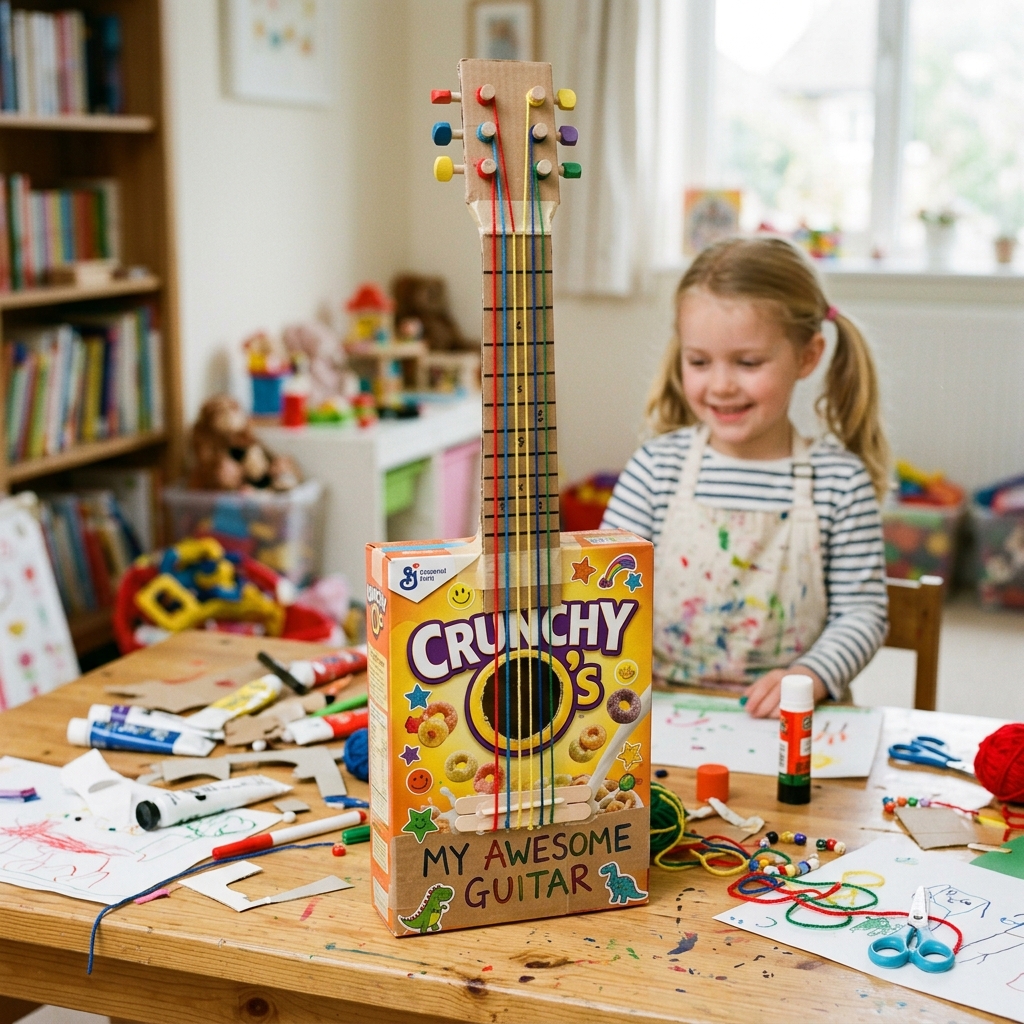
Music has a special way of inspiring children to explore, create, and express themselves. When children have the opportunity not only to play an instrument but also to build one with their own hands, learning becomes even more meaningful. One of the most enjoyable and educational craft projects for children is making a guitar from an empty cereal box. Using recycled household materials, children can create a simple string instrument while discovering the fascinating relationship between music, science, art, and engineering.
A cereal box guitar is much more than a fun craft. It introduces children to the basic principles of sound, vibration, and musical instruments while encouraging creativity, problem-solving, and environmental awareness. Throughout the project, children design, build, decorate, and finally play an instrument that reflects their own imagination and artistic style.
Teachers, parents, and caregivers appreciate this activity because it is affordable, environmentally friendly, and suitable for classrooms, libraries, community workshops, and home learning. Most of the required materials can be found around the house, making it an excellent example of how recycled objects can become valuable educational tools.
Perhaps the greatest reward comes when children strum the rubber band strings for the first time. The excitement of hearing sound produced by an instrument they built themselves creates a memorable learning experience that encourages curiosity, confidence, and creativity.
Why Children Love This Project
Children naturally enjoy making things that they can use after construction.
A cereal box guitar gives them the opportunity to become both inventors and musicians.
They especially enjoy:
- Building their own musical instrument
- Decorating it with original artwork
- Experimenting with different sounds
- Performing for family and friends
- Creating imaginary bands
- Learning simple rhythms
Every finished guitar looks different, allowing children to express their personalities.
Educational Goals
Although this activity feels like play, it supports learning across several subjects.
Children develop:
- Creativity
- Fine motor skills
- Musical awareness
- Scientific thinking
- Engineering skills
- Artistic expression
- Problem-solving
- Communication
- Concentration
- Patience
- Environmental responsibility
- Self-confidence
Project-based learning encourages children to discover concepts through direct experience.
Materials Needed
Most supplies are inexpensive and easy to collect.
Basic materials include:
- Empty cereal box
- Cardboard tube
- Rubber bands of different sizes
- Craft glue
- Masking tape
- Child-safe scissors
- Craft knife (adult use only)
- Ruler
- Pencil
- Paint
- Paintbrushes
- Markers
- Colored paper
- Wooden craft sticks
Optional decorations include:
- Stickers
- Glitter
- Fabric scraps
- Foam sheets
- Ribbon
- Buttons
- Yarn
- Decorative gems
- Washi tape
- Paper stars
Recycled materials help children understand sustainable creativity.
Understanding How a Guitar Works
Before construction begins, children learn the basic parts of a guitar.
They identify:
- The body
- The neck
- The strings
- The sound hole
- The head
Teachers explain that vibrating strings create sound waves that travel through the air to our ears.
Children later observe these ideas while playing their homemade instruments.
Preparing the Cereal Box
The cereal box forms the main body of the guitar.
First, it is emptied and securely closed.
An adult carefully cuts a circular sound hole into the front of the box.
Children may reinforce the box with additional cardboard if needed.
This preparation creates a sturdy foundation.
Building the Guitar Neck
A cardboard tube or folded cardboard strip becomes the neck of the guitar.
Children attach it securely to the body using glue and tape.
They quickly discover that a strong connection improves the instrument’s stability.
Simple construction challenges introduce basic engineering ideas.
Adding the Strings
The strings are the most exciting feature.
Several rubber bands are stretched across the sound hole.
Children notice that:
- Thin rubber bands produce higher sounds.
- Thick rubber bands create lower sounds.
- Tight strings vibrate differently from loose strings.
These observations introduce important scientific concepts through experimentation.
Decorating the Guitar
Now the instrument becomes a work of art.
Children paint and decorate their guitars using themes such as:
- Rainbows
- Jungle animals
- Space adventures
- Ocean life
- Superheroes
- Princess castles
- Dinosaurs
- Musical notes
- Stars
- Flowers
Every guitar reflects its creator’s imagination.
Exploring Color and Design
Painting encourages artistic expression.
Children experiment with:
- Bright colors
- Geometric patterns
- Polka dots
- Stripes
- Hearts
- Stars
- Animal prints
- Abstract designs
There is no right or wrong way to decorate.
Creative freedom builds confidence.
Making Music
Once construction is complete, children begin experimenting with sound.
They practice:
- Strumming
- Plucking
- Fast rhythms
- Slow rhythms
- Loud sounds
- Soft sounds
- Musical patterns
Playing together encourages listening and cooperation.
Discovering the Science of Sound
The project introduces several scientific ideas.
Children observe:
- Vibrations
- Sound waves
- Pitch
- Volume
- Resonance
- Material properties
Seeing and hearing these concepts makes science enjoyable and memorable.
Mathematics in Music
Mathematics appears naturally throughout the project.
Children:
- Measure the neck
- Count the strings
- Compare lengths
- Recognize symmetry
- Estimate distances
Real-life mathematics becomes meaningful.
Developing Fine Motor Ekills
Many construction activities improve coordination.
Children practice:
- Cutting
- Painting
- Drawing
- Stretching rubber bands
- Applying glue
- Positioning decorations
These skills support handwriting and many everyday tasks.
Encouraging Creativity
Every child creates a unique instrument.
Some design:
- Rock guitars
- Rainbow guitars
- Animal guitars
- Space guitars
- Jungle guitars
- Fairy guitars
- Sports-themed guitars
Imagination has no limits.
Group Music Activities
The completed guitars encourage musical cooperation.
Children can:
- Sing together
- Keep simple rhythms
- Play classroom songs
- Perform in groups
- Take turns leading musical games
These activities strengthen social relationships.
Storytelling Through Music
Children often invent stories about their instruments.
Examples include:
The Magical Guitar
The Singing Forest
The Rainbow Band
The Space Concert
The Pirate Music Festival
Combining music and storytelling develops creativity and language skills.
Language Development
Teachers can integrate literacy activities by encouraging children to:
- Write concert invitations
- Describe their guitars
- Create song titles
- Tell musical stories
- Present their instruments
Speaking and writing become connected to meaningful experiences.
Environmental Awareness
The project demonstrates the value of recycling.
Children learn to:
- Reuse household materials
- Reduce waste
- Protect natural resources
- Think creatively about everyday objects
They begin viewing packaging as a valuable resource rather than trash.
Teamwork
Many children enjoy working together.
One child paints.
Another prepares decorations.
Someone stretches the strings.
Others help assemble the instrument.
Collaboration teaches communication, respect, and responsibility.
Home Extension Activities
Families can continue exploring music together.
Ideas include:
- Building additional instruments
- Creating a family band
- Writing simple songs
- Holding home concerts
- Recording performances
- Decorating instruments for holidays
Shared musical experiences strengthen family bonds.
Safety Guidelines
Simple safety rules help everyone enjoy the activity.
Children should:
- Use scissors carefully.
- Ask adults to handle craft knives.
- Stretch rubber bands gently.
- Keep workspaces organized.
- Wash hands after painting.
Safe environments encourage positive learning.
Learning from Challenges
Not every guitar works perfectly at first.
Perhaps:
- A rubber band slips.
- The neck becomes loose.
- Glue dries slowly.
- Decorations fall off.
Children learn perseverance by making improvements.
Mistakes become valuable learning opportunities.
Presenting the Finished Guitars
Children proudly introduce their instruments.
They explain:
- Their design theme
- Decoration choices
- Construction process
- Favorite sounds
- Challenges they solved
Many classrooms finish with a small concert.
Public performances strengthen confidence.
Skills Developed
By completing this project, children strengthen many lifelong abilities.
These include:
- Creative thinking
- Musical awareness
- Scientific curiosity
- Artistic design
- Engineering understanding
- Communication
- Collaboration
- Fine motor coordination
- Environmental responsibility
- Self-expression
These skills support success across many learning areas.
Tips for Teachers
Teachers can make the project even more enjoyable by:
- Preparing recycled materials in advance.
- Demonstrating each construction step.
- Encouraging creative decoration.
- Allowing plenty of music exploration time.
- Praising effort instead of perfection.
- Organizing a classroom concert.
- Displaying finished guitars.
Positive encouragement inspires children to continue creating.
Long-Term Benefits
Unlike many classroom crafts, cereal box guitars continue providing educational value.
Children use them for:
- Music lessons
- Rhythm practice
- Dramatic play
- Storytelling
- Family entertainment
- Creative performances
The instruments often become treasured reminders of children’s creativity and learning.
Conclusion
Building a cereal box guitar is one of the most enjoyable and educational children’s projects because it combines music, science, engineering, creativity, art, and environmental awareness into one memorable experience. By transforming a simple cereal box into a working musical instrument, children discover that imagination and curiosity are powerful tools for learning.
Throughout the project, they strengthen fine motor skills, explore the science of sound, develop artistic confidence, and gain valuable experience solving practical construction challenges. They also learn important lessons about recycling by giving everyday materials a completely new purpose.
Most importantly, the finished guitar becomes much more than a craft. It becomes a musical instrument that encourages singing, storytelling, creativity, and joyful self-expression. Whether built in a classroom, at home, during a summer camp, or in a community workshop, a cereal box guitar inspires children to think like artists, musicians, engineers, and inventors. With only a few recycled materials and plenty of imagination, children can create an instrument that fills the room with music, laughter, learning, and unforgettable memories.
