
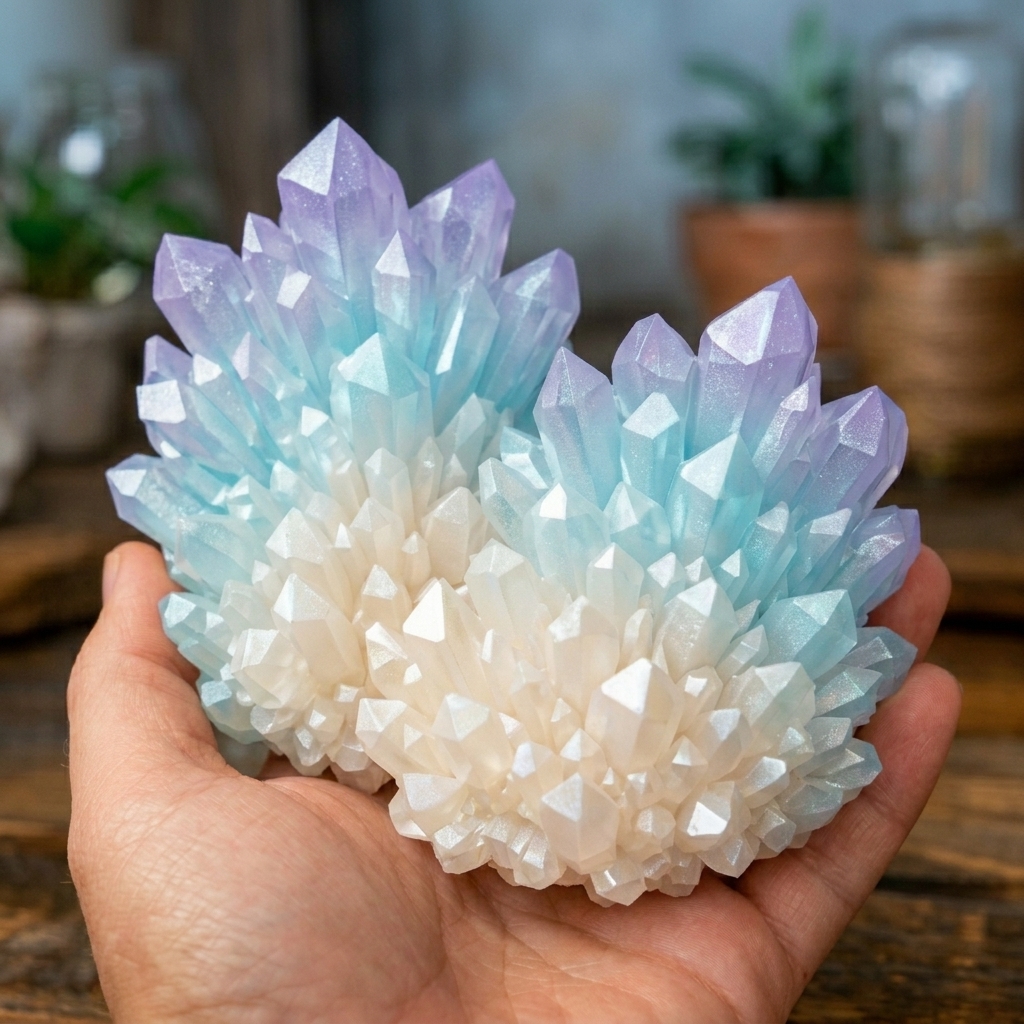
The Colored Crystal Growth Experiment for Children is one of the most fascinating science activities that young learners can enjoy at home or in the classroom. Watching tiny crystals slowly grow into colorful sparkling structures feels almost magical. Yet behind this beautiful transformation lies an exciting scientific process that teaches children about chemistry, solutions, evaporation, and crystal formation.
Unlike many science experiments that produce immediate results, crystal-growing activities encourage patience and observation. Children learn that scientific discoveries often take time, making the experience both educational and rewarding.
This article explores the Colored Crystal Growth Experiment for Children, explains how crystals form, and reveals seven types of crystal growth observations that make this activity a favorite among young scientists.
Quick Summary Table
| Feature | Details |
| Experiment Name | Colored Crystal Growth Experiment for Children |
| Difficulty Level | Easy |
| Recommended Age | 6+ years |
| Time Required | 1–7 days |
| Learning Topics | Chemistry, crystals, solutions |
| Main Materials | Water, salt or borax, food coloring |
| Educational Value | High |
| Fun Factor | Excellent |
What Is the Colored Crystal Growth Experiment for Children?
The Colored Crystal Growth Experiment for Children is a science activity where children create a saturated solution and observe crystals forming over time.
The experiment often involves dissolving a crystal-forming substance such as:
- Salt
- Borax
- Sugar
- Alum
Food coloring is added to create vibrant crystal formations that are visually appealing and exciting to observe.
As the water cools or evaporates, dissolved particles begin arranging themselves into organized patterns called crystals.
Children can watch these crystals grow day by day.
Why Children Love Crystal Experiments
Crystal experiments are popular because they combine science with creativity.
Colorful Results
Children enjoy seeing bright colors appear within crystal structures.
Hands-On Learning
Kids actively participate in mixing solutions and preparing crystal-growing containers.
Excitement of Discovery
Each day brings visible changes.
Children become eager to check on their crystals and document growth progress.
Unique Outcomes
No two crystal formations look exactly alike.
Each experiment creates a one-of-a-kind scientific masterpiece.
Sense of Achievement
Growing crystals successfully gives children confidence in their scientific abilities.
Materials Needed
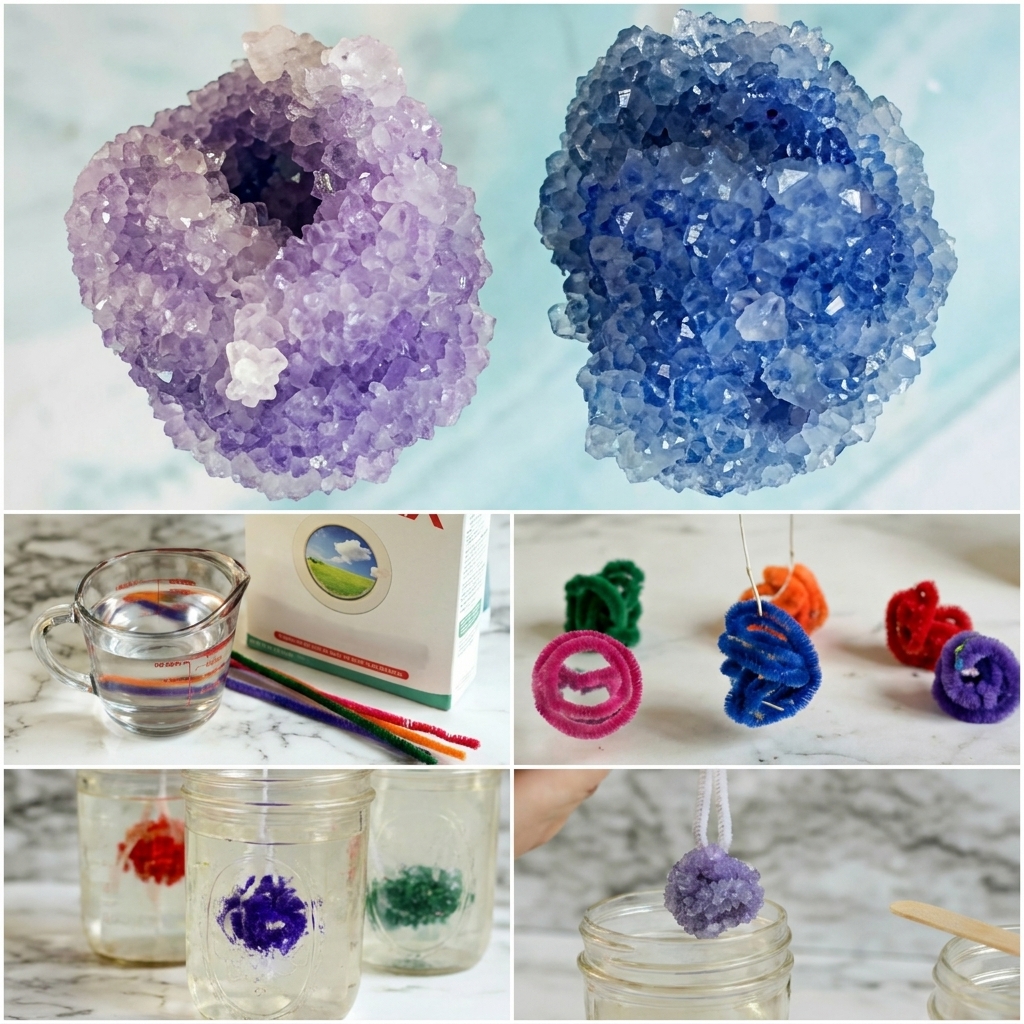
One reason the Colored Crystal Growth Experiment for Children is so popular is that it requires simple materials.
Basic Supplies
- Clear glass jar
- Warm water
- Borax, salt, sugar, or alum
- Food coloring
- Spoon
- String
- Pencil or stick
- Measuring cup
Optional Supplies
- Pipe cleaners
- Magnifying glass
- Notebook
- Camera
These items help children create and observe crystal formations.
Understanding Crystal Formation
Before starting the experiment, it helps to understand what crystals are.
A crystal is a solid material whose particles are arranged in a repeating pattern.
This organized structure gives crystals their:
- Shape
- Sparkle
- Strength
Crystals form when dissolved particles leave a solution and attach together in a regular arrangement.
The process may seem simple, but it creates incredibly beautiful structures.
How the Experiment Works
The Colored Crystal Growth Experiment for Children relies on a scientific principle called saturation.
Saturated Solutions
A saturated solution contains as much dissolved material as possible.
When additional material cannot dissolve, the solution becomes saturated.
Cooling and Evaporation
As the solution cools or water evaporates:
- The liquid holds fewer dissolved particles.
- Excess particles begin forming crystals.
- Crystal growth continues over time.
Children observe these changes firsthand.
Step-by-Step Instructions
Step 1: Prepare Warm Water
Fill a glass jar with warm water.
Step 2: Add Crystal Material
Slowly stir in borax, salt, sugar, or alum until no more dissolves.
Step 3: Add Color
Mix in several drops of food coloring.
Step 4: Suspend the String
Tie a string to a pencil and place it across the jar opening.
The string should hang into the solution.
Step 5: Wait Patiently
Place the jar in a safe location and avoid disturbing it.
Step 6: Observe Daily
Check the crystal growth each day.
Step 7: Record Findings
Document changes in a science journal.
How 7 Crystal Growth Stages Form
Children can observe several fascinating stages during the experiment.
Stage 1: Dissolution
The crystal-forming material dissolves into the warm water.
At this point, no crystals are visible.
What Children Learn
- Solids can dissolve into liquids.
- Solutions can appear clear despite containing particles.
Stage 2: Saturation
The solution reaches its maximum concentration.
Extra material no longer dissolves.
What Children Learn
- Liquids have limits.
- Scientific measurements matter.
Stage 3: Cooling Begins
The water temperature gradually decreases.
The solution becomes unstable.
What Children Learn
- Temperature influences chemical processes.
- Small changes can create big effects.
Stage 4: Crystal Seeds Appear
Tiny crystal particles begin forming.
These are called crystal seeds.
What Children Learn
- Crystal growth starts small.
- Natural processes often begin invisibly.
Stage 5: Crystal Expansion
More particles attach to the crystal seeds.
Growth becomes visible.
What Children Learn
- Patterns emerge through repetition.
- Scientific structures build gradually.
Stage 6: Color Integration
Colored particles become trapped within growing crystals.
The crystals become vibrant and attractive.
What Children Learn
- Color can enhance scientific observations.
- Visual evidence helps understanding.
Stage 7: Mature Crystal Formation
Large crystals develop and display their characteristic shapes.
What Children Learn
- Patience produces results.
- Scientific processes follow predictable patterns.
This final stage is usually the most exciting for children.
The Science Behind Crystal Shapes
Different substances create different crystal structures.
Salt Crystals
Salt often forms cube-shaped crystals.
Sugar Crystals
Sugar creates sparkling crystal clusters.
Borax Crystals
Borax forms large geometric crystals.
Alum Crystals
Alum often produces clear, glass-like formations.
These unique structures result from differences in molecular arrangement.
Why Food Coloring Works
Food coloring makes crystal growth easier to observe.
The coloring becomes incorporated into growing crystals.
Children can compare:
- Red crystals
- Blue crystals
- Green crystals
- Yellow crystals
The colorful results increase engagement and excitement.
Educational Benefits
The Colored Crystal Growth Experiment for Children offers numerous learning opportunities.
Encourages Scientific Observation
Children monitor changes over several days.
Introduces Chemistry Concepts
The activity teaches:
- Solutions
- Saturation
- Evaporation
- Crystal formation
Builds Patience
Unlike instant experiments, crystal growth requires waiting.
Strengthens STEM Skills
The experiment supports science, technology, engineering, and mathematics learning.
Improves Record Keeping
Children can maintain science journals and growth logs.
Creative Crystal Projects
After mastering basic crystal growth, children can explore additional projects.
Crystal Pipe Cleaner Shapes
Create stars, hearts, or snowflakes using pipe cleaners.
Rainbow Crystal Collection
Grow crystals in multiple colors.
Crystal Garden
Grow several crystal types together.
Holiday Crystal Decorations
Use crystals to create seasonal ornaments.
These projects combine art and science.
Common Questions
How Long Does Crystal Growth Take?
Small crystals may appear within a day.
Larger crystals often require several days.
Which Material Produces the Best Crystals?
Borax and alum typically create large, visible crystals quickly.
Can Crystals Grow Indefinitely?
Growth eventually slows as dissolved particles become depleted.
Why Did My Crystals Not Grow?
Possible causes include:
- Insufficient saturation
- Disturbing the container
- Incorrect temperature
Careful preparation improves success.
Real-World Applications of Crystals
Crystals are important in many industries.
Jewelry
Gemstones are natural crystals.
Electronics
Many electronic devices contain crystal components.
Medicine
Scientists use crystal structures to study medicines.
Manufacturing
Industrial crystals appear in many products.
Scientific Research
Researchers study crystals to understand molecular behavior.
Learning about these applications helps children connect experiments to everyday life.
Tips for Success
To achieve the best results:
- Use warm water
- Stir thoroughly
- Create a highly saturated solution
- Avoid moving the jar
- Be patient
- Record observations daily
These simple practices improve crystal growth.
Conclusion
The Colored Crystal Growth Experiment for Children is an engaging and educational science activity that transforms simple household materials into dazzling crystal formations. Through seven fascinating stages of crystal growth, children learn valuable lessons about chemistry, solutions, evaporation, and scientific observation.
The colorful crystals provide visual excitement while encouraging patience and curiosity. Because the experiment is easy to perform, affordable, and highly educational, it remains one of the best STEM activities for young learners.
Whether conducted at home, in a classroom, or as part of a science fair project, the Colored Crystal Growth Experiment for Children offers an unforgettable opportunity to explore the beauty and science of crystal formation. Watching crystals grow day by day reminds children that some of nature’s most amazing processes happen one tiny particle at a time.
