
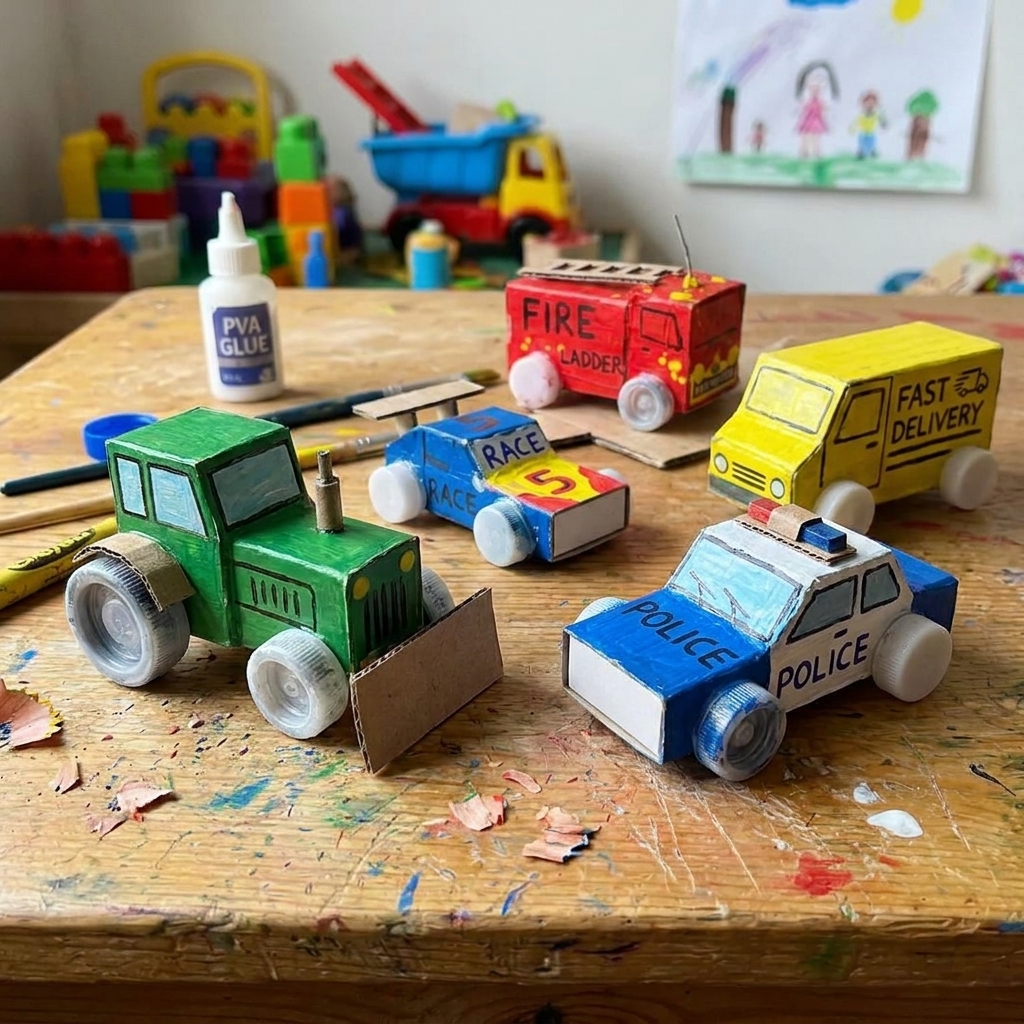
School projects are an excellent way to combine creativity, scientific thinking, and practical skills. They allow students to transform simple classroom lessons into exciting hands-on activities that encourage curiosity and innovation. One enjoyable STEM (Science, Technology, Engineering, and Mathematics) project is building Matchbox Mini Cars using ordinary household and craft materials. Although these miniature vehicles are small, they teach important concepts about engineering, motion, friction, balance, and design.
Toy cars have fascinated children for generations. Their simple appearance hides many interesting engineering ideas. Every wheel, axle, and body shape affects how a car moves. By building a mini car from a small matchbox and other lightweight materials, students gain a better understanding of how real vehicles are designed and why engineers carefully consider every detail.
One of the greatest advantages of this project is its affordability. Most of the required materials are inexpensive or can be recycled from items already found at home. Empty matchboxes, wooden skewers, bottle caps, cardboard, drinking straws, glue, and decorative paper can all become parts of a working miniature vehicle.
The project is suitable for science classes, art lessons, engineering clubs, or home learning. Students can work individually or in teams, comparing different designs and discussing ways to improve their cars. The activity also encourages environmental awareness by showing how recycled materials can be transformed into creative and useful projects instead of being discarded.
Building Matchbox Mini Cars is more than a craft activity. It introduces the engineering design process, which includes planning, building, testing, evaluating, and improving a prototype. Students quickly discover that small changes in design can significantly affect how smoothly the car rolls or how far it travels.
Project Objectives
The main objective is to build a lightweight miniature car that rolls smoothly across a flat surface. During construction, students learn how wheels, axles, friction, and balance influence movement.
Additional goals include developing creativity, improving fine motor skills, strengthening teamwork, and encouraging problem-solving. Students also gain confidence by successfully creating a working model from simple materials.
Materials Needed
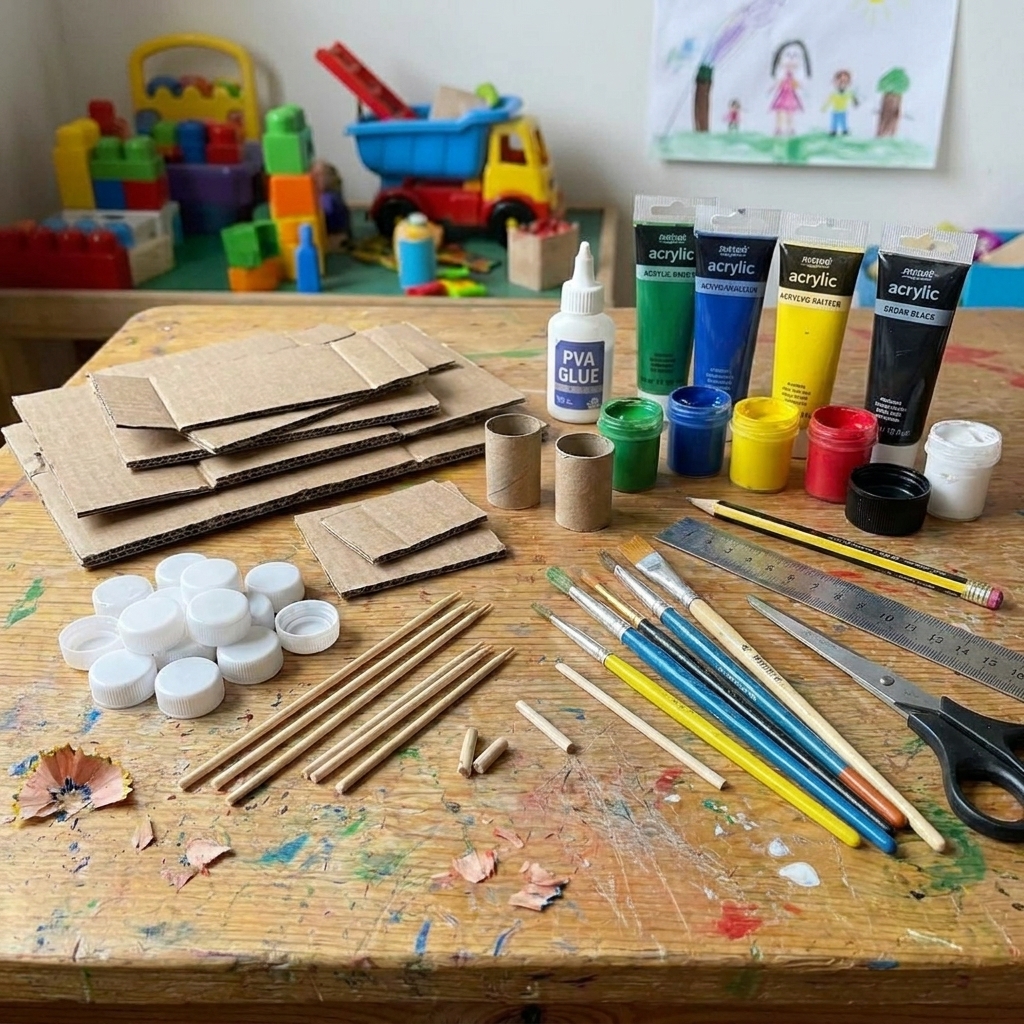
Most of the supplies are easy to obtain.
Recommended materials include:
- Empty matchbox
- Cardboard
- Wooden skewers
- Drinking straws
- Bottle caps or cardboard wheels
- Glue
- Masking tape
- Scissors
- Ruler
- Pencil
- Markers or paint
- Colored paper
- Stickers for decoration
Recycled materials are encouraged because they reduce waste while keeping project costs low.
Planning the Design
Every successful engineering project begins with careful planning. Students should first draw a simple sketch showing the body, wheel placement, axles, and decorative features.
Important questions include:
- How large should the wheels be?
- Where should the axles be positioned?
- How can the car remain balanced?
- Which materials are the strongest and lightest?
Planning helps students organize their ideas before construction begins.
Building the Car Body
The empty matchbox serves as the main body of the miniature car. It is lightweight, strong, and easy to decorate.
Students may reinforce the matchbox using thin cardboard if additional strength is needed. Colored paper, paint, or stickers can transform the plain box into a racing car, police car, ambulance, fire truck, or family vehicle.
Decoration should be added carefully so that it does not interfere with the wheels or add unnecessary weight.
Making the Axles
The axles allow the wheels to rotate freely. Wooden skewers work well because they are straight and lightweight.
Short pieces of drinking straw can be glued underneath the matchbox to act as axle holders. The skewers slide through these tubes, allowing them to rotate smoothly.
Students should ensure the axle holders are perfectly aligned. Even a small misalignment can prevent the car from rolling properly.
Creating the Wheels
Bottle caps make excellent wheels because they are durable and easy to attach. Cardboard circles can also be used if bottle caps are unavailable.
The wheels should all be the same size to ensure smooth movement. A small hole is made in the center of each wheel before attaching it securely to the ends of the axle.
After assembly, students should spin each wheel to check that it rotates freely without rubbing against the body.
Assembling the Mini Car
After preparing the body, wheels, and axles, students can assemble the matchbox mini car. First, the straw axle holders should be glued securely underneath the matchbox body. Once the glue has dried, the wooden skewers can be carefully inserted through the straws.
Next, the wheels are attached to both ends of each axle. Students should make sure that the wheels are evenly spaced and do not touch the sides of the matchbox. If the wheels rub against the body, the extra friction will slow the car.
Before decorating further, the car should be rolled gently across a flat table. This simple test helps identify any alignment problems while they are still easy to fix.
Quick Overview Table
| Feature | Description |
|---|---|
| Project Name | Matchbox Mini Cars |
| Project Type | STEM Engineering and Craft Project |
| Difficulty Level | Easy |
| Recommended Age | 8 years and older |
| Main Materials | Matchbox, bottle caps, wooden skewers, straws, glue, cardboard |
| Science Concepts | Motion, friction, force, balance, wheel and axle |
| Estimated Build Time | 1–2 hours |
| Skills Developed | Creativity, engineering, teamwork, problem-solving |
| Cost | Very Low |
| Final Goal | Build a mini car that rolls smoothly and travels a long distance |
Testing the Car
Testing is one of the most exciting parts of the project. Students should place the car on a smooth surface and gently push it forward. They should observe how straight it travels, how far it rolls, and whether the wheels rotate freely.
Several questions can guide the investigation:
- Does the car move in a straight line?
- Do all four wheels touch the ground?
- Does the car stop quickly?
- Does one side move more slowly than the other?
- Are the axles turning smoothly?
Recording these observations helps students understand which parts of the design work well and which need improvement.
Teachers can encourage students to measure the distance traveled using a ruler or measuring tape and compare the results between different designs.
Improving the Design
Engineering is a process of continuous improvement. After testing, students should think about ways to make their cars perform better.
If the wheels wobble, they should be centered more carefully. If the car turns unexpectedly, the axle holders may need realignment. If the vehicle rolls only a short distance, reducing friction by smoothing the axle or adjusting the wheel spacing may improve performance.
Students may also experiment with larger wheels, lighter materials, or a more aerodynamic body shape. Every modification teaches an important lesson about how design choices influence performance.
Keeping a record of each change and its effect helps students understand the engineering design process.
The Science Behind the Mini Car
Although the project is simple, it demonstrates several important scientific principles.
The wheel and axle is one of the six classical simple machines. It reduces friction and allows objects to move much more easily than sliding them across a surface.
Friction is the force that resists motion. Too much friction between the wheels and axles slows the car, while smooth, well-aligned parts allow the vehicle to travel farther.
Students also learn about force. The push given to the car provides the energy needed to begin moving. As the car rolls forward, friction and air resistance gradually slow it until it stops.
Balance is another key concept. A well-balanced car travels more smoothly than one with uneven weight distribution.
These scientific ideas help students understand not only toy cars but also bicycles, trains, and full-sized automobiles.
Measuring Performance
To make the project more scientific, students can collect and compare data.
Measurements may include:
- Distance traveled
- Time taken to reach a finish line
- Number of successful straight runs
- Wheel diameter
- Car weight
Students can organize this information in tables or graphs and compare the results with those of other groups.
This introduces the scientific method by encouraging observation, measurement, analysis, and evidence-based conclusions.
Common Challenges
Every engineering project presents challenges.
Some common problems include:
- Wheels that do not spin freely
- Bent axles
- Loose glue joints
- Uneven wheel sizes
- Poor balance
- Excessive friction
Students should not become discouraged by these issues. Instead, they should investigate the causes and test possible solutions. Engineers improve their inventions by solving problems one step at a time.
Learning from mistakes is one of the most valuable parts of the project.
Real-World Applications
Although Matchbox Mini Cars are small classroom models, the engineering principles used to build them are the same ones applied by professional automotive engineers. Every modern vehicle is carefully designed to move efficiently, remain balanced, and provide a safe and comfortable ride. Engineers study wheel alignment, friction, weight distribution, aerodynamics, and material strength before a new vehicle is manufactured.
Racing cars are designed to reduce air resistance so they can travel at very high speeds. Family cars focus on comfort, fuel efficiency, and safety. Delivery vans are built to carry heavy loads, while electric vehicles are designed to reduce pollution and save energy. Despite their different purposes, all these vehicles rely on the same basic concepts explored in this classroom project.
By building a miniature car, students gain a better understanding of how engineering improves transportation and why careful planning is essential when creating real machines.
Safety Guidelines
Even though this project uses simple craft materials, students should always follow basic safety rules. Scissors should be handled carefully, and younger children should use them only under adult or teacher supervision. If a hot glue gun is used, it should be operated by an adult or by older students who have received proper instruction.
Wooden skewers have pointed ends, so they should be handled with care. Students should avoid running while carrying project materials and should keep the work area clean and organized to prevent accidents.
Finished cars should be tested only on flat surfaces away from stairs or crowded walkways. Following these simple precautions allows everyone to enjoy the activity safely.
Educational Benefits
The Matchbox Mini Cars project supports learning in many different subjects.
In science, students investigate motion, force, friction, gravity, and balance. They discover how small design changes affect the way a vehicle moves.
In mathematics, they measure wheel sizes, calculate travel distances, compare test results, and organize data into tables or graphs. These activities strengthen observation and analytical thinking.
In engineering, students follow the complete design cycle by planning, building, testing, evaluating, and improving their models. They learn that successful designs are usually the result of repeated experimentation rather than a single attempt.
The project also encourages artistic creativity. Students decorate their cars using paint, colored paper, stickers, and imaginative themes. Some may design racing cars with colorful stripes, while others create police cars, ambulances, taxis, buses, or futuristic vehicles.
Beyond academic knowledge, the activity develops patience, communication, teamwork, responsibility, and perseverance. Students learn to share ideas, solve problems together, and present their finished projects with confidence.
Environmental Awareness
An important lesson from this project is that useful models can be built using recycled materials. Empty matchboxes, bottle caps, cardboard, drinking straws, and leftover craft supplies can all be reused instead of being thrown away.
Recycling helps reduce waste, conserve natural resources, and protect the environment. Students discover that creativity is often more valuable than expensive materials and that everyday household items can become exciting engineering projects.
Teachers can expand this discussion by exploring topics such as sustainable transportation, recycling programs, and environmentally friendly manufacturing.
Creative Extensions
After completing the basic mini car, students can continue exploring new ideas and challenges.
For example, they might design:
- A racing car with a streamlined body.
- A delivery truck that can carry small objects.
- A rescue vehicle with decorative emergency lights.
- A school bus with cardboard windows and seats.
- A futuristic electric car powered by imagination.
Teachers can also organize classroom competitions such as:
- Longest rolling distance.
- Straightest travel path.
- Most creative decoration.
- Strongest vehicle capable of carrying the greatest load.
- Best use of recycled materials.
Another interesting activity is building a small cardboard ramp and comparing how different car designs perform when rolling downhill. Students can investigate how wheel size, weight, and body shape influence speed and distance.
Reflection
Reflection is an important part of every engineering activity. After testing their cars, students should think about questions such as:
- What worked well?
- Which part was the most difficult to build?
- What improvements made the biggest difference?
- Which materials produced the best results?
- What would they change if they built another car?
Writing a short report or presenting their findings to classmates helps reinforce scientific thinking and improves communication skills.
Reflection also teaches students that learning continues even after the project has been completed.
Conclusion
The School Project: Matchbox Mini Cars is an enjoyable and educational activity that combines science, engineering, mathematics, art, and environmental awareness into one creative experience. Using simple household and recycled materials, students can design and build miniature vehicles that demonstrate important scientific principles while encouraging imagination and innovation.
Throughout the project, students learn about wheels and axles, friction, force, balance, motion, and the engineering design process. They experience the excitement of transforming ordinary objects into working models and discover that careful planning, testing, and improvement are the foundations of successful engineering.
The project also develops practical life skills that extend beyond the classroom. Teamwork, creativity, communication, patience, and critical thinking all play important roles during construction and testing. Friendly competitions and classroom discussions make learning enjoyable while encouraging students to apply scientific knowledge in meaningful ways.
Perhaps the greatest lesson is that engineering begins with curiosity. A simple matchbox can become the starting point for exploring how real vehicles are designed and built. By experimenting with different materials and ideas, students gain confidence in their ability to solve problems and create innovative solutions.
In conclusion, the Matchbox Mini Cars project demonstrates that hands-on learning is both enjoyable and effective. It inspires students to observe, experiment, and improve their designs while developing a deeper appreciation for science and engineering. Whether completed at home, in the classroom, or at a science fair, this project encourages creativity, builds confidence, and shows that even the smallest inventions can lead to big discoveries.
