
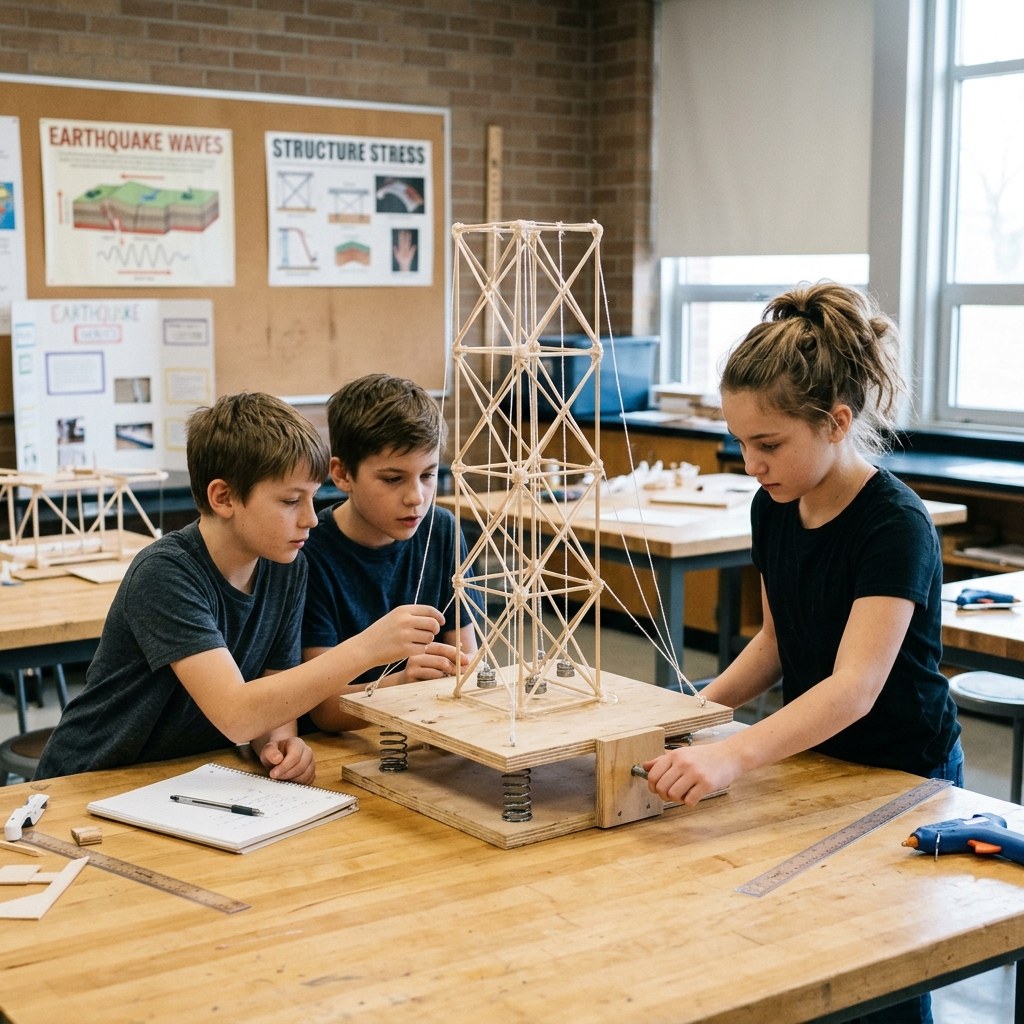
School projects provide students with valuable opportunities to learn through exploration, creativity, and hands-on activities. Instead of only reading about scientific concepts in textbooks, students can investigate how these ideas work in real life by designing, building, testing, and improving practical models. One of the most exciting engineering challenges is constructing an earthquake-resistant tower. This project combines science, technology, engineering, art, and mathematics (STEAM) while encouraging students to think like engineers and problem-solvers.
Earthquakes are among the most powerful natural disasters on Earth. They can cause buildings, bridges, and other structures to shake violently, leading to severe damage if they are not designed properly. Engineers spend years studying how buildings respond to seismic forces and continually develop safer construction methods. Through a classroom project, students gain a basic understanding of these engineering principles by creating miniature towers that can withstand simulated earthquakes.
Building an earthquake-resistant tower is more than a simple craft activity. It teaches students about balance, stability, structural strength, teamwork, creativity, and perseverance. Every design, whether successful or not, provides valuable lessons about engineering and the importance of continuous improvement.
| Quick Overview | Details |
| Project Name | Earthquake-Resistant Tower Challenge |
| Subject | Science, Engineering, STEAM |
| Difficulty | Moderate |
| Recommended Age | 10–16 years |
| Main Materials | Wooden craft sticks, straws, paper, tape, glue |
| Main Goal | Build a tower that survives earthquake simulations |
| Skills Developed | Engineering, teamwork, creativity, critical thinking |
Why This Project Matters
Earthquake-resistant buildings save lives. Around the world, millions of people live in areas where earthquakes occur regularly. Engineers work to design structures that remain standing during seismic events, reducing injuries and protecting communities.
This classroom project introduces students to these real-world challenges. They learn that successful engineering depends not only on strong materials but also on intelligent design. Even lightweight materials can create surprisingly stable structures when assembled correctly.
The project also demonstrates that engineering is a process of planning, testing, learning from mistakes, and making improvements.
Learning Objectives
By completing this project, students should be able to:
- Understand the engineering design process.
- Learn how earthquakes affect buildings.
- Explore stability and balance.
- Investigate structural reinforcement.
- Practice careful measurement and planning.
- Improve teamwork and communication.
- Record scientific observations.
- Develop resilience through repeated testing.
These objectives combine scientific knowledge with practical problem-solving skills.
Materials Needed
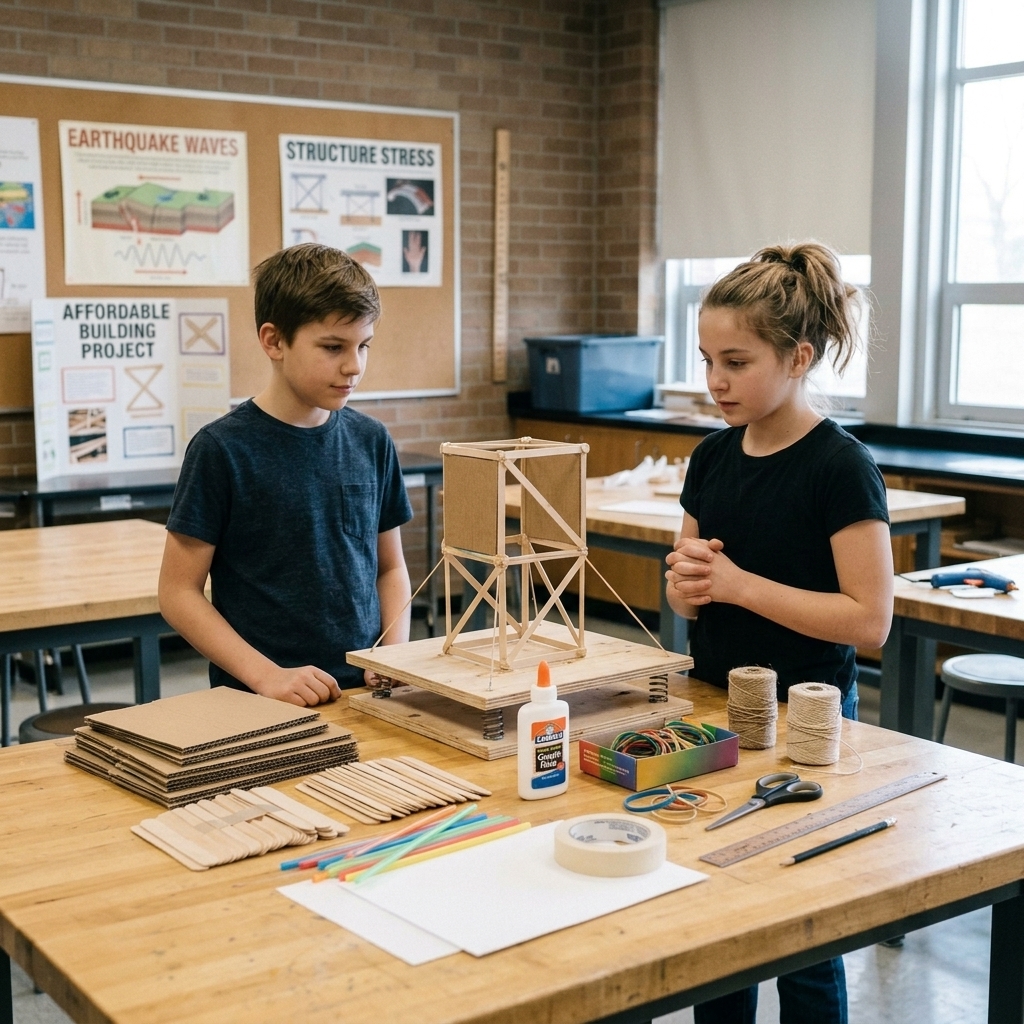
The project uses simple and affordable materials that are available in most classrooms.
Materials include:
- Wooden craft sticks
- Drinking straws
- Cardboard
- Paper
- Masking tape
- White glue or hot glue (with supervision)
- Rubber bands
- String
- Scissors
- Ruler
- Pencil
To simulate an earthquake, students may also use:
- A homemade shake table
- Two pieces of cardboard with marbles between them
- A tray that can be shaken gently by hand
These simple tools effectively demonstrate how earthquakes affect structures.
Understanding Earthquakes
Before construction begins, students should understand what causes earthquakes.
Earthquakes occur when tectonic plates beneath Earth’s surface suddenly move. This movement releases energy that travels through the ground as seismic waves.
These waves cause buildings to shake in several directions. Structures that are poorly designed may crack, lean, or collapse.
Students quickly realize that engineers must prepare buildings to resist these powerful forces.
Planning the Tower
Good engineering begins with thoughtful planning.
Students should sketch several possible tower designs before construction starts.
Important questions include:
- How tall should the tower be?
- How wide should the base be?
- Which shape provides the greatest stability?
- Where should supports be placed?
- How can weak points be strengthened?
Planning saves time and reduces mistakes during construction.
Choosing the Best Shape
The shape of a tower has a significant impact on its strength.
Students may experiment with:
- Square towers
- Triangular towers
- Pyramid-shaped towers
- Cross-braced towers
Many discover that triangular supports improve stability because triangles resist changes in shape more effectively than squares.
Building a Strong Foundation
A stable foundation is essential for every successful tower.
The base should be:
- Wide
- Level
- Secure
- Balanced
A broad foundation lowers the center of gravity, making the structure less likely to tip during shaking.
Students learn that even the strongest upper structure cannot compensate for a weak foundation.
Constructing the Frame
The frame acts as the skeleton of the tower.
Students connect sticks or straws carefully using tape or glue.
Key construction principles include:
- Keeping sections symmetrical.
- Aligning vertical supports.
- Reinforcing corners.
- Checking measurements regularly.
Accuracy during construction improves the tower’s overall strength.
The Importance of Cross Bracing
Cross bracing is one of the most valuable engineering techniques introduced in this project.
Diagonal supports create triangles that strengthen the structure.
Without cross braces, the tower may sway excessively during shaking.
Adding diagonal supports greatly improves resistance to lateral movement.
Students often observe dramatic improvements after installing these braces.
Simulating an Earthquake
Testing is one of the most exciting parts of the activity.
Students place their towers on the shake table.
The table is then shaken gently, followed by increasingly stronger movements.
Students carefully observe:
- Does the tower sway?
- Does it lean?
- Which joints loosen?
- Does any section collapse?
Testing transforms engineering theory into practical experience.
Recording Observations
Scientific investigations require accurate records.
Students may organize results in a table.
| Test | Earthquake Strength | Result | Improvement Needed |
| 1 | Gentle | Stable | None |
| 2 | Moderate | Slight sway | Add braces |
| 3 | Strong | Top leaned | Strengthen upper frame |
| 4 | Very Strong | Successful | Final design complete |
Keeping detailed notes helps students compare designs objectively.
Common Engineering Challenges
Most first attempts reveal weaknesses.
Typical problems include:
- Narrow foundations.
- Loose joints.
- Weak corners.
- Uneven weight distribution.
- Insufficient cross bracing.
- Excessive height.
Students learn that identifying weaknesses is an essential part of engineering.
Improving the Tower
Professional engineers rarely achieve perfect designs immediately.
Students improve their towers by:
- Adding diagonal braces.
- Widening the base.
- Reinforcing joints.
- Reducing unnecessary height.
- Balancing weight more evenly.
- Strengthening weak sections.
Each improvement increases the tower’s ability to survive stronger shaking.
Engineering Concepts Learned
This project introduces several important engineering principles.
Stability
A balanced tower remains upright during movement.
Center of Gravity
Lower centers of gravity improve stability.
Load Distribution
Weight should be spread evenly throughout the structure.
Structural Reinforcement
Extra supports increase strength.
Flexibility
Some movement helps absorb earthquake energy without causing collapse.
Students discover that buildings must be both strong and flexible.
Teamwork Throughout the Project
Building an earthquake-resistant tower encourages collaboration.
Each student can perform a different role.
Examples include:
- Designer
- Builder
- Materials manager
- Tester
- Recorder
- Presenter
Working together allows students to combine different ideas and solve problems more effectively.
Creativity and Innovation
Although every team uses similar materials, every tower becomes unique.
Students may invent:
- New bracing systems.
- Innovative foundations.
- Decorative architectural features.
- Lightweight reinforcement methods.
- Unusual geometric designs.
Creativity plays an important role in successful engineering.
Real-World Applications
This classroom activity closely resembles real engineering challenges.
Engineers designing buildings in earthquake-prone regions consider:
- Flexible foundations.
- Steel reinforcement.
- Shock absorbers.
- Cross bracing.
- Lightweight materials.
- Building height.
Students gain appreciation for the science that protects communities from natural disasters.
Presentation Day
After testing, each team presents its project.
Students explain:
- Their original design.
- Construction process.
- Problems encountered.
- Improvements made.
- Final testing results.
- Lessons learned.
Presentations strengthen communication skills while allowing students to learn from one another.
Skills Developed
The earthquake-resistant tower challenge develops many valuable skills.
Students improve:
- Critical thinking
- Engineering knowledge
- Scientific observation
- Creativity
- Communication
- Collaboration
- Planning
- Decision-making
- Patience
- Problem-solving
These abilities support learning across many academic subjects.
Environmental Awareness
Teachers may also discuss sustainable construction.
Students can build towers using recycled materials such as:
- Scrap cardboard
- Recycled paper
- Used craft sticks
- Paper tubes
This introduces the concept of environmentally responsible engineering.
Reflection
Many students begin the project believing that the strongest tower is simply the tallest or the one built with the most materials. However, testing quickly shows that intelligent design is far more important than size. A carefully balanced tower with strong cross bracing often performs much better than a taller, heavier structure.
Students also discover that failure is an essential part of learning. Every collapsed tower reveals useful information about structural weaknesses. By analyzing these failures and making thoughtful improvements, students experience the same design process used by professional engineers.
Most importantly, the project demonstrates that engineering combines creativity with scientific thinking. Successful designs emerge through observation, experimentation, teamwork, and persistence.
Conclusion
The experience of building an earthquake-resistant tower is an engaging and educational school project that introduces students to the fascinating world of structural engineering. Using simple classroom materials, students learn how buildings respond to earthquakes and discover the importance of balance, reinforcement, flexibility, and careful design. Through planning, construction, testing, observation, and redesign, they experience the engineering design process in a practical and memorable way.
Beyond scientific knowledge, the project develops valuable life skills such as teamwork, creativity, communication, patience, resilience, and critical thinking. Students realize that mistakes are opportunities to improve and that successful engineering depends on continuous learning rather than perfection. By the end of the project, they have not only built a tower capable of resisting simulated earthquakes but also gained confidence in their ability to solve complex problems and think like future engineers. This inspiring experience encourages curiosity, innovation, and a deeper appreciation for the role of engineering in creating safer and more resilient communities.
