
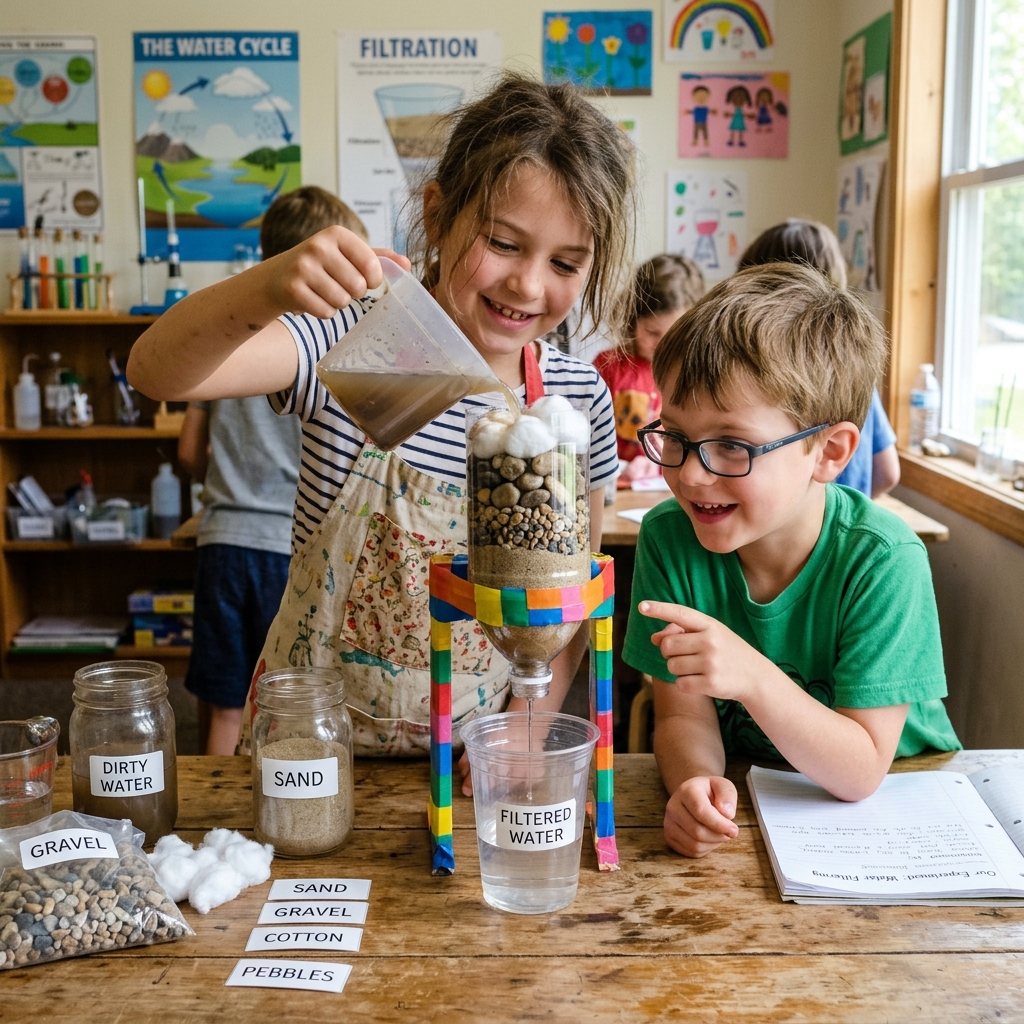
The Water Filter Experiment for Kids is one of the most practical and eye-opening science activities for young learners. It demonstrates how dirty water can be cleaned using simple materials like sand, gravel, cotton, and activated charcoal. This hands-on experiment introduces children to environmental science, engineering thinking, and real-world problem-solving in a fun and engaging way.
Clean water is something many people take for granted, but this experiment helps children understand the importance of water purification and how filtration systems work in everyday life. Through simple steps, kids can build their own mini water filter and observe how layers of materials trap dirt and impurities.
In this article, we explore the Water Filter Experiment for Kids in detail, explain how it works scientifically, and break down seven easy steps to perform it at home or in the classroom.
Summary Table
| Feature | Details |
| Experiment Name | Water Filter Experiment for Kids |
| Difficulty Level | Easy |
| Recommended Age | 6+ years |
| Time Required | 20–30 minutes |
| Key Concept | Filtration and water purification |
| Materials Needed | Bottle, sand, gravel, cotton, charcoal |
| Learning Focus | Environmental science, engineering |
| Outcome | Cleaner filtered water |
What Is the Water Filter Experiment for Kids?
The Water Filter Experiment for Kids is a simple STEM activity where children build a homemade filtration system to clean dirty water. Using everyday materials, they create layers that remove visible impurities from water.
While the filtered water is not safe to drink, it clearly shows how natural and artificial filtration systems work. This experiment is widely used in classrooms because it connects science learning with real-world environmental issues like water pollution and clean water access.
Why This Experiment Is Important
Water filtration is essential for survival, hygiene, and health. This experiment helps children understand:
- How water becomes polluted
- Why filtration is necessary
- How engineering helps solve environmental problems
- How natural systems (like soil) filter water
By performing the Water Filter Experiment for Kids, students begin to think like environmental scientists and engineers.
Materials Needed
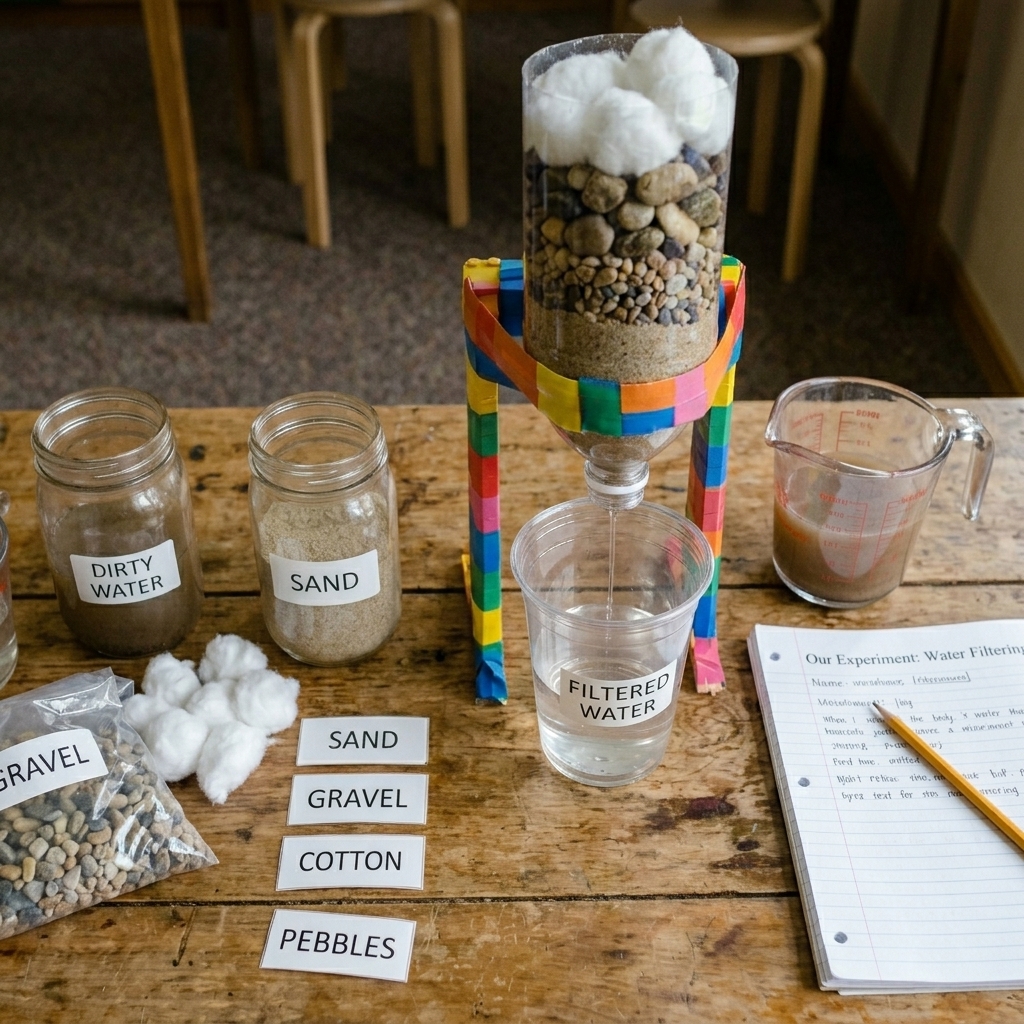
One of the best parts of the Water Filter Experiment for Kids is that it uses simple household materials.
Basic Materials
- Plastic bottle (cut in half)
- Clean container or cup
- Sand
- Gravel or small stones
- Cotton or cotton balls
- Activated charcoal (optional but recommended)
- Dirty water (soil mixed with water)
- Spoon
Optional Materials
- Coffee filter paper
- Cloth or sponge
- Funnel
How a Water Filter Works
Before starting the steps, it’s important to understand how filtration works.
Filtration is a process that separates solid particles from liquids. In this experiment, different materials act as filters:
- Gravel removes large debris
- Sand traps smaller particles
- Cotton captures fine impurities
- Charcoal absorbs chemicals and odors
As water passes through each layer, it becomes progressively cleaner.
Step-by-Step: Water Filter Experiment for Kids
Step 1: Prepare the Bottle
Cut a plastic bottle in half. Place the top half upside down like a funnel into the bottom half or a separate container.
This forms the structure of your filter.
Step 2: Add Cotton Layer
Place cotton or cotton balls at the neck of the bottle.
This acts as the first filter layer, trapping fine particles.
Step 3: Add Activated Charcoal
Pour a layer of activated charcoal above the cotton.
Charcoal helps absorb impurities and improves water clarity.
Step 4: Add Sand Laye
Add a thick layer of clean sand.
Sand filters smaller particles that pass through gravel.
Step 5: Add Gravel Layer
Place gravel or small stones on top of the sand.
This layer blocks larger debris such as dirt and leaves.
Step 6: Pour Dirty Water
Slowly pour dirty water (mixed with soil or mud) into the top of the filter.
Watch how it travels through each layer.
Step 7: Observe the Results
Collect the filtered water in a container.
Observe how it is clearer than the original dirty water.
Although it is not drinkable, it demonstrates the effectiveness of filtration systems.
The Science Behind the Experiment
The Water Filter Experiment for Kids is based on physical and chemical processes.
1. Mechanical Filtration
Solid particles are physically trapped by filter layers.
2. Absorption
Activated charcoal absorbs chemicals and odors.
3. Sedimentation
Heavier particles settle and are caught by gravel and sand.
4. Layered Filtration
Each layer removes different sizes of impurities, improving overall filtration.
Real-World Applications
This experiment connects directly to real-life water systems.
Municipal Water Treatment
Cities use large-scale filtration systems similar to this experiment.
Household Filters
Many home water filters use carbon and layered systems.
Environmental Protection
Filtration helps reduce pollution in rivers and lakes.
Emergency Water Purification
In survival situations, similar methods are used to clean water.
Why Kids Love This Experiment
The Water Filter Experiment for Kids is popular because:
1. It Shows Real Change
Dirty water becomes visibly cleaner.
2. It Is Hands-On
Children build and control the experiment.
3. It Feels Like Engineering
Kids feel like real scientists designing a system.
4. It Uses Everyday Materials
No expensive tools are needed.
5. It Connects to Real Life
Children understand how clean water reaches their homes.
Educational Benefits
This experiment supports multiple learning areas.
Science Skills
- Observation
- Hypothesis testing
- Data comparison
Engineering Thinking
- Designing systems
- Problem-solving
- Layer structuring
Environmental Awareness
- Water pollution issues
- Sustainability concepts
Critical Thinking
- Understanding cause and effect
- Evaluating results
Variations of the Experiment
To make the Water Filter Experiment for Kids more exciting, try these variations:
1. Compare Different Filters
Build multiple filters using different materials.
2. Test Water Clarity
Compare water before and after filtration visually.
3. Time-Based Experiment
Measure how fast water passes through different filters.
4. Natural Filter Challenge
Try using natural materials like grass or soil layers.
Safety Notes
Although safe, keep in mind:
- Do not drink filtered water
- Use clean tools for setup
- Supervise younger children
- Wash hands after the experiment
Common Questions
Can this filter make water drinkable?
No. It only demonstrates filtration principles.
Why is charcoal used?
Charcoal removes impurities and improves clarity.
Which layer is most important?
All layers work together for effective filtration.
Can I reuse the filter?
Yes, but performance decreases after repeated use.
Tips for Best Results
To improve your Water Filter Experiment for Kids:
- Use multiple thin layers
- Pour water slowly
- Use clean sand and gravel
- Add charcoal for better clarity
- Test different dirty water samples
Conclusion
The Water Filter Experiment for Kids is a powerful STEM activity that teaches children how water purification works in the real world. Through seven simple steps, kids can build a functional filtration system and observe how different materials remove impurities from water.
This experiment not only teaches scientific principles like filtration, absorption, and sedimentation, but also builds environmental awareness and engineering skills. It transforms a simple activity into a meaningful learning experience.
By exploring the Water Filter Experiment for Kids, children gain a deeper appreciation for clean water and the science behind it—while enjoying a fun and interactive hands-on project.
