
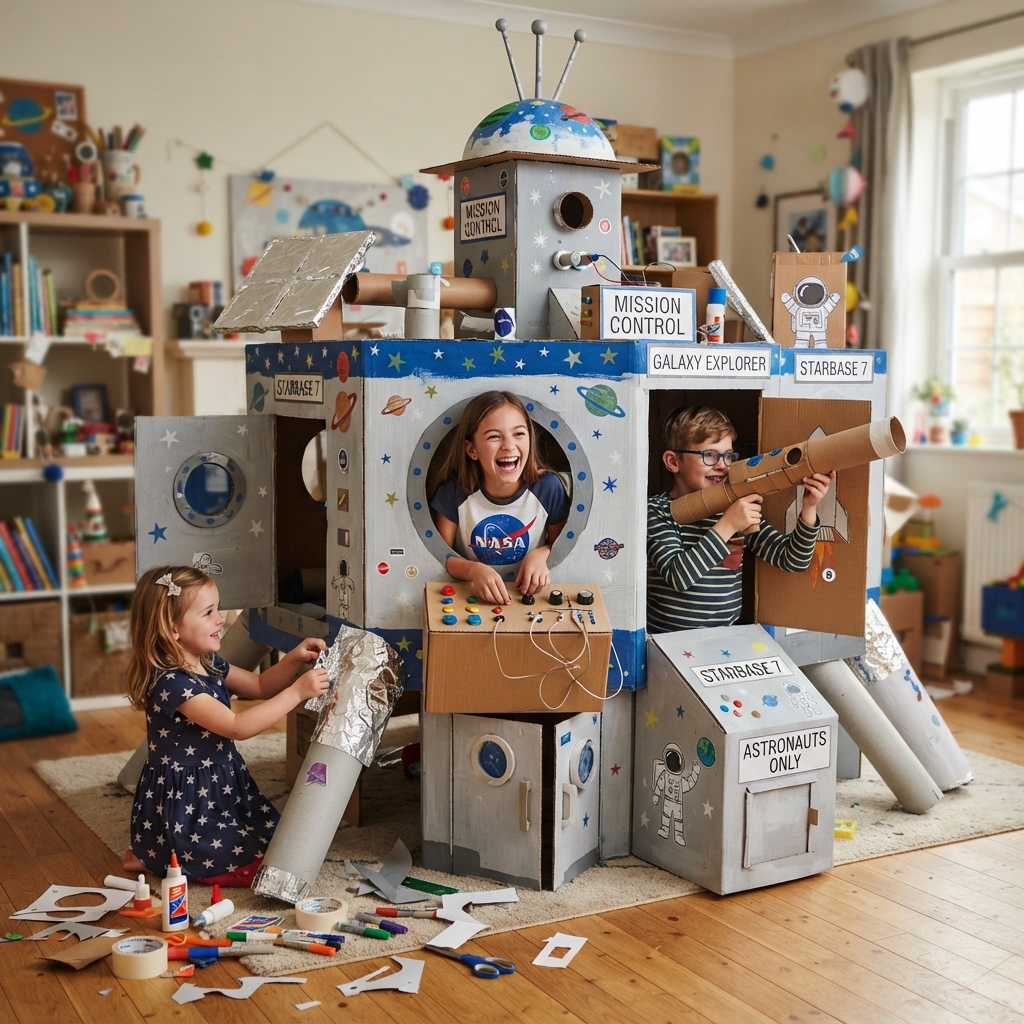
A cardboard space station is an exciting DIY craft that lets children explore the wonders of space while using their imagination and creativity. With recycled cardboard, colorful paper, paint, and a few simple craft supplies, kids can build their own futuristic space station complete with astronauts, rockets, satellites, and science laboratories. This hands-on project encourages learning about space exploration while developing artistic and problem-solving skills.
Whether at home, in the classroom, or during a science-themed activity, a cardboard space station is a fun project that inspires curiosity about the universe.
Why Make a Cardboard Space Station?
Many children dream of becoming astronauts and traveling among the stars. Building a cardboard space station allows them to imagine life in space while creating something unique with recycled materials.
This project helps children:
- Develop creativity through designing space-themed models.
- Improve fine motor skills by cutting, folding, and gluing.
- Learn about space exploration and astronomy.
- Encourage imaginative storytelling and role-playing.
- Practice planning and organization.
- Discover the importance of recycling and reusing materials.
Materials You’ll Need
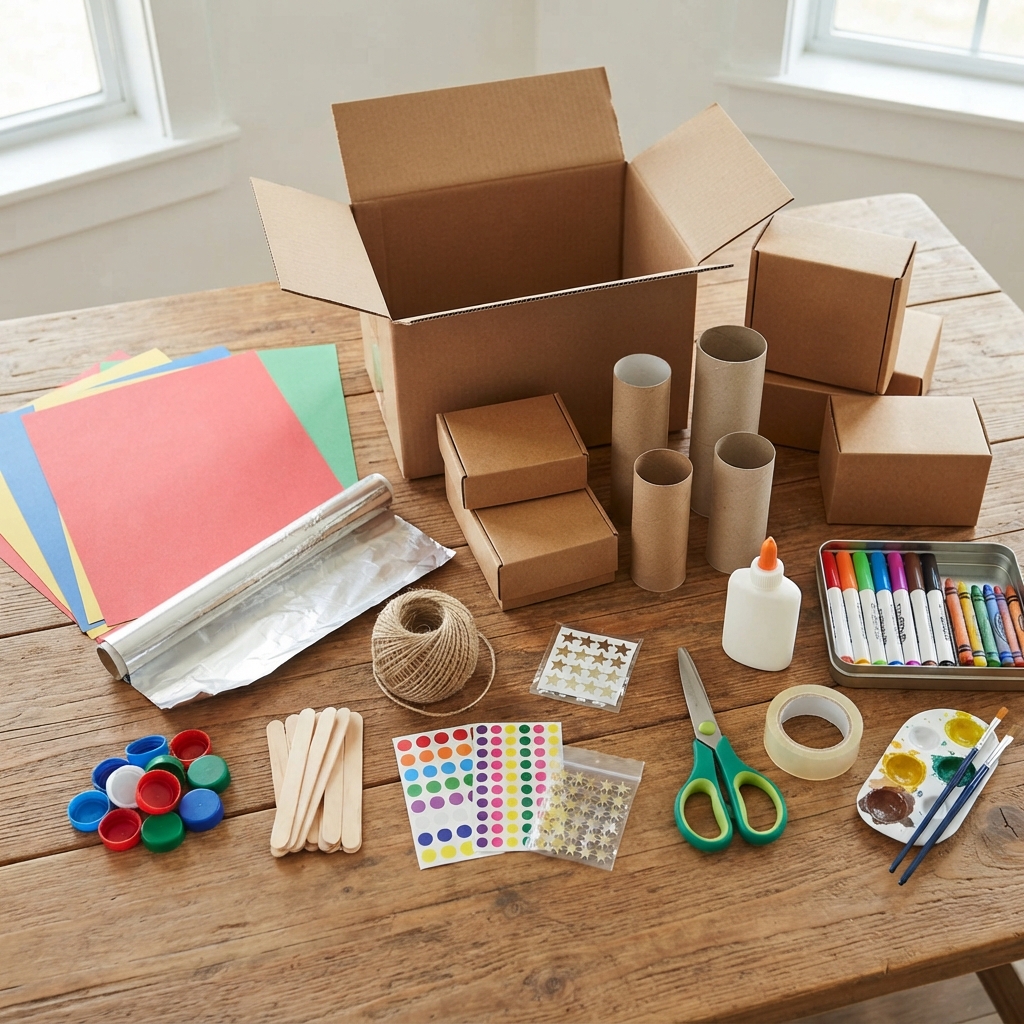
Gather these simple craft supplies:
- Large cardboard box
- Small cardboard boxes
- Cardboard tubes
- Colored construction paper
- Aluminum foil
- Child-safe scissors
- Craft glue or tape
- Markers and crayons
- Paint (optional)
- Bottle caps
- Popsicle sticks
- String
- Colored stickers
- Plastic bottle lids
- Star-shaped stickers (optional)
Most of these supplies can be found around the house or in the recycling bin.
Step 1: Build the Main Space Station
Choose a large cardboard box as the main station.
Cover it with silver paper or aluminum foil to give it a futuristic appearance. Draw windows, doors, antennas, and control panels using markers.
Give your station a fun name, such as:
- Galaxy Explorer Station
- Star Adventure Base
- Cosmic Kids Station
- Moon Mission Center
- Space Discovery Hub
Step 2: Create Connecting Modules
Cut smaller cardboard boxes into different shapes and attach them to the main station.
These modules can become:
- Sleeping quarters
- Science laboratory
- Control room
- Greenhouse
- Medical center
- Storage area
Use cardboard tubes as tunnels connecting each section.
Step 3: Make Solar Panels
Cut rectangles from cardboard.
Cover them with blue or silver paper and draw grid lines to resemble solar panels.
Attach them to the sides of the station using popsicle sticks or folded cardboard supports.
Step 4: Build a Rocket Dock
Create a docking area where rockets can arrive.
Make one or two cardboard rockets using paper tubes and cardboard fins.
Decorate them with colorful flames, windows, and mission logos.
Step 5: Create Astronauts
Draw or cut out astronauts from cardboard.
Give them:
- Space helmets
- Oxygen backpacks
- Space boots
- Gloves
- Mission badges
Children can invent names and jobs for each astronaut.
Step 6: Add Satellites and Spacecraft
Create miniature satellites using bottle caps, cardboard, and popsicle sticks.
You can also build:
- Space shuttles
- Small probes
- Space capsules
- Lunar rovers
Suspend some spacecraft with string to make them appear to float.
Step 7: Decorate Outer Space
Cover the background with black paper.
Decorate it with:
- Stars
- Planets
- Comets
- Meteors
- Galaxies
- The Moon
- Earth
- Shooting stars
This creates a beautiful space environment around the station.
Step 8: Add Science Equipment
Create exciting research tools for your astronauts.
Include:
- Computers
- Telescopes
- Robotic arms
- Weather sensors
- Satellite dishes
- Space robots
These additions encourage children to imagine scientific discoveries.
Step 9: Enjoy Pretend Space Adventures
After finishing the project, children can create exciting stories.
They can pretend to:
- Explore distant planets.
- Repair satellites.
- Conduct science experiments.
- Meet friendly aliens.
- Discover new stars.
- Launch rockets.
- Grow plants in space.
- Protect the station from meteor showers.
Role-playing strengthens imagination and communication skills.
Learning Benefits
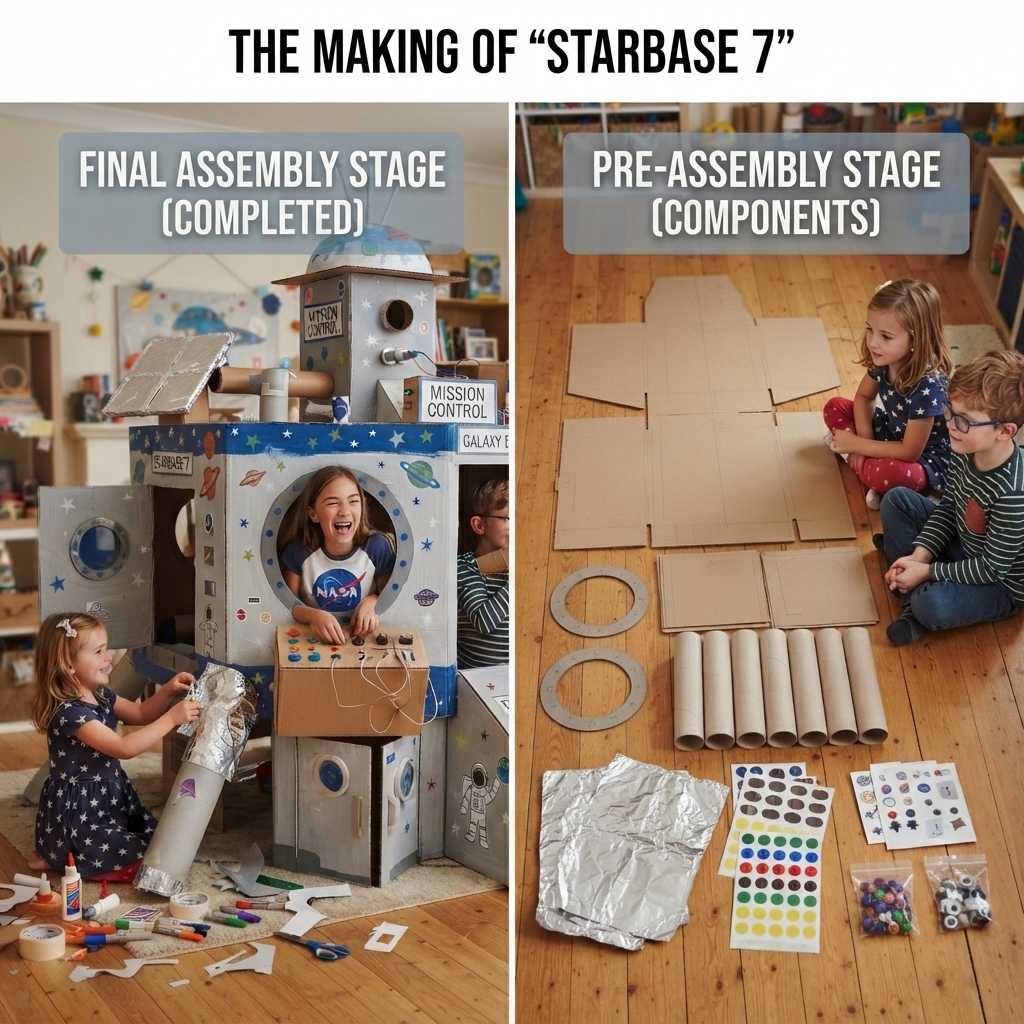
A cardboard space station offers many educational opportunities.
Children practice:
- Fine motor coordination
- Creative thinking
- Problem-solving
- Scientific curiosity
- Storytelling
- Planning and organization
- Teamwork
- Vocabulary development
The project also introduces basic ideas about astronomy, engineering, and space exploration.
Eco-Friendly Crafting
One of the best parts of this activity is giving recycled materials a new purpose.
Old cardboard boxes, paper tubes, bottle caps, and packaging become rockets, satellites, laboratories, and space equipment instead of being discarded.
Children learn that creativity and recycling can work together to protect the environment.
Tips for Parents and Teachers
Make the activity even more exciting by:
- Reading a children’s book about space before crafting.
- Looking at pictures of planets and stars for inspiration.
- Encouraging children to invent their own space missions.
- Discussing how astronauts live and work in space.
- Displaying the completed space station in the classroom or playroom.
- Letting children explain the purpose of each station module.
Celebrate every child’s imagination and scientific curiosity.
Conclusion
A cardboard space station is an inspiring craft project that combines creativity, science, and imaginative play. Children enjoy building futuristic modules, designing rockets, creating astronauts, and exploring the mysteries of the universe through storytelling. Along the way, they strengthen artistic skills, problem-solving abilities, and their understanding of space exploration. Best of all, this eco-friendly project transforms ordinary cardboard into an amazing space station where every mission begins with imagination, discovery, and endless adventure.
