
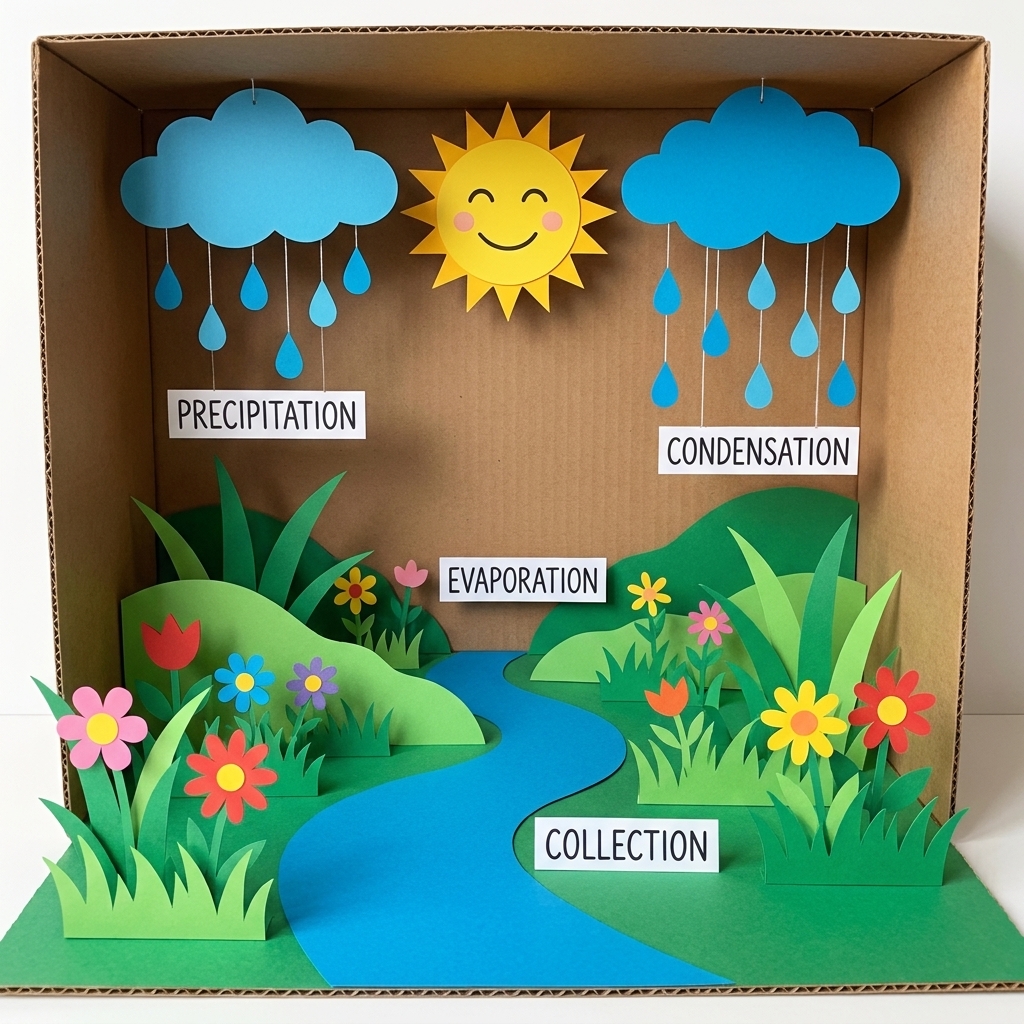
Water is one of the most important natural resources on Earth. Every living thing—including people, animals, and plants—needs water to survive. We use water every day for drinking, cooking, washing, growing food, and many other activities. Although we use water constantly, it never truly disappears. Instead, it moves through a continuous natural process called the water cycle.
The water cycle is the journey that water takes as it travels between the Earth’s surface and the atmosphere. During this journey, water changes from liquid to gas and back to liquid again. It moves through rivers, lakes, oceans, clouds, rain, snow, plants, and the ground before beginning the cycle once more.
Learning about the water cycle helps children understand how nature works and why water is so valuable. Through simple explanations, observations, and fun activities, children can discover how this amazing process supports all life on Earth.
What Is the Water Cycle?
The water cycle is the continuous movement of water around our planet.
Water changes its form and location over and over again. It evaporates into the air, forms clouds, falls as rain or snow, and returns to rivers, lakes, and oceans before starting the journey again.
This cycle has been happening naturally for millions of years and helps keep the Earth’s water supply balanced.
Without the water cycle, there would be no rain, no rivers, and no fresh water for living things.
Why Is Water Important?
Water is essential for every living organism.
People need water to drink and stay healthy.
Animals need water for survival.
Plants use water to grow, produce food, and stay alive.
Water is also important for farming, industry, transportation, and recreation.
Because water is so valuable, understanding how it moves through nature helps children appreciate why it should never be wasted.
The Sun: The Power Behind the Water Cycle
The Sun is the driving force of the water cycle.
Its heat warms oceans, lakes, rivers, and wet ground.
As the water becomes warmer, it changes into water vapor, an invisible gas that rises into the sky.
Without the Sun, evaporation would not happen, and the water cycle would stop.
The Sun provides the energy that keeps the entire process moving.
Evaporation
Evaporation is the first major step in the water cycle.
When the Sun heats water, the liquid changes into water vapor.
This invisible vapor rises into the atmosphere.
Evaporation happens from many places, including:
- Oceans
- Lakes
- Rivers
- Ponds
- Wet soil
- Puddles
Even after a rainy day, puddles slowly disappear because the water evaporates into the air.
Transpiration
Plants also contribute to the water cycle.
They absorb water through their roots and release tiny amounts of water vapor through small openings in their leaves.
This process is called transpiration.
Together, evaporation and transpiration add large amounts of moisture to the atmosphere every day.
Forests and gardens play an important role in this part of the water cycle.
Condensation
As water vapor rises higher into the atmosphere, the air becomes cooler.
The vapor changes back into tiny drops of liquid water.
This process is called condensation.
Millions of tiny water droplets gather together to form clouds.
Condensation also explains why water droplets appear on the outside of a cold glass on a warm day.
Cloud Formation
Clouds are made of tiny water droplets or ice crystals.
Wind moves clouds across the sky, carrying water from one place to another.
Some clouds are white and fluffy, while others are dark and heavy with rain.
Clouds are an important part of weather because they store water until it falls back to Earth.
Precipitation
When water droplets inside clouds become too heavy, they fall back to the Earth’s surface.
This is called precipitation.
Precipitation can occur in different forms, such as:
- Rain
- Snow
- Hail
- Sleet
The type of precipitation depends mainly on the air temperature.
Rain is the most common form in many parts of the world.
Collection
After precipitation reaches the ground, water collects in many places.
It flows into:
- Rivers
- Streams
- Lakes
- Ponds
- Reservoirs
- Oceans
Some water also gathers on the ground in puddles after heavy rain.
Eventually, much of this water returns to the oceans, where the cycle begins again.
Infiltration
Not all rainwater flows across the land.
Some of it soaks into the soil.
This process is called infiltration.
The water moves through the ground and becomes groundwater.
Groundwater is stored beneath the Earth’s surface and supplies wells, springs, and drinking water for many communities.
Runoff
When the ground cannot absorb all the rainwater, the extra water flows across the land.
This movement is called runoff.
Runoff carries water into rivers, lakes, and oceans.
It also helps shape the landscape by slowly wearing away rocks and soil over time.
Groundwater
Groundwater is an important part of the water cycle.
It is stored in spaces between rocks and underground soil.
Many people depend on groundwater for clean drinking water.
Protecting groundwater from pollution is essential because it is difficult to replace once contaminated.
Why the Water Cycle Matters
The water cycle is vital for life.
It:
- Provides fresh water.
- Helps plants grow.
- Supports animals and humans.
- Refills rivers and lakes.
- Produces rain for crops.
- Regulates weather and climate.
- Maintains healthy ecosystems.
Without the water cycle, life on Earth would not exist.
Weather and Climate
The water cycle affects weather every day.
Clouds bring rain and snow.
Evaporation cools the Earth’s surface.
Water vapor helps move heat around the planet.
Long-term climate patterns also influence the water cycle.
Changes in temperature can affect rainfall, droughts, and storms.
Human Impact on the Water Cycle
People can influence the water cycle in many ways.
Cutting down forests reduces transpiration.
Paving roads and cities prevents water from soaking into the ground.
Pollution can contaminate rivers, lakes, and groundwater.
Climate change may alter rainfall patterns and increase extreme weather events.
These changes remind us why protecting nature is so important.
Saving Water
Everyone can help conserve water.
Simple ways include:
- Turning off the tap while brushing teeth.
- Taking shorter showers.
- Fixing leaking faucets.
- Using rainwater to water plants.
- Avoiding unnecessary water waste.
- Keeping rivers and lakes clean.
Small daily actions can make a big difference.
Classroom Activities
Learning about the water cycle becomes more enjoyable through hands-on activities.
Children can:
- Draw the water cycle.
- Build a paper model.
- Create a classroom poster.
- Label each stage of the cycle.
- Watch educational videos.
- Perform simple science experiments.
These activities help children remember each step more easily.
A Simple Experiment
One easy experiment demonstrates condensation.
Place warm water in a clear container and cover it with plastic wrap.
Put a few ice cubes on top of the plastic.
After a short time, water droplets form underneath the plastic.
This shows how warm water evaporates and cools to form condensation, just like clouds.
Adult supervision is recommended when using warm water.
Creative Craft Ideas
Children can also make creative water cycle projects.
Ideas include:
- Cotton ball clouds
- Paper raindrops
- Blue ribbon rivers
- Water cycle wheels
- Pop-up diagrams
- Nature collages
These crafts combine science with art and make learning fun.
Safety During Activities
Safety should always come first.
Children should:
- Use child-safe scissors.
- Handle warm water carefully.
- Keep work areas clean and dry.
- Wash their hands after experiments.
- Follow their teacher’s or parent’s instructions.
Safe learning creates a positive experience for everyone.
Conclusion
The water cycle is one of nature’s most amazing and important processes. It constantly moves water between the Earth’s surface and the atmosphere through evaporation, transpiration, condensation, precipitation, collection, infiltration, and runoff. This endless cycle provides fresh water, supports plants and animals, regulates weather, and makes life on Earth possible.
For children, learning about the water cycle offers an exciting introduction to science and the natural world. Through experiments, crafts, observations, and classroom discussions, they discover how water changes form and travels across our planet. These activities make scientific ideas easier to understand while encouraging curiosity and critical thinking.
Perhaps most importantly, studying the water cycle teaches children to appreciate and protect one of Earth’s most precious resources. By using water wisely and caring for rivers, lakes, and oceans, everyone can help preserve clean water for future generations. Understanding the water cycle reminds us that every drop of water is part of an incredible natural journey that connects all living things on our planet.
