
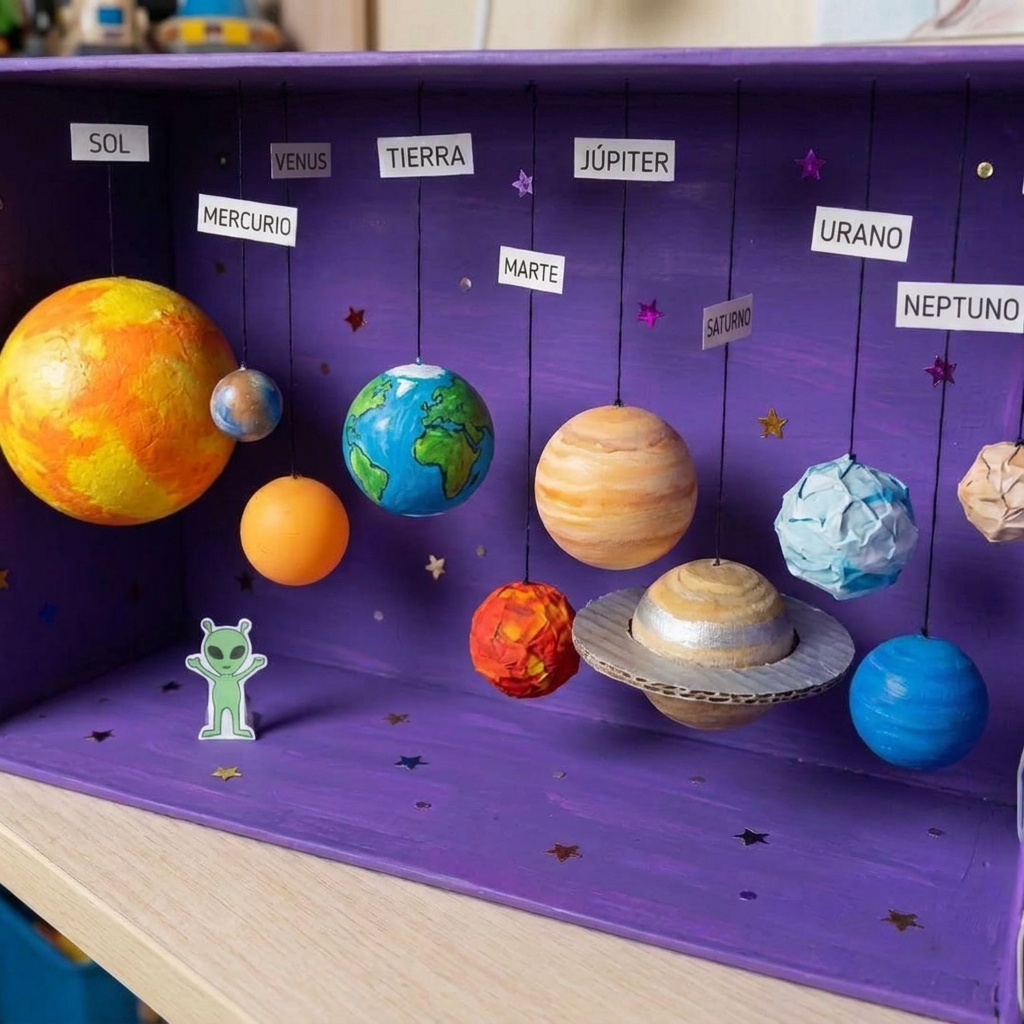
The solar system is one of the most fascinating topics children can explore in science. From the bright Sun to the distant planets, every part of the solar system inspires curiosity and imagination. Many children enjoy looking at the stars at night and asking questions about space, planets, astronauts, and galaxies. A solar system project gives them the opportunity to learn about these exciting topics through creative, hands-on activities.
A school project about the solar system combines science, art, mathematics, and language learning. Instead of simply reading about the planets in a textbook, children can build models, create posters, perform simple experiments, and present their discoveries to classmates. These activities help students understand scientific concepts while encouraging creativity, teamwork, and problem-solving skills.
Whether completed in a classroom, at home, or during a science fair, a solar system project makes learning enjoyable and memorable. It allows children to explore one of the greatest wonders of the universe while developing important academic and practical skills.
What Is the Solar System?
The solar system is made up of the Sun and everything that travels around it because of gravity. This includes eight planets, their moons, dwarf planets, asteroids, comets, and countless smaller objects.
The Sun is at the center of the solar system. It provides the light and heat that make life possible on Earth. Without the Sun, plants, animals, and humans could not survive.
The eight planets orbit the Sun in a specific order. Each planet has unique characteristics, making the solar system an exciting topic for children to study.
The Eight Planets
The planets of the solar system are:
- Mercury
- Venus
- Earth
- Mars
- Jupiter
- Saturn
- Uranus
- Neptune
Each planet is different in size, color, temperature, atmosphere, and distance from the Sun.
Children often enjoy learning the order of the planets by using memory tricks or creating colorful models.
Why Study the Solar System?
Learning about the solar system helps children understand their place in the universe.
They discover that Earth is just one planet among many and that space is incredibly vast.
Studying space also encourages children to ask questions, think scientifically, and develop curiosity about astronomy and exploration.
The topic inspires imagination while introducing important scientific ideas in an engaging way.
Goals of the Project
A solar system project has many educational objectives.
Children learn to:
- Identify the eight planets.
- Understand the position of the Sun.
- Learn basic facts about each planet.
- Develop observation and research skills.
- Improve creativity through model building.
- Practice teamwork.
- Build confidence through presentations.
The project combines learning with enjoyable hands-on experiences.
Materials Needed
Most solar system projects require only simple craft materials.
These may include:
- Foam balls or paper balls
- Cardboard
- Colored paper
- Paint
- Paintbrushes
- Glue
- Scissors
- Markers
- Colored pencils
- Wooden sticks
- String
- Aluminum foil
- Cotton balls
- Glitter
- Black poster board
- Labels
Many materials can also be recycled, making the project environmentally friendly.
Planning the Project
Before beginning, children should decide what type of project they want to create.
Some popular options include:
- A hanging solar system model
- A large classroom poster
- A three-dimensional display
- A rotating mobile
- A science fair presentation
Planning encourages organization and helps children complete their projects successfully.
Creating the Sun
The Sun is the largest object in the project.
Children usually paint a large foam ball or paper circle using bright yellow, orange, and red colors.
They may also add paper flames or rays to make it look more realistic.
While creating the Sun, children learn that it is a star rather than a planet.
Making the Planets
Each planet can be painted using its typical colors.
For example:
- Mercury is gray.
- Venus is yellowish.
- Earth is blue, green, and white.
- Mars is reddish.
- Jupiter has brown, orange, and white stripes.
- Saturn is pale yellow with rings.
- Uranus is light blue.
- Neptune is dark blue.
Painting the planets helps children remember their appearance and characteristics.
Building Saturn’s Rings
Saturn is famous for its beautiful rings.
Children can cut rings from cardboard or thick paper and attach them around the planet.
This simple activity makes Saturn one of the most exciting parts of the project.
Arranging the Solar System
Once all the planets are finished, they are placed in the correct order from the Sun.
The planets are arranged as follows:
- Mercury
- Venus
- Earth
- Mars
- Jupiter
- Saturn
- Uranus
- Neptune
Children learn that the planets orbit the Sun and that the distances between them are enormous.
Although classroom models are not built to scale, they help students understand the overall structure of the solar system.
Learning About Each Planet
As children build their models, they can learn interesting facts about each planet.
For example:
Mercury is the closest planet to the Sun.
Venus is the hottest planet.
Earth is the only known planet with life.
Mars is often called the Red Planet.
Jupiter is the largest planet.
Saturn has spectacular rings.
Uranus rotates on its side.
Neptune is the farthest major planet from the Sun.
These facts make learning enjoyable and memorable.
Creative Decorations
Children can decorate their projects with additional space objects such as:
- Stars
- Comets
- Asteroids
- The Moon
- Rockets
- Astronauts
- Satellites
- Spacecraft
These decorations make the display colorful and exciting.
Science Learning
The solar system project introduces many important scientific ideas.
Children learn about:
- Gravity
- Planetary motion
- Day and night
- Seasons
- The difference between stars and planets
- Space exploration
These concepts provide a strong foundation for future science learning.
Encouraging Creativity
Every child can design a unique solar system model.
Some may paint realistic planets, while others choose artistic colors or imaginative decorations.
Creative freedom encourages originality and builds confidence.
Developing Fine Motor Skills
Building a model requires children to:
- Cut
- Paint
- Glue
- Draw
- Measure
- Assemble
These activities improve hand-eye coordination and fine motor control.
Teamwork and Cooperation
Many classrooms complete solar system projects in groups.
Each team may create one or two planets before combining all the pieces into one large classroom display.
Working together teaches children to:
- Share ideas
- Divide responsibilities
- Solve problems
- Respect different opinions
These social skills are valuable both inside and outside the classroom.
Connecting Different Subjects
A solar system project can be integrated into many school subjects.
Science teaches astronomy.
Art develops creativity through painting and model making.
Mathematics introduces measurements and comparisons of planet sizes.
Language lessons encourage students to write reports or present facts about their planets.
Technology lessons may include educational videos or interactive space simulations.
Presenting the Project
After completing their models, children can present their work to classmates.
Each student explains:
- The planet they created
- Interesting facts about it
- What they learned
- How they built the model
Public speaking helps children build communication skills and confidence.
Safety During the Project
Children should always follow basic safety rules.
They should use child-safe scissors and non-toxic paints and glue.
Sharp tools should only be handled under adult supervision.
The workspace should remain clean and organized throughout the activity.
Extending the Project
Teachers can expand the project with additional activities.
Ideas include:
- Visiting a planetarium
- Watching educational space documentaries
- Reading books about astronauts
- Creating a space-themed classroom display
- Writing stories about traveling through space
- Building simple rockets from recycled materials
These activities deepen children’s understanding of astronomy.
Tips for Teachers
Teachers should prepare materials before the lesson begins.
Instructions should be simple and easy to follow.
Children should have plenty of opportunities to ask questions and explore their own ideas.
The focus should remain on learning and creativity rather than perfection.
Displaying the completed projects in the classroom encourages pride and motivates students.
Conclusion
A solar system project for children is an exciting way to combine science, creativity, and hands-on learning. By building models, painting planets, conducting research, and presenting their work, children gain a deeper understanding of the universe while developing important academic and practical skills.
The project encourages curiosity about space and introduces basic concepts such as planetary motion, gravity, and the role of the Sun in supporting life on Earth. It also strengthens creativity, teamwork, communication, fine motor skills, and critical thinking through engaging activities that make science enjoyable.
Beyond scientific knowledge, the project inspires children to dream, explore, and ask questions about the world beyond our planet. It shows that learning is most effective when students actively participate in the process, using their imagination alongside observation and discovery.
Whether completed in a classroom, at home, or as part of a science fair, a solar system project leaves children with lasting memories and a greater appreciation for the wonders of space. Most importantly, it encourages a lifelong interest in science and reminds young learners that every great discovery begins with curiosity and the desire to explore the unknown.
